

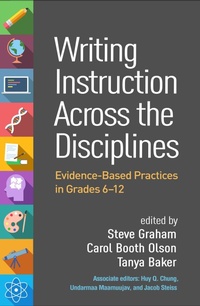
Writing Instruction Across the Disciplines
Evidence-Based Practices in Grades 6-12
Published on 11. November 2025
410 pages
978-1-4625-5914-5 (ISBN)
Description

This book translates the best current research on adolescent writing instruction into teacher-friendly practices that are easy to implement in today's diverse classrooms. Leading experts present instructional methods that are applicable across the curriculum as well as specific, proven techniques to build writing skills and promote critical thinking in English language arts, social studies, science, and math. Key chapters address multimodal writing and pedagogical uses of generative artificial intelligence (AI). Other essential topics include self-regulated strategy development, culturally sustaining writing practices, writing for college readiness, and teaching argument writing. Guiding Questions, Action Steps, and helpful classroom examples in each chapter enhance the book's utility as a teacher resource and course text.
More details
Other editions
Additional editions
Steve Graham | Carol Booth Olson | Tanya Baker
Writing Instruction Across the Disciplines
Evidence-Based Practices in Grades 6-12
Book
approx. 01/2026
1st Edition
Guilford Press
€41.00
Not yet published
Persons
Steve Graham, EdD, is a Regents Professor and the Warner Professor in the Division of Leadership and Innovation at Mary Lou Fulton Teachers College, Arizona State University. Since the 1980s, he has studied how writing develops, how to teach it effectively, and how it can be used to support reading and learning. Dr. Graham's research involves typically developing writers and students with special needs in both elementary and secondary schools, with much of this research occurring in classrooms in urban schools. He is the recipient of the Thorndike Career Award from Division 15 of the American Psychological Association, the William S. Gray Citation of Merit from the International Literacy Association, and the Exemplary Research in Teaching and Teacher Education Award from Division K of the American Educational Research Association, among other awards. He is coauthor of three influential Carnegie Corporation reports on writing and coauthor or coeditor of several books.
Carol Booth Olson, PhD, is Professor Emerita in the School of Education at the University of California, Irvine (UCI). She was founding Director of the UCI Writing Project and served in that capacity for 42 years. Dr. Olson's research focuses on improving academic writing outcomes for all learners, especially culturally and linguistically diverse students in low-socioeconomic-status, high-needs middle and high schools. She served as Director and Principal Investigator of the WRITE Center at UCI and Principal Investigator of the Pathway to Academic Success Project, a professional development intervention that takes a cognitive strategies approach to teaching text-based argument writing in secondary school.
Tanya Baker, EdD, is Executive Director of the National Writing Project and has more than 25 years of experience working in education in and outside of schools. She has worked with many funders and partners to build and manage national programs that connect educators to work together on areas of interest and problems of practice. Dr. Baker served as Co-Principal Investigator of the WRITE CENTER at the School of Education at the University of California, Irvine. She strives throughout her work to design learning experiences that begin with a presumption of competence and are relentlessly collaborative and deeply joyful.
Carol Booth Olson, PhD, is Professor Emerita in the School of Education at the University of California, Irvine (UCI). She was founding Director of the UCI Writing Project and served in that capacity for 42 years. Dr. Olson's research focuses on improving academic writing outcomes for all learners, especially culturally and linguistically diverse students in low-socioeconomic-status, high-needs middle and high schools. She served as Director and Principal Investigator of the WRITE Center at UCI and Principal Investigator of the Pathway to Academic Success Project, a professional development intervention that takes a cognitive strategies approach to teaching text-based argument writing in secondary school.
Tanya Baker, EdD, is Executive Director of the National Writing Project and has more than 25 years of experience working in education in and outside of schools. She has worked with many funders and partners to build and manage national programs that connect educators to work together on areas of interest and problems of practice. Dr. Baker served as Co-Principal Investigator of the WRITE CENTER at the School of Education at the University of California, Irvine. She strives throughout her work to design learning experiences that begin with a presumption of competence and are relentlessly collaborative and deeply joyful.
Content
Introduction: Evidence-Based Practices for Teaching Writing, Steve Graham & Young-Suk Grace Kim
I. Writing Instruction Across the Disciplines
1. Strategies for Teaching Writing to Foster Critical Thinking Across the Disciplines, Carol Booth Olson, Undraa Maamuujav, & Huy Q. Chung
2. Culturally Sustaining Writing Practices, Tricia Ebarvia & Kimberly N. Parker
3. Teaching Argument Writing to Support Secondary Students for College Readiness and Beyond, Tanya Baker
4. Self-Regulated Strategy Development in Secondary Classrooms, Amber B. Ray & Steve Graham
5. Writing Like an Expert: Grammar as a Resource for Teaching Writing in the Disciplines, Debra Myhill
II. Writing in the Disciplines
6. Telling the Stories of Our Lives in Prose and Poetry, Penny Kittle
7. Teaching Argument Writing in the English Language Arts Classroom: Diversity as Resource, Carol D. Lee
8. Multilingual Learners: Writing with Sources throughout Social Studies Inquiry, Chauncey Monte-Sano & Mary Schleppegrell
9. Teaching Counterarguments for Improved Historical Reasoning and Civic Discourse, Tanya Baker, Jacob Steiss, Carol Booth Olson, Nicole Gilbertson, & Huy Q. Chung
10. Constructing and Using Propositional Concept Maps for Writing and Learning in Science, Nancy Romance
11. Writing-to-Learn in the Secondary Science Classroom: Exploring Possibilities for Equity, Catherine Lammert, Alison F. Warren, & Brian Hand
12. Using Writing to Improve Learning in Mathematics, Sharlene A. Kiuhara & Kaitlin Bundock
III. Writing in a Digital World
13. Leveraging Generative Artificial Intelligence to Improve Secondary Writing Instruction, Tamara P. Tate & Mark Warschauer
14. Multimodal Writing: Affordances and Rhetorical Value of Composing Multimodally, Undarmaa Maamuujav, Jenell Krishnan, & Penelope Collins
Index
I. Writing Instruction Across the Disciplines
1. Strategies for Teaching Writing to Foster Critical Thinking Across the Disciplines, Carol Booth Olson, Undraa Maamuujav, & Huy Q. Chung
2. Culturally Sustaining Writing Practices, Tricia Ebarvia & Kimberly N. Parker
3. Teaching Argument Writing to Support Secondary Students for College Readiness and Beyond, Tanya Baker
4. Self-Regulated Strategy Development in Secondary Classrooms, Amber B. Ray & Steve Graham
5. Writing Like an Expert: Grammar as a Resource for Teaching Writing in the Disciplines, Debra Myhill
II. Writing in the Disciplines
6. Telling the Stories of Our Lives in Prose and Poetry, Penny Kittle
7. Teaching Argument Writing in the English Language Arts Classroom: Diversity as Resource, Carol D. Lee
8. Multilingual Learners: Writing with Sources throughout Social Studies Inquiry, Chauncey Monte-Sano & Mary Schleppegrell
9. Teaching Counterarguments for Improved Historical Reasoning and Civic Discourse, Tanya Baker, Jacob Steiss, Carol Booth Olson, Nicole Gilbertson, & Huy Q. Chung
10. Constructing and Using Propositional Concept Maps for Writing and Learning in Science, Nancy Romance
11. Writing-to-Learn in the Secondary Science Classroom: Exploring Possibilities for Equity, Catherine Lammert, Alison F. Warren, & Brian Hand
12. Using Writing to Improve Learning in Mathematics, Sharlene A. Kiuhara & Kaitlin Bundock
III. Writing in a Digital World
13. Leveraging Generative Artificial Intelligence to Improve Secondary Writing Instruction, Tamara P. Tate & Mark Warschauer
14. Multimodal Writing: Affordances and Rhetorical Value of Composing Multimodally, Undarmaa Maamuujav, Jenell Krishnan, & Penelope Collins
Index
