

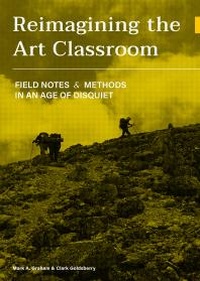
Reimagining the Art Classroom
Field Notes and Methods in an Age of Disquiet
Published on 12. April 2024
264 pages
978-1-78938-779-7 (ISBN)
Description

This book is for artists, teachers, and those who prepare teachers. In the field of art and design education there are many theoretical strands that contribute to the practices of teaching and learning in the visual arts. The problem for artist teachers and those who prepare teaching artists is how to frame the diverse methodologies of art and art education in a way that affords divergent practices as well as deep understanding of issues and trends in the field. Teachers need a field guide that provides a contextual background of theory in order to make their own teaching practice relevant to contemporary art practices and important ideas within the field of education. The book, in its content and presentation of content is pedagogical; it provides a catalyst and prompt for meaningful and personal artistic inquiry and exploration.
The book describes connections between teaching and artistic practices including the pedagogical turn in contemporary art. As a book for artists and designers, it is graphically compelling and visually inspiring. It is designed to be engaging for the practitioner and theoretically robust. A problem with many current texts is that they are written by academics who are often a step removed from the issues of classroom instruction and tend use the language of the scholar, which is appropriate for a scholarly journal, but can be difficult for other audiences. This book will bridge this divide through its use of design, narrative, and descriptions of innovative artistic practices. Rather than being a book about "best practice" it is a book about "diverse practices" within art making and teaching.
This field guide to artistic approaches, including methods for teaching art, frames its arguments around critical questions that artists and art teachers must address such as: What is the role of art and design in secondary education? What will I teach? How do we go about teaching art? How do I know if my teaching is working? What is the role of traditional mediums and methods within contemporary art practices? How can art teachers contribute to the reinvention of schools? How might fluency within a medium be connected to important issues within culture, including the culture of adolescents? This book includes examples of approaches that might provoke or inspire artist and pedagogical inquiry. These are approaches that actively engage students in work that disrupts taken for granted conventions about schooling and its purposes. It considers how art and design might transform the school experience for adolescents.
The book describes connections between teaching and artistic practices including the pedagogical turn in contemporary art. As a book for artists and designers, it is graphically compelling and visually inspiring. It is designed to be engaging for the practitioner and theoretically robust. A problem with many current texts is that they are written by academics who are often a step removed from the issues of classroom instruction and tend use the language of the scholar, which is appropriate for a scholarly journal, but can be difficult for other audiences. This book will bridge this divide through its use of design, narrative, and descriptions of innovative artistic practices. Rather than being a book about "best practice" it is a book about "diverse practices" within art making and teaching.
This field guide to artistic approaches, including methods for teaching art, frames its arguments around critical questions that artists and art teachers must address such as: What is the role of art and design in secondary education? What will I teach? How do we go about teaching art? How do I know if my teaching is working? What is the role of traditional mediums and methods within contemporary art practices? How can art teachers contribute to the reinvention of schools? How might fluency within a medium be connected to important issues within culture, including the culture of adolescents? This book includes examples of approaches that might provoke or inspire artist and pedagogical inquiry. These are approaches that actively engage students in work that disrupts taken for granted conventions about schooling and its purposes. It considers how art and design might transform the school experience for adolescents.
More details
Edition
New edition
Language
English
Place of publication
Bristol
United Kingdom
Publishing group
Intellect
Target group
Professional and scholarly
Edition type
New edition
Illustrations
136 Illustrations, color; 58 Illustrations, black and white
ISBN-13
978-1-78938-779-7 (9781789387797)
Copyright in bibliographic data and cover images is held by Nielsen Book Services Limited or by the publishers or by their respective licensors: all rights reserved.
Schweitzer Classification
Other editions
Additional editions
Mark Graham | Clark Goldsberry
Reimagining the Art Classroom
Field Notes and Methods in an Age of Disquiet
Book
04/2024
Intellect Books
€148.49
Shipment within 3-4 weeks
Mark Graham | Clark Goldsberry
Reimagining the Art Classroom
Field Notes and Methods in an Age of Disquiet
Book
04/2024
Intellect Books
€31.50
Shipment within 3-4 weeks
Persons
Mark Graham is a professor in the Art Department at Brigham Young University. Graham is an internationally known illustrator and has illustrated thirty children picture books. He has exhibited his illustrations at the Society of Illustrators exhibitions, the Bologna Children Book Exhibition and many other national and international venues. He continues to create various kinds of art objects, including mandalas and complex installations.
Clark Goldsberry works as a photographer, artist, high school teacher and adjunct professor. At the high school, he currently teaches AP Art, Advanced Photography, Photo 1, Honors Art, and Art Foundations. And at BYU he teaches Art Ed 339, "Computer Applications for Art Educators."
Clark Goldsberry works as a photographer, artist, high school teacher and adjunct professor. At the high school, he currently teaches AP Art, Advanced Photography, Photo 1, Honors Art, and Art Foundations. And at BYU he teaches Art Ed 339, "Computer Applications for Art Educators."
Content
Introduction
1. Field notes
2. Collage: Composition, improvisation, & resistance
3. Spirit, ink, & memory: Spiritual epistemologies
4. Ideas about nature: Wilderness & an offroad curriculum
5. Mindfulness & gestures of drawing: The human form
6. Photographic paradigms & paradoxes: Three prompts & propositions in a pandemic
7. Occasions for curriculum: On provocations & assignments
8. Artist interviews:
Kevin Cole
Delphine Diallo
Mark Dion
Nina Katchadourian
Oliver Herring
Afterword
Index
1. Field notes
2. Collage: Composition, improvisation, & resistance
3. Spirit, ink, & memory: Spiritual epistemologies
4. Ideas about nature: Wilderness & an offroad curriculum
5. Mindfulness & gestures of drawing: The human form
6. Photographic paradigms & paradoxes: Three prompts & propositions in a pandemic
7. Occasions for curriculum: On provocations & assignments
8. Artist interviews:
Kevin Cole
Delphine Diallo
Mark Dion
Nina Katchadourian
Oliver Herring
Afterword
Index
