

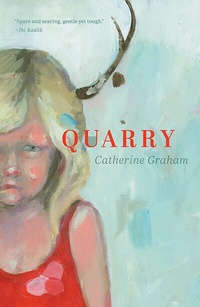
Quarry
Description

Set in southern Ontario during the 1980s, acclaimed poet Catherine Graham's debut novel is as layered as the open-pit mine for which it is named. Only child Caitlin Maharg lives with her parents beside a water-filled limestone quarry, but her idyllic upbringing collapses when she learns her mother is dying. After a series of family secrets emerges, she must confront the past and face her uncertain future. Lyrically charged, jewelled with images, and at times darkly comic, Graham's prose weaves a mysterious, hypnotic tale of loss, deception, and the courage to swim the depths of life alone.
All prices
More details
Other editions
Additional editions
Content
I didn't know what a quarry was until I saw the one that would belong to us. A pit carved for mining. Dig what you need - the dynamite gap - leave a hole for evidence. Don't think about air filling it up. Air fills up everything. Water makes the quarry more than it is; the blue we were drawn to. On the dock, looking out. My mother on one side. My father, the other. Their big shoulders pressing me in.
It was our first summer living beside a lake that wasn't a lake, with wind tents of blue moving in the jewelled sunlight, up and gone and up again. The limestone, cut into jagged rock, layered with the weight of dead animals, ancient sea animals, imprints. Lush green trees, they surrounded as a forest. Dad had found the place by chance after spotting the For Sale sign outside a white gate that led to a long gravel driveway, a bend that led to a mini-lake, the house of Mom's dreams.
We made up dives that summer, me and Cindy. The Watermelon Dive - legs in a V. The About-to-Die Dive - a rambling, dramatic shotgun death off the dock. The Scissor Kick Dive - a flutter of pointed legs in the air. And the Drowning Dive - rise to the surface and float like the dead fish that smacked against the limestone rock, oozing decay's stink. With a two-year advantage, I gave my nine-year-old cousin a three-second head start whenever we raced off the dock to reach the floating raft. Sometimes a hit of the giggles cut through my determination - a memory of something we'd laughed about while lying in the dark, tucked in single beds, or while eating Rice Krispies, opening up our food-filled mouths to shout: see-food diet!
Mom served as judge as she sat on the dock smoking her brand, Benson & Hedges. She was there to rescue us if we were to drown. I knew this was an illusion. Though an athlete, Mom could barely swim and deep water scared her. She excelled at land games, sports with racquets like badminton and tennis, especially tennis. Our shelves of knick-knacks were stacked with gold trophies, tiny females frozen in mid-serve.
"Watch, Mom. Watch!"
"Caitlin Maharg, I'm always watching."
I dove and then Cindy dove and we made her grade us.
"Ten out of ten," said Mom.
"Me or Cindy?"
"Both." She lit another cigarette and exhaled the burst of smoke.
"Aw, Mom! Someone has to win."
Despite her fierce competitiveness on the tennis court and my constant pleading, she refused to budge. We always came out even.
When we got tired of diving, we swam like the darting sunfish, the smallest fish in the quarry.
Standing on tubes was something Cindy could do better than me. Her smaller build gave her an advantage. I could stand on an inner tube, no problem, but my balance wouldn't last like hers. My long legs wobbled like the egg-shaped Weebles we played with on the floor of Cindy's Burlington bedroom when we weren't spying on her two older brothers. My Uncle Jim's new job had brought the Brant family back to Ontario, all the way from Calgary. Because they'd been so far away, I'd never thought of them as family until now.
Dad didn't like to swim. When he did go in the water, to work the stress off himself or shampoo his grey-peppered hair, he stayed within arm's reach of the dock ladder. Because his arm was so long, like all of his limbs, he looked farther away than he really was.
When the water was still, you could see rock bottom. But you couldn't touch it, not off the dock - feet had no resting place. On clear, windless days we watched the carp suspended below, like sunken logs or torpedoes. They never did anything. In fact it was us that scared them, our manic splashes getting in and out of the water, our specialized dives. After the water settled again, Cindy and I would try to find them, but they'd long disappeared.
Sunfish never scared. Surface swimmers, they hovered by the dock with the constant hope of being fed. Desperate nibblers, they mouthed anything, including Mom's cigarette butts, though they always spat them out. Sometimes we felt them nibbling our toes - a safe sensation when we sat on the dock and could see the source of the gummy tickle, but when it happened inside the quarry, as we treaded water or floated on our backs, the Jaws theme song ran through my head, and I imagined the deadly ones - catfish with snake-like whiskers, serpent-shaped muskie with sharp teeth or the turtle with the jaw that could snap your big toe off.
The quarry wasn't always stocked with fish. There were no nearby rivers or tributaries to lead bass, sunfish, perch and more to the lake-sized pit. Dad said previous owners had put them there. And because there were few predators, each species grew in number, including the deadly ones. But Cindy and I were pretty good at waving away the darker things. We had each other and a mother able to watch us.
When Dad came home from work those summer evenings, he watched us too. Barefooted and bare-chested in his blue swimming trunks, he was eager to take in the rest of the day before the sun lay her red blade.
"Let's see your dives," he said.
I dove and then Cindy dove, and after he judged us both, Cindy won. No ties. She gloated silently. Her face, all smile. Not mine. My face, all scowl like my body.
"Not fair," I mumbled, sitting at the dock's edge. I dunked my feet in the water. When I looked downwards, I saw the alarming cut water makes where it meets air; my legs disjointed like eyes unable to see a faraway sight; eyes out of tandem.
"Don," said Mom in that soft tone he listened to. But then, he listened to all her tones.
"It's only a game, Rusty, for God's sake." He chuckled to make things light.
No way had Cindy beaten my Watermelon Dive. She couldn't split her legs in the air like me. Why was he making me lose? Was it because Aunt Doris beat him at swimming games? Dad never played with my feelings when we were alone, just the two of us.
There we were, driving down Grimsby's Main Street with the top down on the Malibu, the summer sun over our heads (Mom at home, fast asleep after her night shift in the ICU), doing Saturday errands. The AM radio blasting out our favourite pop songs: "Tie a Yellow Ribbon Round the Old Oak Tree" and "Love Will Keep Us Together."
Why was he making me lose? Why was I letting him be the judge of me?
I was the one Dad got mad at when Cindy left her wet bathing suit on top of the bed or when he found her damp swim towel balled on the bathroom floor. She smiled with subtle pleasure when she saw my freckled face redden.
Is that what it was like having a sister? Before Cindy came to stay with us that August, if I wanted the last Hello Dolly in the pan I got it. If I wanted to sleep in the other twin bed (my own sheets wet from night sweats), all I had to do was hop over. And when my parents sat on the dock, it was me they watched. My smooth front crawl, my perfect toe-pointed dives, my back-and-forth endurance. My skin prickled and my mouth scowled when praise went to her.
"Wanna play tubes?" Cindy asked, still treading after her win.
"No," I said, turning to Mom. "We have to eat, right?"
Mom looked at her inner wrist to see the watch face; the old habit lived on from when she used to take patients' pulses in the ICU. "The wings won't be done yet. You have time."
But playing tubes meant standing on them for as long as possible. Another game I wasn't prepared to lose, my feelings too fierce to balance properly.
"Race you to the raft," I said in a rush. I would win this game and he couldn't stop me.
"No," said Cindy, grinning. "Think I'll float for a while."
My scowl returned.
I tried to imagine Dad as a boy. "Your father was gangly like a weed," Aunt Doris said the day she dropped Cindy off for her summer stay. She told me he was good at sports, especially baseball. With those long legs of his, he could whip from base to base. But he panicked in water when he couldn't touch bottom. When I'd asked my aunt why, she told me what happened off the dock at Baie-D'Urfé where they grew up, in a house right across from the lake, how Dad and his buddy Louie were out paddling in a canoe one day when Louie stood and started rocking the boat and it tipped. Louie could swim but Dad couldn't. Somehow during his drowning panic, Dad's long arms hit the upturned canoe and he held on.
If that happened to me, I wouldn't have to hold on. I could float or tread water or swim to shore.
"No swimming today, I'm afraid," Mom announced later that week. She was sitting and smoking in her chesterfield nook, her legs curled up. She was looking out the family room window at the pelting rain. "No tennis for me." She sighed.
Since our move to the quarry, she hardly played the game she loved and excelled at. As a little girl, I spent hours watching her through the diamond-link fence. Pock! Straight from the racquet's heart, the sweet spot, the perfect shot. My Malibu Barbie and I silently cheered.
Cindy plonked down beside me on the chesterfield. "Scoot over," she said, nudging me in the ribs. "What should we do?"
I nudged her back before waving away the annoying cigarette smoke. "Don't know," I said. I wanted to swim. I wanted the rain to stop.
Mom lit another cigarette, inhaled and exhaled. "Why don't you girls play Monopoly? The game's in the hall cupboard."
Cindy followed me - out of the family...
