

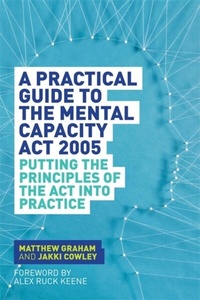
A Practical Guide to the Mental Capacity Act 2005
Putting the Principles of the Act Into Practice
Published on 21. May 2015
192 pages
978-0-85700-940-1 (ISBN)
Description

This book provides a theory-to-practice breakdown of the Mental Capacity Act 2005 and what its implications are for health and social care workers.
Informative and accessible, it provides a clear depiction of the ethos behind the Act and offers instruction for its effective, lawful and person-centred application. This practical guide describes how to assess capacity and what a good assessment of capacity should look like, how to deal with conflicts and dilemmas, and the role of legal authority in decision-making.
A Practical Guide to the Mental Capacity Act 2005 is an invaluable resource for any health and social care professionals working with individuals who lack decision-making capacity.
Informative and accessible, it provides a clear depiction of the ethos behind the Act and offers instruction for its effective, lawful and person-centred application. This practical guide describes how to assess capacity and what a good assessment of capacity should look like, how to deal with conflicts and dilemmas, and the role of legal authority in decision-making.
A Practical Guide to the Mental Capacity Act 2005 is an invaluable resource for any health and social care professionals working with individuals who lack decision-making capacity.
Reviews / Votes
The Mental Capacity Act is widely considered to be a positive piece of legislation but often ignored or misused because of low levels of awareness and understanding. This book will help to rectify that because it provides a clear, comprehensive and accurate description of the Act that is essential reading for anyone working with people who may lack capacity. The authors understand the practical challenges of applying the law on a day to day basis because they both bring an enormous amount of experience of doing this themselves. By emphasising the positive benefits and principles of the Act the book should make a very valuable contribution to improving practice and ensuring the legal rights of people are properly respected and complied with. -- Toby Williamson, Head of Development & Later Life, Mental Health Foundation This accessible practical guide captures the spirit of the Mental Capacity Act 2005.The authors clearly explain what practitioners need to understand about capacity and decision-making and effectively demystify the legal framework. -- Alison Brammer, Senior Lecturer in Law, Keele University This book is a useful resource for practitioners. It is an excellent plain-English guide to the Mental Capacity Act 2005. The points are neatly broken down into bitesize sections (often in bullet-points) which makes the text easy to read and digest, or handy as a quick reference guide. -- Alex Ruck Keene, Barrister and Honorary Research Lecturer at the University of Manchester This is indeed a practical guide to the Mental Capacity Act 2005, written in a very accessible manner, with many helpful examples throughout which clearly illustrate the principles being explained. It encourages practitioners to use the principles of the Act within their daily practice. It will be of use to staff and families who are living or working in a range of settings and is very relevant to a range of client groups, including people with intellectual disabilities and those with autism spectrum conditions. It keeps the person at the very centre of the process of consent, provides clear guidance around what needs to be considered at all stages, encourages reflective practice and highlights the importance of experts of experience. -- Dr Jill Bradshaw, Lecturer in Learning Disabilities, Tizard Centre Written by experienced practitioners in the field, this authoritative yet highly pragmatic book guides readers from all backgrounds expertly through a major piece of health and social care law. Starting from libertarian principles, Matt Graham and Jakki Cowley skilfully achieve their aim to demystify the MCA. They have made the statute, associated best practice guidance and case law easily accessible to those who need support navigating difficult and confusing decisions. Using a no nonsense style, together with a useful range of authentic case and best practice examples, the authors have created a highly useable hand book for the work place. Essential and recommended reading for anyone working within adult health and social care. -- Martin Vernon, Consultant Geriatrician and Clinical Director of Community Services, Central Manchester NHS Foundation TrustMore details
Edition
Digital original
Language
English
Place of publication
London
United Kingdom
Target group
College/higher education
Professional and scholarly
Edition type
Digital original
File size
1,30 MB
ISBN-13
978-0-85700-940-1 (9780857009401)
Copyright in bibliographic data and cover images is held by Nielsen Book Services Limited or by the publishers or by their respective licensors: all rights reserved.
Schweitzer Classification
Other editions
Additional editions
Matthew Graham | Jakki Cowley
A Practical Guide to the Mental Capacity Act 2005
Putting the Principles of the Act Into Practice
Book
05/2015
Jessica Kingsley Publishers
€31.50
Shipment within 15-20 days
Persons
Matthew Graham MSc is Senior Lecturer in Social Work in the School of Social Work, Care and Community at the University of Central Lancashire. He is a registered social worker. Jakki Cowley is co-director of Empowerment Matters, an Advocacy and Mental Capacity Act Resource, Support and Information Agency. She is a committee member of the Court of Protection Practitioners Association (CoPPA). Both of the authors are leading trainers and educators on the Mental Capacity Act 2005 and specialise in delivering training which is accessible to all practitioners as well as service users and carers.
Content
- Intro
- A Practical Guide to the Mental Capacity Act 2005
- Foreword
- Acknowledgments
- Introduction
- Chapter 1. A New Culture of Care
- Organizational culture
- The MCA offers something of great importance
- Where were we before the MCA?
- 'On what authority am I making this decision?'
- Implied consent.really?
- The power dynamic
- Person-centred practice
- Responsibilities at all levels
- Chapter 2. Maximizing Capacity
- Communication and choice
- Triggers for assessment
- Provide support
- Recognize the differing needs of clients
- Provide all relevant information and support
- Try to understand the person's situation
- Allow time for the person
- Open questions
- Environment and timing
- Values
- Independence and autonomy
- Chapter 3. Assessing Capacity
- You are always assessing capacity - whether you know it or not!
- The mental capacity test
- Routine capacity assessments
- It's all about the relationship
- How do we record capacity?
- Chapter 4. Advocacy and Empowerment
- What is advocacy?
- History of advocacy
- Models of non-instructed advocacy
- Principle of independence
- Role of the Independent Mental Capacity Advocate (IMCA)
- Responsibility to instruct an IMCA
- Criteria of instruction
- Accommodation decisions and IMCA involvement
- Compliance with the Mental Capacity Act in hospital
- Care Reviews and IMCA instruction
- Safeguarding and IMCA instruction
- The Care Act 2014 and advocacy instruction
- Deprivation of Liberty and IMCA instruction
- 'Appropriate to consult' and IMCA instruction
- Referral/instruction process
- Report writing
- Impact of an IMCA report
- Litigation friend
- What happens if there is not an IMCA available?
- Top tips
- Chapter 5. Advance Care Planning
- Lasting Power of Attorney
- Responsibilities and restrictions
- Advance decisions to refuse treatment
- Advance decisions - Louise's story
- Advance decisions and the Court of Protection
- Chapter 6. Best Interests
- The question of all questions
- Best interests meetings
- Decision-maker
- The three-part plan
- The only thing certain about certainty is uncertainty!
- Just because you 'can' doesn't mean you 'should'!
- Action plan
- Excluded decisions
- Chapter 7. Liberty and Choice
- Restriction of liberty
- Degree, intensity and frequency
- 'We're not allowed to restrain people'
- Making a distinction
- Deprivation of liberty and the safeguards
- Important for care homes and hospitals to remember.
- Responsibility to instruct an Independent Mental Capacity Advocate (IMCA)
- The role of the IMCA in DoLS
- Bournewood
- Cheshire West
- Supreme Court Decision
- The new test for deprivation of liberty
- What this means in practice
- Current DoLS practice issues
- Future resolution
- References
- Index
- Blank Page
