

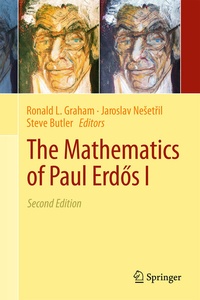
The Mathematics of Paul Erdos I
Description

This is the most comprehensive survey of the mathematical life of the legendary Paul Erdos (1913-1996), one of the most versatile and prolific mathematicians of our time. For the first time, all the main areas of Erdos' research are covered in a single project. Because of overwhelming response from the mathematical community, the project now occupies over 1000 pages, arranged into two volumes. These volumes contain both high level research articles as well as key articles that survey some of the cornerstones of Erdos' work, each written by a leading world specialist in the field. A special chapter "Early Days", rare photographs, and art related to Erdos complement this striking collection. A unique contribution is the bibliography on Erdos' publications: the most comprehensive ever published. This new edition, dedicated to the 100th anniversary of Paul Erdos' birth, contains updates on many of the articles from the two volumes of the first edition, several new articles from prominent mathematicians, a new introduction, more biographical information about Paul Erdos, and an updated list of publications.
The first volume contains the unique chapter "Early Days", which features personal memories of Paul Erdos by a number of his colleagues. The other three chapters cover number theory, random methods, and geometry. All of these chapters are essentially updated, most notably the geometry chapter that covers the recent solution of the problem on the number of distinct distances in finite planar sets, which was the most popular of Erdos' favorite geometry problems.
More details
Other editions
Additional editions
Persons
Ronald L. Graham is currently Professor of Mathematics and Irwin and Joan Jacobs Professor of Computer and Information Sciences at the University of California, San Diego, and Chief Scientist at the California Institute for Telecommunications and Information Technology.
Jaroslav Nesetril is currently Professor of Mathematics and Director of the Institute of Theoretical Computer Science at Charles University, Prague.
Steve Butler is currently Assistant Professor of Mathematics at Iowa State University.
Content
VOLUME I.- Paul Erdos - Life and Work.- Paul Erdos Magic.- Part I Early Days.- Introduction.- Some of My Favorite Problems and Results.- 3 Encounters with Paul Erdos.- 4 Did Erdos Save Western Civilization?.- Integers Uniquely Represented by Certain Ternary Forms.- Did Erdos Save Western Civilization?.- Encounters with Paul Erdos.- On Cubic Graphs of Girth at Least Five.- Part II Number Theory.- Introduction.- Cross-disjoint Pairs of Clouds in the Interval Lattice.- Classical Results on Primitive and Recent Results on Cross-Primitive Sequences.- Dense Difference Sets and their Combinatorial Structure.- Integer Sets Containing No Solution to x+y=3z.- On Primes Recognizable in Deterministic Polynomial Time.- Ballot Numbers, Alternating Products, and the Erdos-Heilbronn Conjecture.- On Landau's Function g(n).- On Divisibility Properties on Sequences of Integers.- On Additive Representation Functions.- Arithmetical Properties of Polynomials.- Some Methods of Erdos Applied to Finite Arithmetic Progressions.- Sur La Non-Dérivabilité de Fonctions Périodiques Associées à Certaines Formules Sommatoires.- 1105: First Steps in a Mysterious Quest.- Part III Randomness and Applications.- Introduction.- Games, Randomness, and Algorithms.- The Origins of the Theory of Random Graphs.- An Upper bound for a Communication Game Related to Time-space Tradeoffs.- How Abelian is a Finite Group?.- One Small Size Approximation Models.- The Erdos Existence Argument.- Part IV Geometry.- Introduction.- Extension of Functional Equations.- Remarks on Penrose Tilings.- Distances in Convex Polygons.- Unexpected Applications of Polynomials in Combinatorics.- The Number of Homothetic Subsets.- On Lipschitz Mappings Onto a Square.- A Remark on Transversal Numbers.- In Praise of the Gram Matrix.- On Mutually Avoiding Sets.- Bibliography.
