

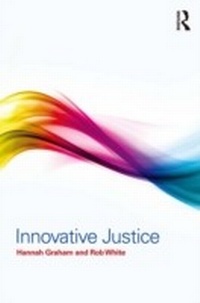
Innovative Justice
1st Edition
Published on 17. July 2014
184 pages
978-1-136-21685-5 (ISBN)
Description

This book showcases innovative justice initiatives from around the world which engage offenders, practitioners and communities to reduce reoffending and support desistance and positive change. It is groundbreaking in bringing together inspiring ideas and pioneering practices to analyse how 'justice done differently' is making a difference.
The voices and experiences of the people at the forefront of these innovative initiatives are presented throughout the book, including offenders, corrections staff and directors, the judiciary, scientists and academics, volunteers and community organisations. Strengths-based research methods are used to investigate and celebrate best practices and 'good news stories' from the field. The authors raise critical questions about what is considered innovative and effective, for whom and in what context, presenting their own conceptual approach for analysing innovation.
With initiatives drawn from diverse jurisdictions and cultures - including the UK, Europe, Australia, Asia, the US and South America - this book showcases original ideas and refreshing developments that have the potential to transform rehabilitation and reintegration practices. The book's substance and style will resonate with practitioners, students and academics across the interdisciplinary fields of criminology and criminal justice.
The voices and experiences of the people at the forefront of these innovative initiatives are presented throughout the book, including offenders, corrections staff and directors, the judiciary, scientists and academics, volunteers and community organisations. Strengths-based research methods are used to investigate and celebrate best practices and 'good news stories' from the field. The authors raise critical questions about what is considered innovative and effective, for whom and in what context, presenting their own conceptual approach for analysing innovation.
With initiatives drawn from diverse jurisdictions and cultures - including the UK, Europe, Australia, Asia, the US and South America - this book showcases original ideas and refreshing developments that have the potential to transform rehabilitation and reintegration practices. The book's substance and style will resonate with practitioners, students and academics across the interdisciplinary fields of criminology and criminal justice.
Reviews / Votes
'For too long "innovation" has been a dirty word in the field of rehabilitation studies, for fear that anything that deviated from the official script would be deemed correctional "quackery". In this remarkable new book, the quacks strike back! Graham and White have assembled an incredible resource for a new generation of rehabilitation scholars and practitioners unafraid to experiment in the name of better outcomes, and, frankly, better science. Innovative Justice is precisely the right book for a true rehabilitation revolution.' - Professor Shadd Maruna, Dean of the School of Criminal Justice, Rutgers University Newark, USA'This fresh and inspirational book celebrates imaginative and progressive work in many different countries that is making a positive difference to the lives of offenders and those around them. Rather than being preoccupied with risks or needs, these initiatives have in common the guiding belief that creative activities and self-expression enable people to flourish: the route to desistance is most likely to be found by affording people opportunities to transcend their identity as offenders by developing their strengths and achieving their potential.' - Rob Canton, Professor in Community and Criminal Justice, De Montfort University, Leicester, UK
'One of the most pressing questions facing criminology today is this: What good can criminal justice do? This isn't just a technical question about "what works". Rather, it suggests a much deeper challenge to frame what Durkheim called "the mission of justice" constructively and to make criminal justice mean something more than, and something better than, harm reduction or containment. Graham and White's excellent and inspiring new collection offers us tantalising glimpses of some possible answers and deserves to be read by anyone and everyone who cares about justice in any of its forms.' - Fergus McNeill, Professor of Criminology & Social Work, University of Glasgow, UK
'Innovative Justice provides a welcome addition to the field of criminology and criminal justice... This timely book presents a number of innovative projects in criminal justice from jurisdictions around the world... The research method itself is somewhat innovative, and the authors succeed in delivering a ground-breaking and inspirational book.' - Dr Daniel Marshall, British Journal of Community Justice
More details
Language
English
Place of publication
London
United Kingdom
Publishing group
Taylor & Francis Ltd
Target group
College/higher education
Product notice
Reflowable
Illustrations
1 s/w Abbildung, 2 s/w Tabellen, 1 s/w Zeichnung
2 Tables, black and white; 1 Line drawings, black and white; 1 Illustrations, black and white
File size
0,93 MB
ISBN-13
978-1-136-21685-5 (9781136216855)
Copyright in bibliographic data and cover images is held by Nielsen Book Services Limited or by the publishers or by their respective licensors: all rights reserved.
Schweitzer Classification
Other editions
Additional editions
Hannah Graham | Rob White
Innovative Justice
Book
07/2015
1st Edition
Routledge
€67.90
Shipment within 10-20 days

Hannah Graham | Rob White
Innovative Justice
Book
07/2014
1st Edition
Routledge
€231.30
Shipment within 15-20 days
Persons
Hannah Graham is an Associate Lecturer in Criminology and a member of the Criminology Research Unit in the School of Social Sciences at the University of Tasmania, Australia. Hannah's research interests include innovative justice, desistance scholarship, penal cultures and practices, vulnerability and people with complex needs, alcohol & other drugs rehabilitation, and the ethics of euthanasia. Together with Rob White, she is co-author of Working with Offenders: A Guide to Concepts and Practices (Willan Publishing/Routledge, 2010). As part of the wider Innovative Justice international research initiative, Hannah has co-produced a website with Rob White, Katrina Clifford and key stakeholders in the field, www.innovativejustice.com
Rob White is a Professor of Criminology and Director of the Criminology Research Unit in the School of Social Sciences at the University of Tasmania, Australia. Rob has made extensive contributions in research, teaching and publishing across the areas of green criminology and transnational environmental justice, juvenile justice and youth studies, critical criminology, restorative justice and mainstream criminal justice. His recent books include Youth Gangs, Violence and Social Respect (Palgrave Macmillan, 2013); Environmental Harm: An Eco-Justice Perspective (Policy Press, 2013) and Climate Change from a Criminological Perspective (Springer, 2012).
Rob White is a Professor of Criminology and Director of the Criminology Research Unit in the School of Social Sciences at the University of Tasmania, Australia. Rob has made extensive contributions in research, teaching and publishing across the areas of green criminology and transnational environmental justice, juvenile justice and youth studies, critical criminology, restorative justice and mainstream criminal justice. His recent books include Youth Gangs, Violence and Social Respect (Palgrave Macmillan, 2013); Environmental Harm: An Eco-Justice Perspective (Policy Press, 2013) and Climate Change from a Criminological Perspective (Springer, 2012).
Content
1. Analysing Innovation 2. Creative Offender Rehabilitation 3. Skills for Change 4. Greening Justice 5. Animals and Therapeutic Justice 6. Beyond Fear and Loathing - Countering Extremism 7. Engaging Offenders with Communities 8. Sustaining Innovation.
