

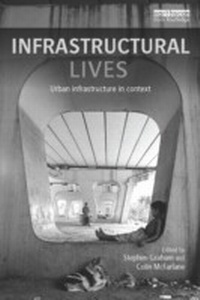
Infrastructural Lives
Urban Infrastructure in Context
1st Edition
Published on 10. October 2014
262 pages
978-1-317-68639-2 (ISBN)
Description

Infrastructural Lives is the first book to describe the everyday experience and politics of urban infrastructures. It focuses on a range of infrastructures in both the global South and North. The book examines how day-to-day experience and perception of infrastructure provides a new and powerful lens to view urban sustainability, politics, economics, cultures and ecologies. An interdisciplinary group of leading and emerging urban researchers examine critical questions about urban infrastructure in different global contexts.
The chapters address water, sanitation, and waste politics in Mumbai, Kampala and Tyneside, analyse the use of infrastructure in the dispossession of Palestinian communities, explore the pacification of Rio's favelas in the run-up to the 2014 World Cup, describe how people's bodies and lives effectively operate as 'infrastructure' in many major cities, and also explores tentative experiments with low-carbon infrastructures.
These diverse cases and perspectives are connected by a shared sense of infrastructure not just as a 'thing', a 'system', or an 'output,' but as a complex social and technological process that enables - or disables - particular kinds of action in the city. Infrastructural Lives is crucial reading for academics, researchers, students and practitioners in urban studies globally.
The chapters address water, sanitation, and waste politics in Mumbai, Kampala and Tyneside, analyse the use of infrastructure in the dispossession of Palestinian communities, explore the pacification of Rio's favelas in the run-up to the 2014 World Cup, describe how people's bodies and lives effectively operate as 'infrastructure' in many major cities, and also explores tentative experiments with low-carbon infrastructures.
These diverse cases and perspectives are connected by a shared sense of infrastructure not just as a 'thing', a 'system', or an 'output,' but as a complex social and technological process that enables - or disables - particular kinds of action in the city. Infrastructural Lives is crucial reading for academics, researchers, students and practitioners in urban studies globally.
Reviews / Votes
"the book is thought-provoking and generates further questions and ideas in the reader's mind about what infrastructures mean and how they intersect with urban lives. For this reason, Infrastructural Lives is an inspirational and highly relevant publication for scholars interested in studying infrastructures through the lens of everyday urbanism, contingency and uncertainty." - Sobia Ahmad Kaker, London School of Economics and Political Sciences, UKMore details
Language
English
Place of publication
London
United Kingdom
Publishing group
Taylor & Francis Ltd
Target group
Professional and scholarly
Product notice
Reflowable
Illustrations
33 s/w Abbildungen
33 Illustrations, black and white
File size
22,77 MB
ISBN-13
978-1-317-68639-2 (9781317686392)
Copyright in bibliographic data and cover images is held by Nielsen Book Services Limited or by the publishers or by their respective licensors: all rights reserved.
Schweitzer Classification
Other editions
Additional editions
Book
10/2014
1st Edition
Routledge
€262.20
Shipment within 15-20 days
Book
10/2014
1st Edition
Routledge
€93.80
Shipment within 15-20 days
Persons
Stephen Graham is Professor of Cities and Society at Newcastle University's School of Architecture, Planning and Landscape, UK. His research addresses the complex links between urban places and mobilities, infrastructures, militarization, surveillance, security and war. His books include Telecommunications and the City, Splintering Urbanism (both with Simon Marvin), Disrupted Cities: When infrastructures fail and Cities Under Siege: The new military urbanism. His next book, Vertical: The politics of up and down, is currently in preparation.
Colin McFarlane is Reader in Urban Geography at Durham University, UK. His research focusss on the experience and politics of urban infrastructure, especially in relation to informal settlements. His recent research has focused on the politics of sanitation in informal settlements in Mumbai, India. His books include Learning the City: Knowledge and translocal assemblage, Urban Navigations: Politics, space and the city in South Asia (with Jonathan Shapiro Anjaria) and Urban Informalities: Reflections on the formal and informal (with Michael Waibel).
Colin McFarlane is Reader in Urban Geography at Durham University, UK. His research focusss on the experience and politics of urban infrastructure, especially in relation to informal settlements. His recent research has focused on the politics of sanitation in informal settlements in Mumbai, India. His books include Learning the City: Knowledge and translocal assemblage, Urban Navigations: Politics, space and the city in South Asia (with Jonathan Shapiro Anjaria) and Urban Informalities: Reflections on the formal and informal (with Michael Waibel).
Content
Foreword Arjun Appadurai Introduction Steve Graham and Colin McFarlane Part I: Knowing Infrastructure 1. Relational infrastructure in postcolonial urban worlds AbdouMaliq Simone 2. Infra-City: speculations on flux and history in infrastructure-making Vyjayanthi Rao Part II: Infrastructural Violence and Dispossession 3. Water Wars in Mumbai Stephen Graham, Renu Desai and Colin McFarlane. Waiting in the ruins: the aesthetics and politics of favela urbanization in "PACification" Mariana Cavalcanti 5. Road 443: Cementing dispossession, normalizing segregation and disrupting everyday life in Palestine Omar Jabary Salamanca Part III: Waste, Process, Infrastructure 6. The uncanny materialities of the everyday: domesticated nature as the invisible "other" Maria Kaika 7. Kampala's Sanitary Regime: Whose toilet is it anyway? Stephanie Terrani Brown 8. Cleaning Up the Streets: Newcastle-upon-Tyne's Night-Time Neighbourhood Services Team Rob Shaw Part IV: Adjustment and Experimentation 9. Maintaining experiments and the material agency of the urban Vanesa Castan Broto and Harriet Bulkeley 10. Low carbon nation: making new market opportunities Mike Hodson and Simon Marvin
