

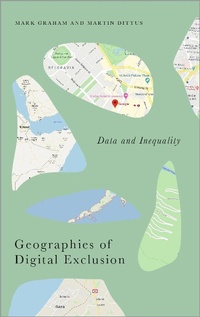
Geographies of Digital Exclusion
Data and Inequality
1st Edition
Published on 20. January 2022
190 pages
978-1-78680-742-7 (ISBN)
Description

Today's urban environments are layered with data and algorithms that fundamentally shape how we perceive and move through space. But are our digitally dense environments continuing to amplify inequalities rather than alleviate them? This book looks at the key contours of information inequality, and who, what and where gets left out.
Platforms like Google Maps and Wikipedia have become important gateways to understanding the world, and yet they are characterised by significant gaps and biases, often driven by processes of exclusion. As a result, their digital augmentations tend to be refractions rather than reflections: they highlight only some facets of the world at the expense of others.
This doesn't mean that more equitable futures aren't possible. By outlining the mechanisms through which our digital and material worlds intersect, the authors conclude with a roadmap for what alternative digital geographies might look like.
Platforms like Google Maps and Wikipedia have become important gateways to understanding the world, and yet they are characterised by significant gaps and biases, often driven by processes of exclusion. As a result, their digital augmentations tend to be refractions rather than reflections: they highlight only some facets of the world at the expense of others.
This doesn't mean that more equitable futures aren't possible. By outlining the mechanisms through which our digital and material worlds intersect, the authors conclude with a roadmap for what alternative digital geographies might look like.
Reviews / Votes
'Conceptually rich and well-illustrated, this is a valuable analysis of data power at the global scale' -- Prof. Rob Kitchin, Maynooth University 'An enlightening and accessible introduction to digital geographies and why they are important to our understanding of digital exclusion' -- Alex Singleton, Professor of Geographic Information Science, University of Liverpool 'Demonstrates how so much digital data is sourced from a very limited range of geographical locations and laboured over in various ways, and what difference this makes to the information about places on platforms like OpenStreetMap, Google Maps and Wikipedia' -- Gillian Rose, Professor of Human Geography at the School of Geography and the Environment, University of Oxford 'Systematic, sobering, yet uplifting, this volume makes the convincing case that digital transformation is not the end of geography, nor is it an equaliser for the diverse cultures and peoples across the globe' -- Jack Linchuan Qiu, Professor at the Department of Communications and New Media, National University of Singapore 'An important and insightful book. Graham and Dittus eloquently map, measure and critically interrogate digital geographies in a way that forces us to reckon with their power and politics, the injustices they incur, and how we might imagine alternatives.' -- Professor Lina Dencik, Co-Director of the Data Justice Lab, Cardiff University, UK 'A must read for those deeply concerned about long hidden people and places who have been marginalised in the politics of place-making, including within digital worlds like Wikipedia and Google' -- Payal Arora, author of the 'Next Billion Users' and Co-Founder of FemLab.CoMore details
Series
Edition
1. Auflage
Language
English
Place of publication
London
United Kingdom
Target group
Professional and scholarly
Illustrations
24 Maps; 15 Graphs; 2 Figures
File size
4,55 MB
ISBN-13
978-1-78680-742-7 (9781786807427)
Copyright in bibliographic data and cover images is held by Nielsen Book Services Limited or by the publishers or by their respective licensors: all rights reserved.
Schweitzer Classification
Other editions
Additional editions
Book
01/2022
Pluto Press
€26.50
Shipment within 10-20 days
Persons
Mark Graham is Professor of Internet Geography at the Oxford Internet Institute, University of Oxford. His research focuses on information geographies and the difference that changing digital connectivities make at the world's economic margins.
Content
List of Figures
Series Preface
Acknowledgements
1. We All Are Digital Geographers
2. When the Map Becomes the Territory
3. Making Digital Geographies
4. A Geography of Digital Geographies
5. Digital Augmentations of the City
6. Who are the Map-Makers?
7. Information Power and Inequality
8. Towards More Just Digital Geographies
Epilogue
Appendix
Reference tables
Data sources
Methodology for Chapter 5
Bibliography
Index
Series Preface
Acknowledgements
1. We All Are Digital Geographers
2. When the Map Becomes the Territory
3. Making Digital Geographies
4. A Geography of Digital Geographies
5. Digital Augmentations of the City
6. Who are the Map-Makers?
7. Information Power and Inequality
8. Towards More Just Digital Geographies
Epilogue
Appendix
Reference tables
Data sources
Methodology for Chapter 5
Bibliography
Index
