

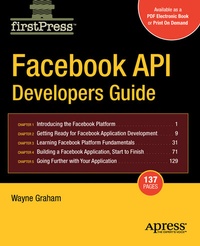
Facebook API Developers Guide
Published on 8. September 2008
XII, 100 pages
978-1-4302-0970-6 (ISBN)
Description

The Facebook API allows web developers to create Facebook applications and access Facebook data from other applications. Facebook API Developers Guide covers the use and implementation of the Facebook API-what the key features are and how you can access them. You will learn, through practical examples, the main features of the Facebook API including an introduction to the API-specific languages FQL and FBML. These examples are further supported by the introduction of other technologies like language libraries, relational database management systems, and XML.
- Covers all key features of the Facebook API
- Explains the API languages FQL and FBML
- Teaches by example, with useful code and tips you can use in your own applications
More details
Other editions
Additional editions
Person
strongWayne Graham/strong is the emerging technology coordinator at the Earl Gregg Swem Library at the College of William and Mary in Williamsburg, Virginia.
Content
Introducing the Facebook Platform.- Getting Ready for Facebook Application Development.- Learning Facebook Platform Fundamentals.- Building a Facebook Application, Start to Finish.- Going Further with Your Application.
