

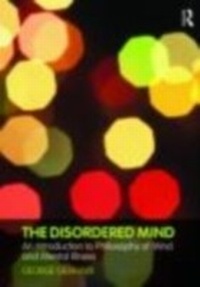
The Disordered Mind
An Introduction to Philosophy of Mind and Mental Illness
1st Edition
Published on 7. August 2014
XIV, 290 pages
978-0-203-85786-1 (ISBN)
Description

"George Graham is contemporary philosophy's most gifted and humane writer. The Disordered Mind is a wise, deep, and thorough inquiry into the nature of the human mind and the various 'creaks, cracks, and crevices' into which it is prone sometimes to wander."
Owen Flanagan, Duke University, USA
"The book is a success, it is consistently insightful and humane, and conveys a clear understanding not only of relevant philosophical topics, but also of a much more difficult issue, the relevance of those topics to understanding mental illness."
Philip Gerrans, University of Adelaide, Australia
"The Disordered Mind is a must read for anyone who is a psychiatrist, psychologist, philosopher, neurologist, or mental health worker. Indeed, it is a must read for any thoughtful person who simply desires to understand more deeply and more realistically the workings of their own mind as well as the workings of the human mind in general."
Richard Garrett, Bentley University, USA
Mental disorder raises profound questions about the nature of the mind. The Disordered Mind: An Introduction to Philosophy of Mind and Mental Illness is the first book to systematically examine and explain, from a philosophical standpoint, what mental disorder is: its reality, causes, consequences, and more. It is also an outstanding introduction to philosophy of mind from the perspective of mental disorder.
Each chapter explores a central question or problem about mental disorder, including:
- What is mental disorder and can it be distinguished from neurological disorder?
- What roles should reference to psychological, cultural, and social factors play in the medical/scientific understanding of mental disorder?
- What makes mental disorders undesirable? Are they diseases?
- Mental disorder and the mind-body problem
- Is mental disorder a breakdown of rationality? What is a rational mind?
- Addiction, responsibility and compulsion
- Ethical dilemmas posed by mental disorder, including questions of dignity and self-respect.
Each topic is clearly explained and placed in both a clinical and philosophical context. Mental disorders discussed include clinical depression, dissociative identity disorder, anxiety, religious delusions, and paranoia. Several non-mental neurological disorders that possess psychological symptoms are also examined, including Alzheimer's disease, Down's syndrome, and Tourette's syndrome. Additional features, such as chapter summaries and annotated further reading, provide helpful tools for those coming to the subject for the first time.
Throughout, George Graham draws expertly on issues that cut across philosophy, science, and psychiatry. As such, The Disordered Mind is a superb introduction to the philosophy of mental disorder for students of philosophy, psychology, psychiatry, and related mental health professions.
PHILOSOPHY/PSYCHOLOGY
Owen Flanagan, Duke University, USA
"The book is a success, it is consistently insightful and humane, and conveys a clear understanding not only of relevant philosophical topics, but also of a much more difficult issue, the relevance of those topics to understanding mental illness."
Philip Gerrans, University of Adelaide, Australia
"The Disordered Mind is a must read for anyone who is a psychiatrist, psychologist, philosopher, neurologist, or mental health worker. Indeed, it is a must read for any thoughtful person who simply desires to understand more deeply and more realistically the workings of their own mind as well as the workings of the human mind in general."
Richard Garrett, Bentley University, USA
Mental disorder raises profound questions about the nature of the mind. The Disordered Mind: An Introduction to Philosophy of Mind and Mental Illness is the first book to systematically examine and explain, from a philosophical standpoint, what mental disorder is: its reality, causes, consequences, and more. It is also an outstanding introduction to philosophy of mind from the perspective of mental disorder.
Each chapter explores a central question or problem about mental disorder, including:
- What is mental disorder and can it be distinguished from neurological disorder?
- What roles should reference to psychological, cultural, and social factors play in the medical/scientific understanding of mental disorder?
- What makes mental disorders undesirable? Are they diseases?
- Mental disorder and the mind-body problem
- Is mental disorder a breakdown of rationality? What is a rational mind?
- Addiction, responsibility and compulsion
- Ethical dilemmas posed by mental disorder, including questions of dignity and self-respect.
Each topic is clearly explained and placed in both a clinical and philosophical context. Mental disorders discussed include clinical depression, dissociative identity disorder, anxiety, religious delusions, and paranoia. Several non-mental neurological disorders that possess psychological symptoms are also examined, including Alzheimer's disease, Down's syndrome, and Tourette's syndrome. Additional features, such as chapter summaries and annotated further reading, provide helpful tools for those coming to the subject for the first time.
Throughout, George Graham draws expertly on issues that cut across philosophy, science, and psychiatry. As such, The Disordered Mind is a superb introduction to the philosophy of mental disorder for students of philosophy, psychology, psychiatry, and related mental health professions.
PHILOSOPHY/PSYCHOLOGY
More details
Other editions
Additional editions

Book
01/2010
1st Edition
Routledge
€117.80
Article exhausted; check for reprint
Book
01/2010
1st Edition
Routledge
€49.70
Article exhausted; check for reprint
Person
George Graham is Professor of Philosophy and Neuroscience at Georgia State University and a past president of the Society for Philosophy and Psychology. He is co-author and co-editor of the Oxford Textbook of Philosophy and Psychiatry (2006).
Content
1. Introduction 2. Conceiving Mental Disorder 3. Disorder of Mental Disorder 4. On Being Skeptical about Mental Disorder 5. Seeking Norms for Mental Disorder 6. An Original Position 7. Addiction and Responsibility for Self 8. Reality Lost and Found 9. Minding the Missing Me Epilogue: The Final Affliction: Copenhagen Interpretation. Index
