

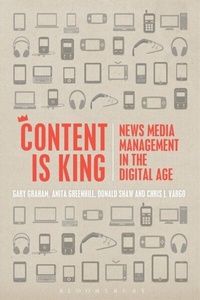
Content is King
News Media Management in the Digital Age
1st Edition
Published on 22. October 2015
288 pages
978-1-62356-750-7 (ISBN)
Description

From the viewpoint of newspaper organizations the main competitive media has shrunk to only one, the internet. But the effect of this innovation has been devastating in capturing the vast majority of the advertising revenues on which newspapers have depended. The larger the internet-based media became the more newspapers and other media shrank. Pairing an academic and former industry news manager, this textbook assesses the situation in which the regional news media industry finds itself, and explores methods, processes and techniques, which might usefully be introduced to help the news media firm secure a viable future.
In focusing on newspapers, magazines, TV and radio, the work is filled with real-life examples and interviews with news media managers, illustrating how management is being conducted in this age of turbulence. The goal is to give students practice in solving complex strategic problems and to provide them with a series of intellectual and professional exercises. Their method of using case studies will enable students to explore in detail key theoretical issues before applying them to real life management settings.
In focusing on newspapers, magazines, TV and radio, the work is filled with real-life examples and interviews with news media managers, illustrating how management is being conducted in this age of turbulence. The goal is to give students practice in solving complex strategic problems and to provide them with a series of intellectual and professional exercises. Their method of using case studies will enable students to explore in detail key theoretical issues before applying them to real life management settings.
Reviews / Votes
This is an unusual and insightful book that should be of value to both scholars and practitioners of journalism. It comes at a time when news media economics have changed dramatically, and it provides helpful suggestions and examples for news media managers who are grappling with these changes. * David H. Weaver, Distinguished Professor Emeritus of Journalism, Indiana University, USA * The quest for innovative revenue models to support local news organizations in the new communication and social environment must address a broad array of core questions about this environment. Content Is King addresses a host of these questions in depth - the information needs of contemporary communities defined in diverse ways, use of social media to interact with these communities, the process of value creation in professional journalism, maintaining the civic role of local news media, and numerous others. The current turbulence of local journalism can spawn opportunity through thoughtful consideration of these questions. * Maxwell McCombs, J.H. Jones Chair in Communication Emeritus, University of Texas at Austin, USA * This positive and practical volume brings expertise and experiences from Europe and the United States to bear on the knotty problem of news strategy in the digital era. Content is King will convince both students and managers of the ongoing importance of a community- and consumer-focus, the need to engage with technology and innovation, and the value of synergies between old and new media. The authors also present inventive ideas on how media policy and news content can increase political engagement, and why this matters. * Neil Thurman, Professor of Communication, Ludwig Maximilian University of Munich, Germany *More details
Edition
1. Auflage
Language
English
Place of publication
New York
United States
Publishing group
Bloomsbury Publishing PLC (Digital)
Illustrations
100 bw illus
ISBN-13
978-1-62356-750-7 (9781623567507)
Copyright in bibliographic data and cover images is held by Nielsen Book Services Limited or by the publishers or by their respective licensors: all rights reserved.
Schweitzer Classification
Other editions
Additional editions
Book
10/2015
Bloomsbury Academic USA
€57.10
Shipment within 3-4 weeks
Persons
Gary Graham is a Lecturer in Service Operations at the University of Leeds, UK. He is the author of 30 internationally refereed research papers, a co-investigator on 6 EPSRC/ESRC grants and is regularly invited to leading management conferences to present his research.
Anita Greenhill is Senior Lecturer and Programme Director for the Masters in Management degree at Manchester Business School, UK. She is the author of more than 60 internationally refereed research papers, and regularly comments on the policy and social implications of digital change in the North of England.
Donald Shaw is an American journalism historian, theorist, author, retired U.S. Army Reserve officer, and writer who taught 46 years at the School of Journalism and Mass Communication. He also has been visiting professor at six other universities and has lectured at more than 20 universities in the United States and abroad.
Chris J. Vargo is an Assistant Professor of Public Relations at The University of Alabama, USA. He specializes in the use of computer science methods to investigate social media using theories from the communication and journalism disciplines.
Anita Greenhill is Senior Lecturer and Programme Director for the Masters in Management degree at Manchester Business School, UK. She is the author of more than 60 internationally refereed research papers, and regularly comments on the policy and social implications of digital change in the North of England.
Donald Shaw is an American journalism historian, theorist, author, retired U.S. Army Reserve officer, and writer who taught 46 years at the School of Journalism and Mass Communication. He also has been visiting professor at six other universities and has lectured at more than 20 universities in the United States and abroad.
Chris J. Vargo is an Assistant Professor of Public Relations at The University of Alabama, USA. He specializes in the use of computer science methods to investigate social media using theories from the communication and journalism disciplines.
Content
Chapter 1 Introduction
Section One. Challenges facing newspapers
Chapter 2. News media and their Communities
Chapter 3. Disruptive Technological Innovation
Section Two. Management and leadership of news media firms
Chapter 4. Establishing Leadership and Strategic Management
Chapter 5. Value Chain Structure and Properties
Chapter 6. Self-Organizing Value Creation
Chapter 7 Managing Cross Media Synergy
Section Three. Future Management Visions
Chapter 8. Creative News Media Visions
Chapter 9. Digital Printing and Customization
Chapter 10. Positioning, Self Branding, Visual Identity, Concepts and Thoughts
Chapter 11. Conclusions
Index
Section One. Challenges facing newspapers
Chapter 2. News media and their Communities
Chapter 3. Disruptive Technological Innovation
Section Two. Management and leadership of news media firms
Chapter 4. Establishing Leadership and Strategic Management
Chapter 5. Value Chain Structure and Properties
Chapter 6. Self-Organizing Value Creation
Chapter 7 Managing Cross Media Synergy
Section Three. Future Management Visions
Chapter 8. Creative News Media Visions
Chapter 9. Digital Printing and Customization
Chapter 10. Positioning, Self Branding, Visual Identity, Concepts and Thoughts
Chapter 11. Conclusions
Index
