

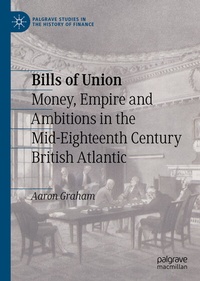
Bills of Union
Description

This book brings together for the first time more than half a dozen proposals for an imperial paper currency in the mid-eighteenth century British Atlantic, to show how manage colonial currency and banking in the expanding empire. Existing studies have looked at the successes and failures of schemes in individual colonies. But some had grander ambitions, such as Benjamin Franklin, and offered proposals for 'imperial' or 'continental' paper currencies and monetary unions which would help knit together colonial territories throughout North America and even the Caribbean into a cohesive whole during a moment of imperial reform. This book brings together these proposals for the first time, including several never studied before, to show how thinkers and writers on empire, currency and finance drew on financial practices, precedents and principles from across the British Atlantic to present their own visions of monetary union and the futureof empire. In doing so it makes an important and original contribution to the wider histories of monetary and financial thought and theory and the roots of American monetary policy, and the links between finance, empire, politics, reform and revolution. It will be of interest to academics working on the history of finance, banking and currency in the British Isles, North America and the Caribbean in the eighteenth century, as well as those working on the political economy of the British Empire, including mercantilism, trade, warfare and the politics of empire in the decades leading up to the American Revolution.
More details
Other editions
Additional editions
Person
Aaron Graham is a Research Associate at the University of Oxford. He has previously held a Leverhulme Early Career Fellowship at University College London and a British Academy Postdoctoral Fellowship at the University of Oxford, and was an Earhart Foundation Fellow in American History at the William L. Clements Library. He has published extensively on government, politics, finance and warfare in the British Atlantic between 1660 and 1850, and is currently working on a study of slavery, society, security and the colonial state in Jamaica in the age of revolutions between 1770 and 1840.
Content
1. Introduction.- 2. Land Banks.- 3. Currency Banks.- 4. Conclusion.
