

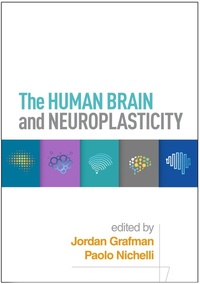
The Human Brain and Neuroplasticity
Description

From foundational concepts to emerging technologies, this book reviews current human neuroplasticity research and its clinical applications. Experts in the field cover the biology and mechanisms of neuronal plasticity, its role in learning and development, and cortical reorganization in aging and disease. Chapters explore the challenges of translating research into effective, individualized treatments for neurological and psychiatric conditions across the lifespan. Cutting-edge topics include enhancing brain health in older adults, advances in brain-computer interfaces, and the impact of intensive digital media use on cognition, attention, and brain organization. The book features eight pages of full-color illustrations.
More details
Other editions
Additional editions
Persons
Jordan Grafman, PhD, is Director of Brain Injury Research and Chief of the Cognitive Neuroscience Laboratory at the Shirley Ryan AbilityLab and Professor in the Department of Physical Medicine and Rehabilitation at Northwestern University. He served as Chief of the Cognitive Neuroscience Laboratory at the National Institute of Neurological Disorders and Stroke for several decades. With more than 600 publications, Dr. Grafman currently focuses his research on the brain bases of belief and the brain networks supporting reward and reinforcement. He also leads the Vietnam Head Injury Study. Dr. Grafman is a recipient of the U.S. Department of Defense Meritorious Service Award, the National Institutes of Health Award of Merit, the National Institutes of Health Director's Award, and the Research Award from the Alexander von Humboldt Foundation in Germany.
Paolo Nichelli, MD, is a retired Full Professor of Neurology at the University of Modena and Reggio Emilia in Modena, Italy, and former Clinical Director of the Neuroscience Department at the Sant'Agostino-Estense Modena Hospital. Since the beginning of his career, his research has focused on clinical and experimental neuropsychology. As a Visiting Scientist in the Cognitive Neuroscience Laboratory at the National Institute of Neurological Disorders and Stroke in the early 1990s, Dr. Nichelli became interested in using functional neuroimaging methods, which he later helped implement in Modena. A founding member and past president of the Italian Society of Neuropsychology, Dr. Nichelli has published over 280 scientific articles and book chapters.
Content
2. Neurobiology Methods for Studying Neuronal Plasticity in Animal Models, Tara Keck
3. Methods for Studying Brain Plasticity in Humans, Christine J. Charvet
4. Different Levels of Plasticity, Luca Bonfanti
5. Basic Mechanisms of Plasticity in Learning and Memory, Dustin Fetterhoff, Manuela Costa, & Bryan Strange
6. Development and Plasticity of the Human Visual System, Maxime Bleau & Maurice Ptito
7. Adaptive Plasticity, Davide Bottari & Elena Nava
8. Cortical Reorganization after Brain Damage, Valentina Azzollini & Leonardo G. Cohen
9. Brain Plasticity, Cognitive Reserve, and Aging, Georgette Argiris, Christian Habeck, & Yaakov Stern
10. Therapeutic Interventions for Maladaptive Neurological Disorders, Negar Nasrkhani, Nasem Raies, Rachel Chang, Nishaad Sheth, Amitabh Bhattacharya, Naaz Desai, & Robert Chen
11. Therapeutic Interventions for Modulation of Brain Plasticity in Neurological and Psychiatric Diseases, Ali Jannati, Joyce Gomes-Osman, Davide B. Cappon, & Alvaro Pascual-Leone
12. Effects of Physical Exercise, Cognitive Training, and Multidomain Intervention on the Aging Brain, Louis Bherer & Tudor Vrinceanu
13. Brain-Computer Interfaces and Plasticity of the Human Nervous System, Natalie Mrachacz-Kersting & Dario Farina
14. Brain Plasticity in the Age of the Internet, Martin Korte
15. Concluding Thoughts on Neuroplasticity, Jordan Grafman & Paolo Nichelli
Index
