

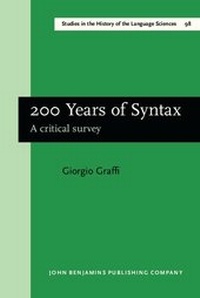
200 Years of Syntax
A critical survey
1st Edition
Published on 11. April 2001
XIV, 551 pages
978-90-272-8457-0 (ISBN)
Description

This book argues convincingly against the widespread opinion that very few syntactic studies were carried out before the 1950s. Relying on the detailed analysis of a large amount of original sources, it shows that syntactic matters were in fact carefully investigated throughout both the 19th century and during the first half of the 20th century. Moreover, it illustrates how the enormous development of syntactic research in the last fifty years has already condemned even several recent ideas and analyses to oblivion, and deeply influenced current research programs. The wealth of research undertaken over the last two centuries is presented here in a systematic way, taking as its starting point the relationship of syntax with psychology throughout this period. The critical ideas expressed in the text are based on a detailed illustration of the different syntactic models and analyses rather than on the polemics between the different schools.
More details
Other editions
Additional editions
Book
04/2001
John Benjamins Publishing Co
€148.40
Shipment within 10-15 days
Person
Content
- 200 YEARS OF SYNTAX A CRITICAL SURVEY
- Editorial page
- Title page
- Copyright page
- Table of contents
- PREFACE
- CHAPTER 1 INTRODUCTION
- 1. 'History of linguistic science' and 'history of linguistic thought'
- 2. Syntax and psychology: vicissitudes of a relationship
- 3. Overall design of the volume
- PART I THE AGE OF PSYCHOLOGISM IN LINGUISTICS
- CHAPTER 2 THE RISE AND FALL OF 'PSYCHOLOGISTIC' SYNTAX
- 0. Introduction
- 1. The legacy of the grammaire générale and its abandonment
- 1.1 'Philosophical ' grammar
- 1.2 Humboldt's views on syntax
- 2. Steinthal's program and the birth of psychologism in linguistics
- 2.1 Hegel, Herbart and Humboldt's influence on Steinthal
- 2.2 The "divorce" of grammar from logic
- 2.3 'Ethnopsychology' and language classification
- 3. Developments of psychologism
- 3.1 Ethnopsychology in Gabelentz
- 3.2 Paul and other opponents of ethnopsychology
- 3.3 Wundt's impact on linguistics
- 3.4 The debate between Wundt and the Neogrammarians
- 4. The criticism of psychologism: Brentano, Marty, Husserl
- 4.1 Brentano's 'intentionalistic' psychology
- 4.2 Marty's philosophy of language
- 4.3 Husserl
- 5. Towards the crisis of psychologism
- 5.1 Overview
- 5.2 Language as a 'social phenomenon ': the French school and the school of Geneva
- 5.3 Logic and psychology vs. grammar in Jespersen
- 5.4 Bühler and the functional view of language
- CHAPTER 3 "WHAT IS SYNTAX?
- 0. Introduction
- 1. Crisis in the logic-based model of syntax
- 2. Grammatical, logical and psychological categories
- 2.1 'Syntactic ' order and 'psychological' order
- 2.2 The logical' and 'psychological' subject and predicate
- 2.3 'Subject' is not a linguistic category
- 2.4 Towards the abandoning of 'psychological' categories
- 3. The debate on impersonals
- 3.1 Do 'subjectless' sentences exist?
- 3.2 What does the subject pronoun of impersonal sentences mean?
- CHAPTER 4 THE ANALYSES OF THE SENTENCE AND OF THE WORD GROUPS
- 0. Introduction
- 1. 'What is a sentence?'
- 1.1 The rise and fall of the equation sentence - judgement
- 1.2 Main clauses and dependent clauses
- 1.3 New models of the sentence: 'psychological', 'grammatical','communicative '
- 1.4 The sentence as judgement: resumption of the old model in a psychologistic framework
- 1.5 Criticisms of Wundt's conception of the sentence and new approaches to the problem
- 1.6 Ries ' theory of the sentence
- 1.7 Jespersen 's notion of 'nexus '
- 2. The nature and classification of word groups
- 2.1 Word groups vs. sentences
- 2.2 Attribution vs. predication
- 2.3 The internal structure of word groups
- 2.4 Word order inside word groups
- PART II THE AGE OF STRUCTURAL LINGUISTICS
- CHAPTER 5 THE ROLE OF SYNTAX IN THE STRUCTURALIST SYSTEMS
- 0. Introduction
- 1. New insights and ties with the past
- 1.1 Saussure 's dichotomies and their impact on syntactic research
- 1.2 'Language', 'speech ' and thought: Gardiner and Sandmann
- 2. Syntax in the early phase of European and American structuralism
- 2.1 The syntax of the Geneva school: the birth of 'syntagmatics '
- 2.2 The syntax of Prague school
- 2.3 Syntactic concepts in Bloomfield and Sapir
- 2.4 The Copenhagen school: Brøndal
- 2.5 The Copenhagen school: 'function ' and 'government' in glossematics
- 2.6 Tesnière: syntax as 'connection '
- 3. Later developments of structuralist syntax
- 3.1 Frei and Mikus ' syntagmatics
- 3.2 The syntax of the post-war Prague school: 'syntactic levels ' and 'communicative dynamism '
- 3.3 Other European syntacticians
- 3.4 Benveniste: from historical-comparative grammar to general grammar
- 3.5 The Post-Bloomfieldian distributional approach to syntax
- 3.6 Harris' transformational theory
- CHAPTER 6 STRUCTURALIST APPROACHES TO SENTENCE ANALYSIS
- 0. Introduction
- 1. The sentence as a unit
- 1.1 Sentence as a phenomenon of parole
- 1.2 'Sentences' and 'utterances'
- 1.3 Classification of sentence types
- 1.4 'Sentences ' and 'clauses '
- 2. Analysis of sentence structure
- 2.1 'Grammatical' vs. 'psychological' or 'actual' analysis
- 2.2 The grammatical aspect of the sentence: the subject-predicate relation
- 2.3 More on the problem of verbless sentences: the notion of 'zero sign '
- 2.4 Feldertheorie and the analysis of the sentence
- CHAPTER 7 THE TECHNIQUES OF SYNTACTIC DESCRIPTION
- 0. Introduction
- 1. Definition and typology of constructions
- 1.1. American structuralism: 'endocentric ' and 'exocentric ' constructions
- 1.2 European structuralism: 'determination', 'coordination', and 'predication'
- 2. Looking for syntactic units: non-procedural approaches
- 2.1 Parts of speech and syntactic nodes in Tesnière
- 2.2 De Groot's classification of word groups
- 3. Looking for syntactic units: procedural approaches
- 3.1 Immediate Constituents analysis
- 3.2 Harris' procedure 'from morpheme to utterance'
- 3.3 Glossematic procedures
- 3.4 'Syntagmatic ' procedures
- 3.5 The representation of discontinuous constituents
- PART III THE AGE OF SYNTACTIC THEORIES
- CHAPTER 8 THE SHAPING OF SYNTACTIC THEORIES
- 0. Introduction
- 1. A genealogical classification of syntactic theories
- 2. Syntax and the logical analysis of language
- 3. Beyond American structuralism
- 3.1. Tagmemics
- 3.2 Syntax, linguistic universals and typology
- 4. The emergence of generative syntax
- 4.1 The birth of generative syntax
- 4.2 The syntactic model of The Logical Structure of Linguistic Theory
- 4.3 From The Logical Structure of Linguistic Theory to Aspects of the Theory of Syntax: towards the 'standard theory '
- 4.4 The standard theory becomes standard practice
- 4.5 Beyond the standard theory
- CHAPTER 9 DIFFERENT VIEWS OF SYNTAX
- 0. Introduction
- 1. Generative syntax and the proliferation of syntactic theories
- 1.1 The impact of generative syntax
- 1.2 Some debated points: issues of principle
- 1.3 Some debated points: empirical issues
- 2. Natural languages as formal languages: Montague Grammar
- 3. Functional and typological theories of syntax
- 3.1 The galaxy of functionalism
- 4. Trends in generative syntax
- 4.1 Syntax as semantics and 'natural logic': Generative Semantics
- 4.2 Relational Grammar
- 4.3 'One-level' approaches to syntax: LFG and GPSG
- CHAPTER 10 THE 'CHOMSKIAN PROGRAM'
- 0. Introduction
- 1. Chomsky's concept of 'Universal Grammar'
- 2. The seventies: 'conditions' and 'filters'
- 2.1 Restricting the functioning of grammatical rules: 'conditions on transformations '
- 2.2 The birth of the notions of 'trace ' and 'Logical Form '
- 2.3 Restricting the format of grammatical rules: 'structure-preserving constraint ' and 'X-bar theory '
- 2.4 Abandoning grammatical rules: Filters and Case
- 3. The 'Principles and Parameters' model
- 3.1 The Pisa lectures: 'government' as the unifying notion
- 3.2 After the Pisa lectures: 'thematic roles ' and 'chains '
- 3.3 Developing the Principles and Parameters model
- 4. The strive for simplicity or the 'Minimalist Program'
- 4.1 New proposals on syntactic representations
- 4.2 Main features of the Minimalist Program
- 4.3 'The antisymmetry of syntax'
- REFERENCES
- INDEX OF NAMES
- INDEX OF SUBJECTS
