

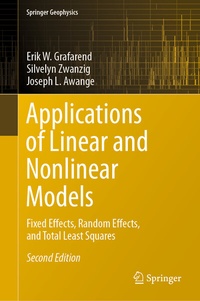
Applications of Linear and Nonlinear Models
Description

This book provides numerous examples of linear and nonlinear model applications. Here, we present a nearly complete treatment of the Grand Universe of linear and weakly nonlinear regression models within the first 8 chapters. Our point of view is both an algebraic view and a stochastic one. For example, there is an equivalent lemma between a best, linear uniformly unbiased estimation (BLUUE) in a Gauss-Markov model and a least squares solution (LESS) in a system of linear equations. While BLUUE is a stochastic regression model, LESS is an algebraic solution. In the first six chapters, we concentrate on underdetermined and overdetermined linear systems as well as systems with a datum defect. We review estimators/algebraic solutions of type MINOLESS, BLIMBE, BLUMBE, BLUUE, BIQUE, BLE, BIQUE, and total least squares. The highlight is the simultaneous determination of the first moment and the second central moment of a probability distribution in an inhomogeneous multilinear estimationby the so-called E-D correspondence as well as its Bayes design. In addition, we discuss continuous networks versus discrete networks, use of Grassmann-Plucker coordinates, criterion matrices of type Taylor-Karman as well as FUZZY sets. Chapter seven is a speciality in the treatment of an overjet. This second edition adds three new chapters:
(1) Chapter on integer least squares that covers (i) model for positioning as a mixed integer linear model which includes integer parameters. (ii) The general integer least squares problem is formulated, and the optimality of the least squares solution is shown. (iii) The relation to the closest vector problem is considered, and the notion of reduced lattice basis is introduced. (iv) The famous LLL algorithm for generating a Lovasz reduced basis is explained.
(2) Bayes methods that covers (i) general principle of Bayesian modeling. Explain the notion of prior distribution and posterior distribution. Choose the pragmatic approach for exploring the advantages of iterative Bayesian calculations and hierarchical modeling. (ii) Present the Bayes methods for linear models with normal distributed errors, including noninformative priors, conjugate priors, normal gamma distributions and (iii) short outview to modern application of Bayesian modeling. Useful in case of nonlinear models or linear models with no normal distribution: Monte Carlo (MC), Markov chain Monte Carlo (MCMC), approximative Bayesian computation (ABC) methods.
(3) Error-in-variables models, which cover: (i) Introduce the error-in-variables (EIV) model, discuss the difference to least squares estimators (LSE), (ii) calculate the total least squares (TLS) estimator. Summarize the properties of TLS, (iii) explain the idea of simulation extrapolation (SIMEX) estimators, (iv) introduce the symmetrized SIMEX (SYMEX) estimator and its relation to TLS, and (v) short outview to nonlinear EIV models.
The chapter onalgebraic solution of nonlinear system of equations has also been updated in line with the new emerging field of hybrid numeric-symbolic solutions to systems of nonlinear equations, ermined system of nonlinear equations on curved manifolds. The von Mises-Fisher distribution is characteristic for circular or (hyper) spherical data. Our last chapter is devoted to probabilistic regression, the special Gauss-Markov model with random effects leading to estimators of type BLIP and VIP including Bayesian estimation.
A great part of the work is presented in four appendices. Appendix A is a treatment, of tensor algebra, namely linear algebra, matrix algebra, and multilinear algebra. Appendix B is devoted to sampling distributions and their use in terms of confidence intervals and confidence regions. Appendix C reviews the elementary notions of statistics, namely random events and stochastic processes. Appendix D introduces the basics of Groebner basis algebra, its careful definition, the Buchberger algorithm, especially the C. F. Gauss combinatorial algorithm.
More details
Other editions
Additional editions
Persons
Professor Joseph Awange joined Spatial Sciences (School of Earth and Planetary Sciences, Curtin University, Australia) in 2006 under a Curtin Research Fellowship and concurrently undertook the prestigious Alexander vonHumboldt (AvH) Fellowship at the Geodetic Institute (Karlsruhe Institute of Technology, Germany) having been awarded the Australian 2008-2011 Ludwig Leichhardt Memorial Fellowship for experienced researchers. In 2015, he won all the three major Fellowship Awards: Alexander von Humboldt (Germany), Japan Society of Promotion of Science (Japan) and Brazil Frontier of Science (Brazil) to carry out research in those countries. At Curtin University, he is currently a Professor of Environmental Geoinformatics engaged in teaching and research having attracted more than $2.5M worth of research grants. He obtained his BSc and MSc degrees in Surveying from the University of Nairobi (Kenya), and was also awarded a merit scholarship by the German Academic Exchange Program (DAAD), which facilitated his obtaining a second MSc degree and PhD in Geodesy at Stuttgart University (Germany). In 2002-2004, he was awarded the prestigious Japan Society for Promotion of Science (JSPS) Fellowship to pursue postdoctoral research at Kyoto University (Japan). Prof Awange attained International Editorial role in Springer Earth Science Books and has authored more than 20 scholarly books with the prestigious Springer International publishers and more than 200 peer-reviewed high impact journal publications (in e.g., Remote Sensing of Environment, Journal of Climate, Climatic Change, Advances in Water Resources, International Journal of Climatology, and Journal of Hydrology among others). His main research areas that have attracted media coverage (e.g., Environmental Monitor) are in the fields of (i) Environmental Geoinformatics: Satellite Environmental Sensing (e.g., changes in global and regional stored water (surface, underground, ice, and soil moisture) using GRACE/GRACE-FO and TRMM satellites; Climate Change using GNSS and altimetry satellites), which is employed to face the emerging challenges of the 21st century posed by increased extreme hydroclimatic conditions, e.g., severity and frequency of droughts in Australia and Greater Horn of Africa (GHA), and the changing monsoon characteristics in Asia and Africa leading to floods, and (ii) Mathematical Geosciences: Hybrid-symbolic solutions that delivers hybrid symbolic-numeric computations (HSNC), which is a large and growing area at the boundary of mathematics and computer science and currently an active area of research.
