

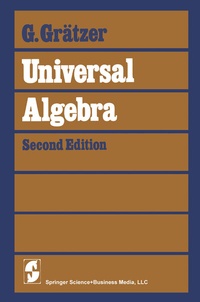
Universal Algebra
Description

Universal Algebra heralded as ". . . the standard reference in a field notorious for the lack of standardization . . .", has become the most authoritative, consistently relied on text in a field with applications in other branches of algebra and other fields such as combinatorics, geometry, and computer science.
Each chapter is followed by an extensive list of exercises and problems. The "state of the art" account also includes new appendices (with contributions from B. Jónsson, R. Quackenbush, W. Taylor, and G. Wenzel) and a well selected additional bibliography of over 1250 papers and books which makes this an indispensable new edition for students, faculty, and workers in the field.
"This book will certainly be, in the years to come, the basic reference to the subject." The American Mathematical Monthly (First Edition)
"In this reviewer's opinion [the author] has more than succeeded in his aim. The problems at the end of each chapter are well-chosen; there are more than 650 of them. The book is especially suitable for self-study, as the author frequently provides ample explanation not only of what he is proving, but also of how and why he is proving it. As a reference work for the specialist or a text for the student, the book is highly recommended." Mathematical Reviews (First Edition)
"Since the first day of its appearance in 1968, this book has been the standard reference in universal algebra, and no book since has reached its quality." Journal of Symbolic Logic (Second Edition)
More details
Other editions
Additional editions
Person
George Grätzer is a Doctor of Science at the University of Manitoba. He authored three other books on LaTex: First Steps in LaTeX and Math into LateX, which is now in its third edition and has sold more than 6000 copies. Math into LaTeX was chosen by the Mathematics Editor of Amazon.com as one of the ten best books of 2000. He has also written many articles and a few books on the subject of lattices and universal algebra. In addition, Grätzer is the founder of the international mathematical journal, Algebra Universalis.
