

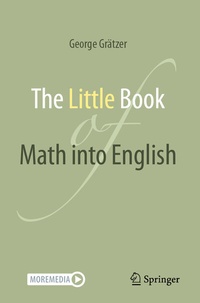
The Little Book of Math into English
Description

This colorful and concise little book is uniquely tailored for those who write mathematical texts at any level and are eager to improve their English writing skills. The easy-to-read guide focuses on helping the writer avoid common English mistakes in mathematical writing. With just a few minutes of engaging, light reading each day, the reader will learn to create clearer, more readable, math texts.
The book covers 23 crucial topics, ranging from correct article and preposition usage to proper usage of dashes, conjunctions, and prepositions. It also addresses the construction of direct sentences, effective introductory phrases for formulas, and more. As a bonus to the reader, 'Practice makes perfect' exercises relating to each topic are freely accessible on this book's Springer website.
Appendix A gives a quick tutorial on grammatical terms and constructs. Appendix B looks at ChatGPT and the positive aspects of its powerful capabilities. Additionally, Paul Halmos's article on 'How to write mathematics' is included in Appendix C. It deals with the mathematical aspects of writing.
Reviews / Votes
"The book is written in a lively and concise style, with illustrations, conversations (performed through ChatGBT) and well chosen examples included. By writing it, the author did a great service to the mathematical community. I think the book will become a must for everyone desiring to write mathematics in a clear and grammatically correct English." (Stefan Cobzas, zbMATH 1557.00001, 2025)
More details
Other editions
Additional editions
Person
George Grätzer is emeritus professor of mathematics from the University of Manitoba. He specializes in lattice theory and universal algebra and has written several publications in both subjects. He has written about 270 research papers and 33 books. Professor Grätzer's 6th edition of his comprehensive LaTeX manuals published in 2024 in addition to his most recent The Little Book of Math into English.
Content
Introduction.- Overview.- 1. Little words I. Prepositions.- 2. Little words II. Pronouns.- 3. Little words III. Conjunctions.- 4. Little Words IV. So, such, that.- 5. Little words V. Like, such as.- 6. Little words VI. Either, or, both.- 7. Little marks I. Punctuation.- 8. Little marks II. Hyphens.- 9. Little marks III. Dashes.- 10. Little transitions. Short version.- 11. Little transitions. Longer version.- 12. Little Intros.- 13. Little run. Run-on sentences.- 14. Little trip. To go or going.- 15. Little dangling.- 16. Little numbers. Les and fewer, both and two.- 17. Little pause. Comma before if.- 18. Little ambiguity.- 19. Little active vs. passive.- 20. Little speed. Faster and fastests.- 21. Little distinctions.- 22. Little modification.- 23. Little only.- A. Little grammar.- B. Little ChatGPT.- C. How to write mathematics by P.R. Halmos.- Bibliography.
