

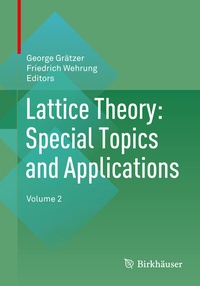
Lattice Theory: Special Topics and Applications
Description

George Grätzer's Lattice Theory: Foundation is his third book on lattice theory (General Lattice Theory, 1978, second edition, 1998). In 2009, Grätzer considered updating the second edition to reflect some exciting and deep developments. He soon realized that to lay the foundation, to survey the contemporary field, to pose research problems, would require more than one volume and more than one person.
So Lattice Theory: Foundation provided the foundation. Now we complete this project with Lattice Theory: Special Topics and Applications, in two volumes, written by a distinguished group of experts, to cover some of the vast areas not in Foundation.
This second volume is divided into ten chapters contributed by K. Adaricheva, N. Caspard, R. Freese, P. Jipsen, J.B. Nation, N. Reading, H. Rose, L. Santocanale, and F. Wehrung.
More details
Other editions
Additional editions
Persons
George Grätzer, Member of the Canadian Academy of Sciences and Foreign Member of the Hungarian Academy of Sciences, is the author of 26 books in five languages and about 270 articles, most of them on his research in lattice theory.
Friedrich Wehrung is professor at the University of Caen and an associate editor for Algebra Universalis , a mathematical journal devoted to universal algebra and lattice theory. He is the author of numerous publications in the field and wrote an appendix to the second edition of Grätzer's General Lattice Theory .
