

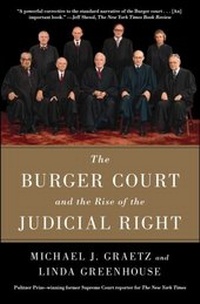
The Burger Court and the Rise of the Judicial Right
1st Edition
Published on 7. June 2016
480 pages
978-1-4767-3252-7 (ISBN)
Description

A revelatory look at the Warren Burger Supreme Court finds that it was not moderate or transitional, but conservative?and it shaped today's constitutional landscape. It is an ?important book...a powerful corrective to the standard narrative of the Burger Court? (The New York Times Book Review).
When Richard Nixon campaigned for the presidency in 1968 he promised to change the Supreme Court. With four appointments to the court, including Warren E. Burger as the chief justice, he did just that. In 1969, the Burger Court succeeded the famously liberal Warren Court, which had significantly expanded civil liberties and was despised by conservatives across the country.
The Burger Court is often described as a ?transitional? court between the Warren Court and the Rehnquist and Roberts Courts, a court where little of importance happened. But as this ?landmark new book? (The Christian Science Monitor) shows, the Burger Court veered well to the right in such areas as criminal law, race, and corporate power. Authors Graetz and Greenhouse excavate the roots of the most significant Burger Court decisions and in ?elegant, illuminating arguments? (The Washington Post) show how their legacy affects us today.
?Timely and engaging? (Richmond Times-Dispatch), The Burger Court and the Rise of the Judicial Right draws on the personal papers of the justices as well as other archives to provide ?the best kind of legal history: cogent, relevant, and timely? (Publishers Weekly).
When Richard Nixon campaigned for the presidency in 1968 he promised to change the Supreme Court. With four appointments to the court, including Warren E. Burger as the chief justice, he did just that. In 1969, the Burger Court succeeded the famously liberal Warren Court, which had significantly expanded civil liberties and was despised by conservatives across the country.
The Burger Court is often described as a ?transitional? court between the Warren Court and the Rehnquist and Roberts Courts, a court where little of importance happened. But as this ?landmark new book? (The Christian Science Monitor) shows, the Burger Court veered well to the right in such areas as criminal law, race, and corporate power. Authors Graetz and Greenhouse excavate the roots of the most significant Burger Court decisions and in ?elegant, illuminating arguments? (The Washington Post) show how their legacy affects us today.
?Timely and engaging? (Richmond Times-Dispatch), The Burger Court and the Rise of the Judicial Right draws on the personal papers of the justices as well as other archives to provide ?the best kind of legal history: cogent, relevant, and timely? (Publishers Weekly).
More details
Other editions
Additional editions
Michael J. Graetz | Linda Greenhouse
The Burger Court and the Rise of the Judicial Right
Book
06/2017
Atria Books
€36.50
Shipment within 10-20 days
Michael J. Graetz | Linda Greenhouse
The Burger Court and the Rise of the Judicial Right
Book
06/2016
Simon & Schuster
€47.60
Article exhausted; check different version
Persons
Michael J. Graetz is a Professor of Law at Columbia Law School and the Justus S. Hotchkiss Professor of Law Emeritus at Yale University. He has previously published seven books and many articles on a wide range of public policy issues. He also served in important policy positions at the Treasury Department and was a John Simon Guggenheim Memorial Fellow and a fellow of the American Academy of Arts and Sciences.
Linda Greenhouse, recipient of the Pulitzer Prize and other major journalism awards, covered the Supreme Court for The New York Times for nearly thirty years. Since 2009, she has taught at Yale Law School and written a biweekly op-ed column on the Court as a contributing writer for the Times. She is a graduate of Radcliffe College, Harvard, and earned a master of studies in law degree from Yale Law School. This is her fourth book about the Supreme Court.
Linda Greenhouse, recipient of the Pulitzer Prize and other major journalism awards, covered the Supreme Court for The New York Times for nearly thirty years. Since 2009, she has taught at Yale Law School and written a biweekly op-ed column on the Court as a contributing writer for the Times. She is a graduate of Radcliffe College, Harvard, and earned a master of studies in law degree from Yale Law School. This is her fourth book about the Supreme Court.
Content
- Intro
- Dedication
- Introduction: A Counterrevolution Reclaimed
- Part One: Crime
- 1. The Fall and Rise of the Death Penalty
- 2. Taming the Trilogy
- 3. Closing the Federal Courthouse Doors
- Part Two: Race
- 4. Still Separate, Still Unequal
- 5. Seeking a Higher Education
- Part Three: Social Transformation
- 6. Privacy at a Price
- 7. The Rocky Road to Sex Equality
- 8. Expression and Repression
- 9. A Religious People's Court
- Part Four: Business
- 10. Corporations Are People Too
- 11. Battling Workplace Inequality
- Part Five: The Presidency
- 12. Power and Its Abuse
- 13. Richard Nixon in Warren Burger's Court
- Conclusion: A Lasting Legacy
- Appendix: The Members of the Burger Court
- Acknowledgments
- About Michael J. Graetz and Linda Greenhouse
- Notes
- Photo Credits
- Index
- Copyright
