

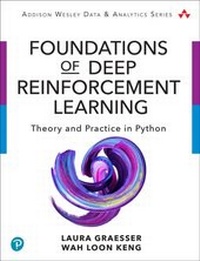
Foundations of Deep Reinforcement Learning
Theory and Practice in Python
1st Edition
Published on 28. January 2020
416 pages
978-0-13-517248-3 (ISBN)
Description

The Contemporary Introduction to Deep Reinforcement Learning that Combines Theory and Practice
Deep reinforcement learning (deep RL) combines deep learning and reinforcement learning, in which artificial agents learn to solve sequential decision-making problems. In the past decade deep RL has achieved remarkable results on a range of problems, from single and multiplayer games-such as Go, Atari games, and DotA 2-to robotics.
Foundations of Deep Reinforcement Learning is an introduction to deep RL that uniquely combines both theory and implementation. It starts with intuition, then carefully explains the theory of deep RL algorithms, discusses implementations in its companion software library SLM Lab, and finishes with the practical details of getting deep RL to work.
This guide is ideal for both computer science students and software engineers who are familiar with basic machine learning concepts and have a working understanding of Python.
Understand each key aspect of a deep RL problem
Explore policy- and value-based algorithms, including REINFORCE, SARSA, DQN, Double DQN, and Prioritized Experience Replay (PER)
Delve into combined algorithms, including Actor-Critic and Proximal Policy Optimization (PPO)
Understand how algorithms can be parallelized synchronously and asynchronously
Run algorithms in SLM Lab and learn the practical implementation details for getting deep RL to work
Explore algorithm benchmark results with tuned hyperparameters
Understand how deep RL environments are designed
Register your book for convenient access to downloads, updates, and/or corrections as they become available. See inside book for details.
Deep reinforcement learning (deep RL) combines deep learning and reinforcement learning, in which artificial agents learn to solve sequential decision-making problems. In the past decade deep RL has achieved remarkable results on a range of problems, from single and multiplayer games-such as Go, Atari games, and DotA 2-to robotics.
Foundations of Deep Reinforcement Learning is an introduction to deep RL that uniquely combines both theory and implementation. It starts with intuition, then carefully explains the theory of deep RL algorithms, discusses implementations in its companion software library SLM Lab, and finishes with the practical details of getting deep RL to work.
This guide is ideal for both computer science students and software engineers who are familiar with basic machine learning concepts and have a working understanding of Python.
Understand each key aspect of a deep RL problem
Explore policy- and value-based algorithms, including REINFORCE, SARSA, DQN, Double DQN, and Prioritized Experience Replay (PER)
Delve into combined algorithms, including Actor-Critic and Proximal Policy Optimization (PPO)
Understand how algorithms can be parallelized synchronously and asynchronously
Run algorithms in SLM Lab and learn the practical implementation details for getting deep RL to work
Explore algorithm benchmark results with tuned hyperparameters
Understand how deep RL environments are designed
Register your book for convenient access to downloads, updates, and/or corrections as they become available. See inside book for details.
Reviews / Votes
"This book provides an accessible introduction to deep reinforcement learning covering the mathematical concepts behind popular algorithms as well as their practical implementation. I think the book will be a valuable resource for anyone looking to apply deep reinforcement learning in practice."-Volodymyr Mnih, lead developer of DQN
"An excellent book to quickly develop expertise in the theory, language, and practical implementation of deep reinforcement learning algorithms. A limpid exposition which uses familiar notation; all the most recent techniques explained with concise, readable code, and not a page wasted in irrelevant detours: it is the perfect way to develop a solid foundation on the topic."
-Vincent Vanhoucke, principal scientist, Google
"As someone who spends their days trying to make deep reinforcement learning methods more useful for the general public, I can say that Laura and Keng's book is a welcome addition to the literature. It provides both a readable introduction to the fundamental concepts in reinforcement learning as well as intuitive explanations and code for many of the major algorithms in the field. I imagine this will become an invaluable resource for individuals interested in learning about deep reinforcement learning for years to come."
-Arthur Juliani, senior machine learning engineer, Unity Technologies
"Until now, the only way to get to grips with deep reinforcement learning was to slowly accumulate knowledge from dozens of different sources. Finally, we have a book bringing everything together in one place."
-Matthew Rahtz, ML researcher, ETH Zuerich
All prices
More details
Series
Edition
1. Auflage
Language
English
Place of publication
Boston
United States
Publishing group
Pearson Education (US)
Target group
Professional and scholarly
File size
22,61 MB
ISBN-13
978-0-13-517248-3 (9780135172483)
Copyright in bibliographic data and cover images is held by Nielsen Book Services Limited or by the publishers or by their respective licensors: all rights reserved.
Schweitzer Classification
Other editions
Additional editions
Laura Graesser | Wah Loon Keng
Foundations of Deep Reinforcement Learning
Theory and Practice in Python
Book
02/2020
Addison Wesley
€47.00
Shipment within 15-20 days
Persons
Laura Graesser is a research software engineer working in robotics at Google. She holds a master's degree in computer science from New York University, where she specialized in machine learning.
Wah Loon Keng is an AI engineer at Machine Zone, where he applies deep reinforcement learning to industrial problems. He has a background in both theoretical physics and computer science.
Wah Loon Keng is an AI engineer at Machine Zone, where he applies deep reinforcement learning to industrial problems. He has a background in both theoretical physics and computer science.
Content
Chapter 1: Introduction to Reinforcement Learning
Part I: Policy-Based and Value-Based Algorithms
Chapter 2: Policy Gradient
Chapter 3: State Action Reward State Action
Chapter 4: Deep Q-Networks
Chapter 5: Improving Deep Q-Networks
Part II: Combined Methods
Chapter 6: Advantage Actor-Critic
Chapter 7: Proximal Policy Optimization
Chapter 8: Parallelization Methods
Chapter 9: Algorithm Summary
Part III: Practical Tips
Chapter 10: Getting Reinforcement Learning to Work
Chapter 11: SLM Lab
Chapter 12: Network Architectures
Chapter 13: Hardward
Chapter 14: Environment Design
Epilogue
Appendix A: Deep Reinforcement Learning Timeline
Appendix B: Example Environments
References
Index
Part I: Policy-Based and Value-Based Algorithms
Chapter 2: Policy Gradient
Chapter 3: State Action Reward State Action
Chapter 4: Deep Q-Networks
Chapter 5: Improving Deep Q-Networks
Part II: Combined Methods
Chapter 6: Advantage Actor-Critic
Chapter 7: Proximal Policy Optimization
Chapter 8: Parallelization Methods
Chapter 9: Algorithm Summary
Part III: Practical Tips
Chapter 10: Getting Reinforcement Learning to Work
Chapter 11: SLM Lab
Chapter 12: Network Architectures
Chapter 13: Hardward
Chapter 14: Environment Design
Epilogue
Appendix A: Deep Reinforcement Learning Timeline
Appendix B: Example Environments
References
Index
