

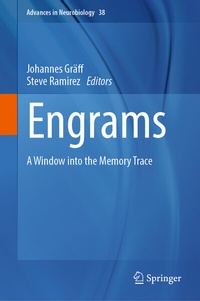
Engrams
Description

This is the first book to extensively explore the current state-of-the-art and promise of engram cells, the closest physical approximation of the memory trace to date. Converging evidence suggests that memories are stored, at least in part, as specific populations of engram cells. In this book, the leading experts in engram biology share their continuously refined insights on how engram cells contribute to information encoding and storage, across diverse brain regions and behavioral modalities. " Engrams: A Window into the Memory Trace " is broad in scope and spans molecular, cellular, circuit, computational as well as societal-philosophical aspects of memory engrams. Particular emphasis is placed on their emerging translational value for memory dysfunctions in age and stress-related disorders.
More details
Other editions
Additional editions
Persons
Johannes Gräff, PhD, is Associate Professor and Director of the Laboratory of Neuroepigenetics at the Brain Mind Institute of the Ecole Polytechnique Federale de Lausanne (EPFL) in Lausanne, Switzerland. Trained as a biologist at the University of Lausanne, Johannes Gräff obtained his PhD in Neuroscience at ETH Zurich before pursuing his postdoctoral studies at the Picower Institute of Learning and Memory at the Massachusetts Institute of Technology in Boston, USA. His laboratory studies the molecular underpinnings of memory formation, storage and change, with a particular emphasis on epigenetic mechanisms.
Steve Ramirez is an Associate Professor of Psychological and Brain Sciences at Boston University and a former Junior Fellow of Harvard University. He received his B.A. in neuroscience from Boston University and went on to receive his Ph.D. in neuroscience at MIT. His lab focuses on imaging and manipulating memories throughout the mammalian brain, with a particular emphasis on artificially modulating memories to alleviate symptoms associated with pathologies of the brain.
Content
Section I: Introduction .- Engrams to remember - A conversation between Johannes and Steve.- Section II: Engram cells and their mnemonic role across different brain structures .- Engrams: From behavior to brain-wide networks.- Memory storage in distributed engram cell ensembles.- Hippocampal engrams and contextual memory.- The role of prefrontal ensembles in memory across time - Time-dependent transformations of prefrontal memory ensembles.- Section III: Insights into intra-engram functioning .- All IEGs are not created equal - Molecular sorting within the memory engram.- Unveiling transcriptional and epigenetic mechanisms within engram cells: Insights into memory formation and stability.- The synaptic engram.- Section IV: Beyond associative learning: Engrams for other memory processes .- Engrams of fear memory attenuation.- Adult neurogenesis, context encoding, and pattern separation: A pathway for treating overgeneralization.- What can hippocampal engrams tell us about encoding spatial navigation?.- Understanding others' distress through past experiences: The role of memory engram cells in observational fear.- Section V: Beyond the neurobiology of engrams .- A computational framework for memory engrams.- Engram studies: A call for historical, philosophical and sociological approaches.- If engrams are the answer, what is the question?.
