

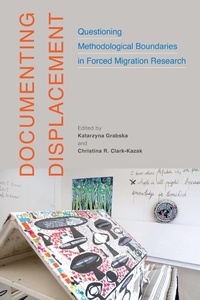
Documenting Displacement
Questioning Methodological Boundaries in Forced Migration Research
1st Edition
Published on 15. February 2022
424 pages
978-0-2280-0950-4 (ISBN)
Description

Legal precarity, mobility, and the criminalization of migrants complicate the study of forced migration and exile. Traditional methodologies can obscure both the agency of displaced people and hierarchies of power between researchers and research participants. This project critically assesses the ways in which knowledge is co-created and reproduced through narratives in spaces of displacement, advancing a creative, collective, and interdisciplinary approach.
Documenting Displacement explores the ethics and methods of research in diverse forced migration contexts and proposes new ways of thinking about and documenting displacement. Each chapter delves into specific ethical and methodological challenges, with particular attention to unequal power relations in the co-creation of knowledge, questions about representation and ownership, and the adaptation of methodological approaches to contexts of mobility. Contributors reflect honestly on what has worked and what has not, providing useful points of discussion for future research by both established and emerging researchers.
Innovative in its use of arts-based methods, Documenting Displacement invites researchers to explore new avenues guided not only by the procedural ethics imposed by academic institutions, but also by a relational ethics that more fully considers the position of the researcher and the interests of those who have been displaced.
Documenting Displacement explores the ethics and methods of research in diverse forced migration contexts and proposes new ways of thinking about and documenting displacement. Each chapter delves into specific ethical and methodological challenges, with particular attention to unequal power relations in the co-creation of knowledge, questions about representation and ownership, and the adaptation of methodological approaches to contexts of mobility. Contributors reflect honestly on what has worked and what has not, providing useful points of discussion for future research by both established and emerging researchers.
Innovative in its use of arts-based methods, Documenting Displacement invites researchers to explore new avenues guided not only by the procedural ethics imposed by academic institutions, but also by a relational ethics that more fully considers the position of the researcher and the interests of those who have been displaced.
Reviews / Votes
"Documenting Displacement advances and challenges our thinking and approach to conducting ethically sound research with people on the move. It effectively questions our more traditional research tools and approaches while providing guidance in how to explore alternatives." Susan McGrath, York UniversityMore details
Series
Language
English
Place of publication
Canada
Canada
Target group
Professional and scholarly
Illustrations
22 photos, 6 diagrams, 2 tables
File size
6,40 MB
ISBN-13
978-0-2280-0950-4 (9780228009504)
Copyright in bibliographic data and cover images is held by Nielsen Book Services Limited or by the publishers or by their respective licensors: all rights reserved.
Schweitzer Classification
Other editions
Additional editions
Katarzyna Grabska | Christina R. Clark-Kazak
Documenting Displacement
Questioning Methodological Boundaries in Forced Migration Research
Book
02/2022
McGill-Queen's University Press
€40.00
Shipment within 15-20 days
Katarzyna Grabska | Christina R. Clark-Kazak
Documenting Displacement
Questioning Methodological Boundaries in Forced Migration Research
Book
02/2022
McGill-Queen's University Press
€172.33
Article not available at the moment
Persons
Katarzyna Grabska is a senior researcher at the Peace Research Institute Oslo. Christina R. Clark-Kazak is associate professor in the Graduate School of Public and International Affairs at the University of Ottawa.
Content
- Cover
- DOCUMENTING DISPLACEMENT
- Title
- Copyright
- Dedication
- Contents
- Figures and Tables
- Acknowledgments
- Introduction: Documenting Displacement beyond Methodological and Ethical Boundaries
- SECTION ONE Ethics, Power, and Knowledge
- 1 Ethical Challenges of Conducting Longitudinal Community-Based Research with Refugees: Reflections from Peer Researchers
- 2 Critical Reflexivity and Decolonizing Narrative: Reflections from the Field
- 3 Exhibiting Displacement: Refugee Art, Methodological Dubiety, and the Responsibility (Not) to Document Loss
- 4 Ethical and Methodological Issues When Conducting Research with Children in Situations of Forced Migration
- 5 Modalities of Knowing in Difficult Circumstances: Methodological and Ethical Parameters of Engagement with Southern/South Sudanese Residing in the Capital of Sudan
- SECTION TWO Reimagining Displacement Research through Creative Collaborative Methodologies
- 6 Sound and Memory: Collaborative Reflection on Using Sound Postcards in Rebuilding Social Fabric with Victims of Forced Displacement in Colombia
- 7 Transient Lives and Lasting Messages: Graffiti Analysis as a Methodological Tool to Capture Migrants' Experiences While on the Move
- 8 In Whose Voice? And for Whom? Collaborative Filming and Narratives of Forced Migration
- 9 Methodological and Ethical Reflections on the Displaces Participatory Photographic Project in the "Calais Jungle"
- 10 Memories, Stories, and Material Traces: Exploring Displacement through Collaging and Participatory Art Installation
- SECTION THREE Crossing Methodological and Disciplinary Boundaries
- 11 Opportunities and Challenges of Using Computer-Based Simulation in Migration and Displacement Research: A focus on Lesbos, Greece
- 12 Overcoming Over-Research: The mmp Approach
- 13 Life Story Narratives, Memory Maps, and Video Stories: Spatial Narratives of Urban Displacement in Sri Lanka
- 14 The Worn Words Project: Narrative Mobilization, Refugee Discourse, and Digital Media Production
- Contributors
- Index
