

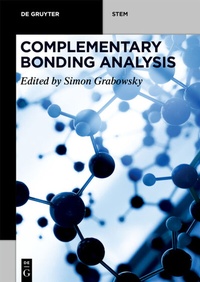
Complementary Bonding Analysis
The Art of Deliberative Listening
1st Edition
Published on 6. April 2021
VIII, 394 pages
978-3-11-066007-4 (ISBN)
Description

As chemical bonds are not observable, there are various theories and models for their description. This book presents a selection of conceptually very different and historically competing views on chemical bonding analysis from quantum chemistry and quantum crystallography. It not only explains the principles and theories behind the methods, but also provides practical examples of how to derive bonding descriptors with modern software and of how to interpret them.
More details
Other editions
Additional editions
Simon Grabowsky
Complementary Bonding Analysis
Book
04/2021
1st Edition
De Gruyter
€61.95
Article exhausted; check different version
Simon Grabowsky
Complementary Bonding Analysis
E-Book
04/2021
1st Edition
De Gruyter
€69.95
Available for download
Person
Simon Grabowsky
, U Bern, Switzerland.
Content
- Intro
- Preface
- Contents
- Part I: The importance of chemical bonding concepts
- 1 Introduction to complementary bonding analysis
- 2 Chemical concepts of bonding and current research problems, or: Why should we bother to engage in chemical bonding analysis?
- Part II: Bonding descriptors from quantum chemistry
- 3 Quantum theory of atoms in molecules and the AIMAll software
- 4 Electron localizability indicator and bonding analysis with DGrid
- 5 Is there a unique way of localizing molecular orbitals, and why not
- 6 Natural bond orbital theory: Discovering chemistry with NBO7
- 7 Valence bond theory with XMVB
- 8 Energy decomposition analysis in the context of quantitative molecular orbital theory
- Part III: Bonding descriptors from quantum crystallography
- 9 Introduction to quantum crystallography
- 10 Multipole modeling with MoPro and XD
- 11 X-ray constrained wavefunction analysis with Tonto
- 12 Introduction to noncovalent interactions
- 13 Beyond Hirshfeld surface analysis: Interaction energies, energy frameworks and lattice energies with CrystalExplorer
- 14 Visualizing non-covalent interactions with NCIPLOT
- Appendix
- Index
- Erratum to: Chapter 2 Chemical concepts of bonding and current research problems, or: Why should we bother to engage in chemical bonding analysis? By Dietmar Stalke
