

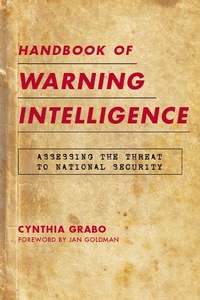
Handbook of Warning Intelligence
Assessing the Threat to National Security
1st Edition
Published on 16. March 2010
326 pages
978-0-8108-7095-6 (ISBN)
Description

Handbook of Warning Intelligence: Assessing the Threat to National Security was written during the cold war and was classified for 40 years. The majority of this manual, however, is now finally available to the general public. An abridged version, Anticipating Surprise: Analysis for Strategic Warning, was published, but this original document goes into much greater detail about the fundamentals of intelligence analysis and forecasting. It discusses military analysis, as well as the difficulties in understanding political, civil, and economic analysis and assessing what it means for analysts to have "warning judgment."
Much of what Grabo writes in her book seems to appear in many of the numerous commission reports that emerged after the 9/11 attacks. However, this book was written in response to the "surprise attack" of the Soviet Union's invasion of Czechoslovakia in 1968. According to the author, that event was no surprise. And while analysts have to take some of the blame for their failure to strenuously present their case that the threat was real and imminent, what occurred was a failure by policymakers to listen to the warning intelligence reports that were written at the time.
Much of what Grabo writes in her book seems to appear in many of the numerous commission reports that emerged after the 9/11 attacks. However, this book was written in response to the "surprise attack" of the Soviet Union's invasion of Czechoslovakia in 1968. According to the author, that event was no surprise. And while analysts have to take some of the blame for their failure to strenuously present their case that the threat was real and imminent, what occurred was a failure by policymakers to listen to the warning intelligence reports that were written at the time.
More details
Series
Edition
1. Auflage
Language
English
Place of publication
Lanham
United States
ISBN-13
978-0-8108-7095-6 (9780810870956)
Copyright in bibliographic data and cover images is held by Nielsen Book Services Limited or by the publishers or by their respective licensors: all rights reserved.
Schweitzer Classification
Other editions
Additional editions
Book
04/2010
Scarecrow Press
€126.00
Shipment within 10-20 days
Book
03/2010
Scarecrow Press
€78.50
Shipment within 10-20 days
Persons
Cynthia Grabo was an intelligence analyst from 1942 to 1979 and the first woman senior intelligence analyst at the Defense Intelligence Agency.
Content
- Intro
- Contents
- Foreword
- Author's Note to Original Edition
- Chapter 1. General Nature of the Problem
- Chapter 2. Definitions of Terms and Their Usage
- Chapter 3. What Warning Is and Is Not
- Chapter 4. Warning and Collection
- Chapter 5. Intentions versus Capabilities
- Chapter 6. Problems of Organization and Management
- Chapter 7. Indicator Lists
- Chapter 8. The Compiling of Indications
- Chapter 9. Can Computers Help?
- Chapter 10. Some Fundamentals of Indications Analysis
- Chapter 11. Some Specifics of the Analytical Method
- Chapter 12. What Makes a Good Warning Analyst?
- Chapter 13. Importance of Military Indications
- Chapter 14. Order-of-Battle Analysis in Crisis Situations
- Chapter 15. Analysis of Mobilization
- Chapter 16. Logistics Is the Queen of Battles
- Chapter 17. Other Factors in Combat Preparations
- Chapter 18. Coping with Extraordinary Military Developments
- Chapter 19. Importance of Political Factors for Warning
- Chapter 20. Basic Political Warning-A Problem of Perception
- Chapter 21. Some Specific Factors in Political Warning
- Chapter 22. Economic Indicators
- Chapter 23. Civil Defense
- Chapter 24. Security, Counter-Intelligence and Agent Preparations
- Chapter 25. Warning from the Totality of Evidence
- Chapter 26. The Impact on Warning of Circumstances Leading to War
- Chapter 27. Reconstructing the Enemy's Decision-Making Process
- Chapter 28. Assessing the Timing of Attack
- Chapter 29. Deception: Can We Cope with It?
- About the Author
