

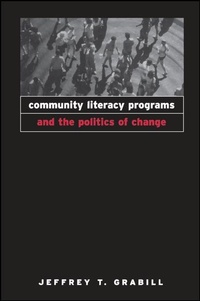
Community Literacy Programs and the Politics of Change
1st Edition
Published on 30. August 2001
221 pages
978-0-7914-9015-0 (ISBN)
Description

An examination of community literacy programs--with an eye toward radical change.
Community Literacy Programs and the Politics of Change argues that the meaning and value of literacy is a function of specific local institutions. At the core of the book is an examination of one institution, Western District Adult Basic Education. Grabill moves between the case of Western District and literacy theory from disciplines like rhetoric, composition, education, sociology, and professional and technical writing in order to develop a theory of institutions and institutional change. The book enables researchers and teachers to locate spaces where change is possible within institutional systems and then work in those spaces to change the meaning and value of literacy.
Jeffrey T. Grabill is Assistant Professor of English at Georgia State University.
Community Literacy Programs and the Politics of Change argues that the meaning and value of literacy is a function of specific local institutions. At the core of the book is an examination of one institution, Western District Adult Basic Education. Grabill moves between the case of Western District and literacy theory from disciplines like rhetoric, composition, education, sociology, and professional and technical writing in order to develop a theory of institutions and institutional change. The book enables researchers and teachers to locate spaces where change is possible within institutional systems and then work in those spaces to change the meaning and value of literacy.
Jeffrey T. Grabill is Assistant Professor of English at Georgia State University.
More details
Other editions
Additional editions
Jeffrey T. Grabill
Community Literacy Programs and the Politics of Change
Book
08/2001
State University of New York Press
€34.00
Shipment within 10-20 days
Jeffrey T. Grabill
Community Literacy Programs and the Politics of Change
Book
08/2001
State University of New York Press
€96.00
Shipment within 10-20 days
Person
Jeffrey T. Grabill is Assistant Professor of English at Georgia State University.
Content
Figures and Tables
Preface
Acknowledgments
1. Disciplinary Gaps, Institutional Power, and Western District Adult Basic Education
2. Locating the Meaning and Value of Literacy
3. Exercising Power: Who Decides Which Literacies Count
4. Utopic Visions, The Technopoor, and Public Access to Networked Writing Technologies: Community Literacy Programs as On-Ramps
5. Community and Community Literacies
6. Participatory Institutional Design
7. Next Steps: Tactics for Change
Notes
References
Index
