

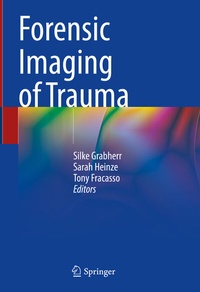
Forensic Imaging of Trauma
Description

Forensic Imaging is increasingly gaining importance in post-mortem and medico-legal investigations, particularly in cases of trauma. Indeed, the digitization of a body, serving as evidence in court, has become standard practice in many countries. To analyze forensic images effectively, one must possess expertise not only in radiological interpretation but also in understanding post-mortem changes as well as the morphology of lesions and their medico-legal implications. Neither of the two disciplines involved, Radiology and Forensic Medicine, can fully provide the necessary knowledge individually. Hence, Forensic Radiology is now recognized as a discipline that integrates both specializations. This book aims to bridge the gap between these two fields by elucidating the morphology of specific trauma-related lesions. It seeks to assist in identifying these lesions in forensic images and interpreting them accurately from a medico-legal perspective.
The introductory chapter clarifies the distinctions between radiological interpretation and medico-legal imaging interpretation. It subsequently presents various techniques used in Forensic Imaging, outlining their respective advantages and limitations. Furthermore, this book is the first to comprehensively cover various types of trauma encountered in forensic medicine, including blunt trauma, sharp trauma, ballistic trauma, thermal trauma and explosions. A separate chapter is dedicated to each of them. Additionally, it addresses specific commonly observed cases such as traffic accidents, asphyxia and child abuse in dedicated chapters.
Each chapter provides a concise summary of the essential medico-legal background and knowledge crucial for the final interpretation. It then outlines the appropriate radiological techniques for investigating the specific trauma and offers practical tips for image acquisition. Radiological findings are subsequently listed and illustrated in corresponding figures. Finally, the book explains the medico-legal interpretation of the observed findings and provides guidance on how to report them.
This book represents a pioneering effort to amalgamate the knowledge of forensic medicine and radiology regarding the interpretation of various trauma cases. It serves as a valuable handbook for every practitioner in this field, offering practical insights from image acquisition to the ultimate interpretation of collected data.
More details
Other editions
Additional editions
Persons
Prof. Silke Grabherr is the Director of the University Center of Legal Medicine (CURML), Lausanne-Geneva, which is a multi-site center, located at 16 different sites in the French speaking part of Switzerland. She is Full Professor at the Faculty of biology and medicine of the University of Lausanne and the Faculty of medicine of the University of Geneva. She is a forensic pathologist, specialized in forensic imaging.
Prof. Sarah Heinze is the Director of the Diagnostic & Research Institute of Forensic Medicine, Graz, Austria. She is Full Professor at the Medical University of Graz. She is a forensic pathologist and radiologist. Her main fields of research and interest are forensic imaging and clinical forensic medicine.
Prof. Tony Fracasso
is a forensic pathologist, professor of legal medicine at the University of Geneva. His main fields of research and interest are forensic histopathology and the pathology of child abuse.
