

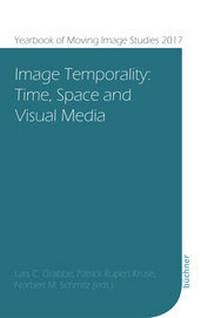
Image Temporality
Time, Space and Visual Media
1st Edition
Published on 17. November 2017
208 pages
978-3-941310-93-3 (ISBN)
Description

Media technology plays a significant role in addressing the different sense modalities of the recipient or user. This role seems to deeply influence our concepts of time and space: The more a media technology is becoming a trigger for sensory and perceptual experiences, the bigger is the influence on temporality and spatiality. Image Temporality could be one part of the temporality discourse to connect the concepts of static and dynamic images with the approaches in modern media theory, philosophy of mind, perceptual theory, aesthetics, and film studies as well as the complex range of image science.This volume monitors and discusses the relation of time, space and visual media within the perspective of an autonomous image science.
More details
Other editions
Additional editions
Lars C. Grabbe | Patrick Rupert-Kruse | Norbert M. Schmitz
Image Temporality
Time, Space and Visual Media
Book
11/2017
1st Edition
Büchner-Verlag
€49.00
Shipment within 10-20 days
Lars C. Grabbe | Patrick Rupert-Kruse | Norbert M. Schmitz
Image Temporality
Time, Space and Visual Media
Book
11/2017
1st Edition
Büchner-Verlag
€29.00
Article exhausted; check different version
Persons
Lars Christian Grabbe studierte Philosophie, Soziologie und Neue Deutsche Literaturwissenschaft und Medienwissenschaften an der Christian-Albrechts-Universität zu Kiel (CAU). Im Jahr 2011 promovierte er an der Technischen Universität Chemnitz zum Thema Georg Simmels Objektwelt. Verstehensmodelle zwischen Geschichtsphilosophie und Ästhetik. Seit 2010 ist er Lehrbeauftragter für "Theorie und Geschichte symbolischer Formen" am Instituts für Kunst-, Design- und Medienwissenschaften (IKDM) der Muthesius-Kunsthochschule in Kiel. Im März 2014 wechselte er zudem an den Fachbereich Design der Fachhochschule Münster als Dozent für Medientheorie und Kommunikation. Dort ist er seit Juni 2017 Professor für Theorie der Wahrnehmung, Kommunikation und Medien. Seine Forschungsschwerpunkte liegen im Bereich der Phänosemiose, Medientheorie und -philosophie, Bildwissenschaft, Wahrnehmungstheorie, Kommunikationstheorie, Ästhetik, Filmwissenschaft.
Patrick Rupert-Kruse, Dr. phil, Professor für Medientheorie und Immersionsforschung am Fachbereich Medien, an der Fachhochschule Kiel; 2010 Dissertation zum Thema Imagination und Empathie, lehrte und forschte an der CAU zu Kiel; Leiter des Instituts für immersive Medien (ifim), seit 2015 Vorsitzender der Gesellschaft für interdisziplinäre Bildwissenschaft (GiB), Gründungsmitglied der Forschungsgruppe Bewegtbildwissenschaft Kiel | Münster und verantwortlicher Redakteur des Jahrbuches immersiver Medien, Managing Editor des Yearbook of Moving Image Studies (YoMIS). Seine Forschungs- und Arbeitsschwerpunkte sind: Theorie immersiver Medien, Medientheorie und -philosophie, Medienwirkungsforschung, Bewegtbildwissenschaft.
Norbert M. Schmitz lehrt als Professor für Ästhetik an der Muthesius - Kunsthochschule. Er hat zwischen 1992 und 1996 als Hochschulassistent am Lehrstuhl für Kunstgeschichte der Bergischen Universität-Gesamthochschule Wuppertal gearbeitet. Im Jahr 2000 war er wissenschaftlicher Mitarbeiter am SFB 240 an der Universität-Gesamthochschule Siegen für das Projekt 'Anschluß - Einschluß - Teilnahme'- Formen interaktiver Medienkunst'.
Patrick Rupert-Kruse, Dr. phil, Professor für Medientheorie und Immersionsforschung am Fachbereich Medien, an der Fachhochschule Kiel; 2010 Dissertation zum Thema Imagination und Empathie, lehrte und forschte an der CAU zu Kiel; Leiter des Instituts für immersive Medien (ifim), seit 2015 Vorsitzender der Gesellschaft für interdisziplinäre Bildwissenschaft (GiB), Gründungsmitglied der Forschungsgruppe Bewegtbildwissenschaft Kiel | Münster und verantwortlicher Redakteur des Jahrbuches immersiver Medien, Managing Editor des Yearbook of Moving Image Studies (YoMIS). Seine Forschungs- und Arbeitsschwerpunkte sind: Theorie immersiver Medien, Medientheorie und -philosophie, Medienwirkungsforschung, Bewegtbildwissenschaft.
Norbert M. Schmitz lehrt als Professor für Ästhetik an der Muthesius - Kunsthochschule. Er hat zwischen 1992 und 1996 als Hochschulassistent am Lehrstuhl für Kunstgeschichte der Bergischen Universität-Gesamthochschule Wuppertal gearbeitet. Im Jahr 2000 war er wissenschaftlicher Mitarbeiter am SFB 240 an der Universität-Gesamthochschule Siegen für das Projekt 'Anschluß - Einschluß - Teilnahme'- Formen interaktiver Medienkunst'.
Content
- Cover
- Contents
- Acknowledgements
- About the Yearbook of Moving Image Studies (YoMIS)
- Introduction
- Media Time as Aesthetic Strategy in Modernism: On the Aesthetics of Time and Media between Avant-Garde Film, Classical Style, and New Media
- Husserl at the Mutoscope:A Phenomenological Regard at the Temporality of Static and Moving Images
- Her Self: Dilemmas of the Post-Human in Spike Jonze's Her
- Hitchcock's Simulacra: Crystallizing the Mental Operations of Rear Window and Vertigo
- Temporal Paradoxes in the Perception of Roy Andersson's Tableau Films
- Time and Media: The Temporal Dynamics of Immersive MediaTechnology
- A Body to Look through: Onto the Spatiotemporal Matters of Attendance
- Mediating the Interval
- Installation Art and the Mobile Embodied Viewer
- Authors
