

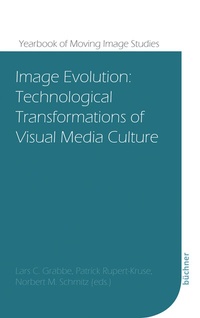
Image Evolution
Technological Transformations of Visual Media Culture
1st Edition
Published on 23. January 2019
190 pages
978-3-96317-670-8 (ISBN)
Description

The history of images can be described as a history of technology and mediality. The development of images is deeply rooted in the potentials of media technologies and the numerous human inventions in the range of traditional craftsmanship, engineering science, computer science, and art and design.
The factual embedding of images in the historical-technological processes constitutes a complex structure of an autonomous »image evolution« that must be highlighted, characterized and analyzed by the interdisciplinary academic discourses that are related to the functions and structures of visuality, pictoriality, and forms of multi-sensoric representations.
The chosen term »evolution« is deliberately indicating structural laws that underlie historical events. These laws are intentional and logical processes of a historical and technological interdependency. In this interdependency, technology is evolving out of its inherent structures and additionally embedded in anthropological conditions and sociocultural dynamics. In this context, we should work with the concept of an »image evolution«.
The factual embedding of images in the historical-technological processes constitutes a complex structure of an autonomous »image evolution« that must be highlighted, characterized and analyzed by the interdisciplinary academic discourses that are related to the functions and structures of visuality, pictoriality, and forms of multi-sensoric representations.
The chosen term »evolution« is deliberately indicating structural laws that underlie historical events. These laws are intentional and logical processes of a historical and technological interdependency. In this interdependency, technology is evolving out of its inherent structures and additionally embedded in anthropological conditions and sociocultural dynamics. In this context, we should work with the concept of an »image evolution«.
More details
Other editions
Additional editions
Lars C. Grabbe | Patrick Rupert-Kruse | Norbert M. Schmitz
Image Evolution
Technological Transformations of Visual Media Culture
Book
01/2019
1st Edition
Büchner-Verlag
€49.00
Shipment within 10-20 days
Persons
Editor
Prof. Dr. Lars C. Grabbe studierte Philosophie, Soziologie und Neue Deutsche Literaturwissenschaft und Medienwissenschaften an der Christian-Albrechts-Universität zu Kiel. 2011 promovierte er an der Technischen Universität Chemnitz zu »Georg Simmels Objektwelt. Verstehensmodelle zwischen Geschichtsphilosophie und Ästhetik.« Ab 2010 war er Lehrbeauftragter für »Theorie und Geschichte symbolischer Formen« am Institut für Kunst-, Design- und Medienwissenschaften der Muthesius-Kunsthochschule in Kiel. 2014 wechselte er zudem an den Fachbereich Design der Fachhochschule Münster als Dozent für Medientheorie und Kommunikation. Dort ist er seit Juni 2017 Professor für Theorie der Wahrnehmung, Kommunikation und Medien. Forschungsschwerpunkte: Phänosemiose, Medientheorie und -philosophie, Bildwissenschaft, Wahrnehmungstheorie, Kommunikationstheorie, Ästhetik, Filmwissenschaft.
ISNI:
ISNI:
Prof. Dr. Patrick Rupert-Kruse, Professor für Medientheorie und Immersionsforschung am Fachbereich Medien an der Fachhochschule Kiel; 2010 Dissertation zum Thema Imagination und Empathie, lehrte und forschte an der CAU zu Kiel; Leiter des Instituts für immersive Medien (ifim), seit 2015 Vorsitzender der Gesellschaft für interdisziplinäre Bildwissenschaft (GiB), Gründungsmitglied der Forschungsgruppe Bewegtbildwissenschaft Kiel und verantwortlicher Redakteur des Jahrbuches immersiver Medien. Forschungs- und Arbeitsschwerpunkte: Theorie immersiver Medien, Medientheorie und -philosophie, Medienwirkungsforschung, Bewegtbildwissenschaft.
ISNI: GND:
ISNI: GND:
Prof. Dr. Norbert M. Schmitz, Professor für Ästhetik an der Muthesius Kunsthochschule in Kiel. Er hat zwischen 1992 und 1996 als Hochschulassistent am Lehrstuhl für Kunstgeschichte der Bergischen Universität- Gesamthochschule Wuppertal gearbeitet. Im Jahr 2000 war er wissenschaftlicher Mitarbeiter am SFB 240 an der Universität- Gesamthochschule Siegen für das Projekt »>Anschluß - Einschluß - Teilnahme< - Formen interaktiver Medienkunst«.
ISNI: GND:
ISNI: GND:
Content
- Cover
- Contents
- Acknowledgements
- About the Yearbook of Moving Image Studies (YoMIS)
- Introduction (Lars C. Grabbe, Patrick Rupert-Kruse & Norbert M. Schmitz)
- The Aesthetics of Virtual Art: A Phenomenological Approach (Fabrizia Bandi)
- Art and Perfect Illusion: From Architecture to Cinema in the Era of Technological Convergence (Christiane Wagner)
- The Rise of Things is the End of Images: A Picture is Worth a Thousand Hands (Andreas Schelske)
- Image Transformation: The Hyperaisthesis of Digital Images (Lars C. Grabbe)
- Orientation and Cartographic Imagination in the Age of the Digital Earth: Notes Toward an Aesthetics of Google Earth (Tommaso Morawski)
- Cinegrams of Premediation: Harun Farocki's Videograms of a Revolution and the Future of Cinema (Dario Cecchi)
- An Economical Model for Theorizing the Perception of Visual Narrative in Digital Cinema (Giorgos Dimitriadis)
- From Images of Lines to Images of Particles: The Role of the Film Camera in Flow Visualization (Mario Schulze & Sarine Waltenspül)
- Authors
