

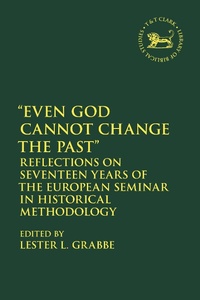
Even God Cannot Change the Past
Reflections on Seventeen Years of the European Seminar in Historical Methodology
1st Edition
Published on 23. August 2018
256 pages
978-0-567-68057-0 (ISBN)
Description

This volume represents the final publication of the European Seminar in Historical Methodology. The volume reflects on the ground-breaking work of this prestigious seminar in the field of biblical history.
In part one, long-term members of the seminar (Bob Becking, Ehud Ben Zvi, Philip R. Davies, Ernst Axel Knauf, Niels Peter Lemche, Thomas L Thompson) provide reflections on its work. Part two presents an opportunity for readers to benefit from contributions that have remained heretofore unpublished. This includes material on the Persian period, questions of orality and writing, and contributions on the Maccabean period. Bringing these papers together in a published form provides a fitting way to round out the work of this significant endeavour in historical methodology.
In part one, long-term members of the seminar (Bob Becking, Ehud Ben Zvi, Philip R. Davies, Ernst Axel Knauf, Niels Peter Lemche, Thomas L Thompson) provide reflections on its work. Part two presents an opportunity for readers to benefit from contributions that have remained heretofore unpublished. This includes material on the Persian period, questions of orality and writing, and contributions on the Maccabean period. Bringing these papers together in a published form provides a fitting way to round out the work of this significant endeavour in historical methodology.
More details
Series
Edition
1. Auflage
Language
English
Place of publication
London
United Kingdom
Publishing group
Bloomsbury Publishing PLC
Target group
College/higher education
ISBN-13
978-0-567-68057-0 (9780567680570)
Copyright in bibliographic data and cover images is held by Nielsen Book Services Limited or by the publishers or by their respective licensors: all rights reserved.
Schweitzer Classification
Other editions
Additional editions
Lester L. Grabbe
Even God Cannot Change the Past
Reflections on Seventeen Years of the European Seminar in Historical Methodology
Book
01/2020
T.& T.Clark Ltd
€49.10
Shipment within 3-4 weeks
Lester L. Grabbe
Even God Cannot Change the Past
Reflections on Seventeen Years of the European Seminar in Historical Methodology
Book
07/2018
T.& T.Clark Ltd
€178.27
Shipment within 3-4 weeks
Person
Lester L. Grabbe is Professor Emeritus of Hebrew Bible and Early Judaism at the University of Hull, UK.
Content
Contributors
Abbreviations
Introduction - Lester L. Grabbe, University of Hull, UK
Part I: Statements on and Evaluations of the Seminar
1. Why Start with the Text? The Fall of Samaria Revisited - Bob Becking, University of Utrecht, Netherlands
2. Clio Today and Ancient Israelite History: Some Thoughts and Observations at the Closing Session of the European Seminar for Historical Methodology - Ehud Ben Zvi, University of Alberta, Canada
3. 'Just the Facts, Ma'am!' Reflections on the ESHM - Philip R. Davies, University of Sheffield, UK
4. Vingt Ans Apres: A Personal Retrospective - Ernst Axel Knauf, University of Bern, Switzerland
5. The Future of Israel's History - Niels Peter Lemche, University of Copenhagen, Denmark
6. The Problem of Israel in the History of the South Levant - Thomas L. Thompson, University of Copenhagen, Denmark
Part II: Tidying Up . . .: Publication of Papers from Sessions Not Published
7. 1997 Session: From the Volume, Leading Captivity Captive (1998)
8. The Exilic Period as an Urgent Case for a Historical Reconstruction Without the Biblical Text - Rainer Albertz, University of Münster, Germany
9. 2008 Session in Libbon on the Oral, the Written, and Cultural Memory
10. Cultural Memory in Practice: Ezra and Nehemiah - Philip R. Davies, University of Sheffield, UK
11. The Oral, the Written, the Forgotten, the Remembered: Studies in Historiography and their Implication for Ancient Israel - Lester L. Grabbe, University of Hull, UK
12. 2011 Session on Thessaloniki on the Maccabees and Thessalonians
13. The Relation between Samaria and Jerusalem in the Early Maccabean Period Revisited: A Case Study about the Reception of Phinehas - Tobias Funke, University of Leipzig, Germany
14. From Philadelphus to Hyrcanus: A Shorter Path between the Formation and the Canonization of Biblical Historiography - Philippe Guillaume, University of Bern, Switzerland
15. Joshua Maccabaeus: Another Reading of 1 Maccabees 5 - Ernst Axel Knauf, University of Münster, Germany
Part III: Conclusion
16. Seventeen Years of the European Seminar in Historical Methodology: A Personal View of the Results - Lester L. Grabbe, University of Hull, UK
Index of References
Index of Authors
Abbreviations
Introduction - Lester L. Grabbe, University of Hull, UK
Part I: Statements on and Evaluations of the Seminar
1. Why Start with the Text? The Fall of Samaria Revisited - Bob Becking, University of Utrecht, Netherlands
2. Clio Today and Ancient Israelite History: Some Thoughts and Observations at the Closing Session of the European Seminar for Historical Methodology - Ehud Ben Zvi, University of Alberta, Canada
3. 'Just the Facts, Ma'am!' Reflections on the ESHM - Philip R. Davies, University of Sheffield, UK
4. Vingt Ans Apres: A Personal Retrospective - Ernst Axel Knauf, University of Bern, Switzerland
5. The Future of Israel's History - Niels Peter Lemche, University of Copenhagen, Denmark
6. The Problem of Israel in the History of the South Levant - Thomas L. Thompson, University of Copenhagen, Denmark
Part II: Tidying Up . . .: Publication of Papers from Sessions Not Published
7. 1997 Session: From the Volume, Leading Captivity Captive (1998)
8. The Exilic Period as an Urgent Case for a Historical Reconstruction Without the Biblical Text - Rainer Albertz, University of Münster, Germany
9. 2008 Session in Libbon on the Oral, the Written, and Cultural Memory
10. Cultural Memory in Practice: Ezra and Nehemiah - Philip R. Davies, University of Sheffield, UK
11. The Oral, the Written, the Forgotten, the Remembered: Studies in Historiography and their Implication for Ancient Israel - Lester L. Grabbe, University of Hull, UK
12. 2011 Session on Thessaloniki on the Maccabees and Thessalonians
13. The Relation between Samaria and Jerusalem in the Early Maccabean Period Revisited: A Case Study about the Reception of Phinehas - Tobias Funke, University of Leipzig, Germany
14. From Philadelphus to Hyrcanus: A Shorter Path between the Formation and the Canonization of Biblical Historiography - Philippe Guillaume, University of Bern, Switzerland
15. Joshua Maccabaeus: Another Reading of 1 Maccabees 5 - Ernst Axel Knauf, University of Münster, Germany
Part III: Conclusion
16. Seventeen Years of the European Seminar in Historical Methodology: A Personal View of the Results - Lester L. Grabbe, University of Hull, UK
Index of References
Index of Authors
