

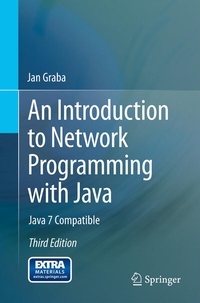
An Introduction to Network Programming with Java
Description

Since the second edition of this text, the use of the Internet and networks generally has continued to expand at a phenomenal rate. This has led to both an increase in demand for network software and to improvements in the technology used to run such networks, with the latter naturally leading to changes in the former. During this time, the Java libraries have been updated to keep up with the new developments in network technology, so that the Java programming language continues to be one of the mainstays of network software development.
In providing a very readable text that avoids getting immersed in low-level technical details, while still providing a useful, practical guide to network programming for both undergraduates and busy IT professionals, this third edition continues the trend of its predecessors. To retain its currency, the text has been updated to reflect changes that have taken place in Java's network technology over the past seven years (including the release of Java 7), whilst retaining its notable features of numerous code examples, screenshots and end-of-chapter exercises.
Reviews / Votes
From the reviews of the third edition:
"The author treats both the network and Java with clarity, sensitivity to readers' needs, and completeness. . This book is an ideal introduction to network programming for readers who are familiar with Java and want to extend their knowledge and capacity, programmers who want a fundamental understanding of how Java can be deployed in network contexts, and students who want to extend their knowledge of Java into the realm of network programming." (Marlin Thomas, Computing Reviews, November, 2013)
More details
Other editions
Additional editions
Previous edition
Content
Preface.- Basic Concepts, Protocols and Terminology.- Starting Network Programming in Java.- Multithreading and Multiplexing.- File Handling.- Remote Method Invocation (RMI).- CORBA.- Java Database Connectivity.- Servlets.- JavaServer Pages (JSPs).- JavaBeans.- Multimedia.- Applets.- Appendix A - Structured Query Language (SQL).- Index.
