

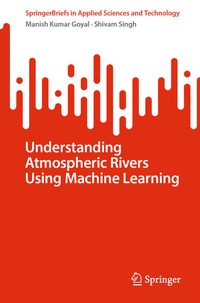
Understanding Atmospheric Rivers Using Machine Learning
Description

This book delves into the characterization, impacts, drivers, and predictability of atmospheric rivers (AR). It begins with the historical background and mechanisms governing AR formation, giving insights into the global and regional perspectives of ARs, observing their varying manifestations across different geographical contexts. The book explores the key characteristics of ARs, from their frequency and duration to intensity, unraveling the intricate relationship between atmospheric rivers and precipitation. The book also focus on the intersection of ARs with large-scale climate oscillations, such as El Niño and La Niña events, the North Atlantic Oscillation (NAO), and the Pacific Decadal Oscillation (PDO). The chapters help understand how these climate phenomena influence AR behavior, offering a nuanced perspective on climate modeling and prediction. The book also covers artificial intelligence (AI) applications, from pattern recognition to prediction modeling and early warning systems. A case study on AR prediction using deep learning models exemplifies the practical applications of AI in this domain. The book culminates by underscoring the interdisciplinary nature of AR research and the synergy between atmospheric science, climatology, and artificial intelligence
More details
Other editions
Additional editions
Persons
Prof. Manish Kumar Goyal is a Chair professor- BIS Standardization and Dean, Infrastructure Development at Indian Institute of Technology Indore. His research interests include water resources engineering, GIS, and remote sensing applications in water and environment and climate change. He received a B.Tech. degree in Civil Engineering from the National Institute of Technology Warangal with distinction and an M.Tech. degree from the Indian Institute of Technology Roorkee. After a brief stint in corporate, he pursued a Ph.D. degree at IIT Roorkee in collaboration with the University of Waterloo, Canada. He went on to pursue further research as a postdoctoral fellow at Nanyang Technological University, Singapore, and McGill University, Canada. He holds more than 100 publications in different domains of GIS and Remote Sensing, Water Resources, Climate Change, Hydrological and Hydrodynamic Modeling, Snow and Glacier Melt, Soil Carbon Sequestration, Anthropogenic Changes, Risk, and Resilience.His name has appeared in Top 2% scientist , list prepared by Stanford University in 2020, 2021, 2022 and 2023.
Content
Understanding Atmospheric Rivers and Exploring Their Role as Climate Extremes.- Characterization and Impacts of Atmospheric Riversharacterization and Impacts of Atmospheric Rivers.- Key Characteristics of Atmospheric Rivers and Associated Precipitation.- Major Large-Scale Climate Oscillations and their Interactions with Atmospheric Rivers.- Role of Machine Learning in Understanding and Managing Atmospheric Rivers.
