

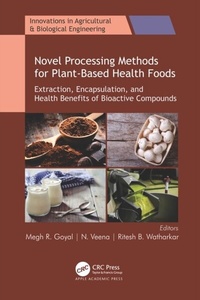
Novel Processing Methods for Plant-Based Health Foods
Extraction, Encapsulation, and Health Benefits of Bioactive Compounds
1st Edition
Published on 10. March 2023
358 pages
978-1-000-57770-9 (ISBN)
Description

This new volume presents an array of new and emerging techniques in the food processing sector, focusing on the extraction, encapsulation, and health benefits of bioactive Compounds. It illustrates various applications of novel food processing extraction and encapsulation techniques along with the health and safety aspects of plant-derived bioactive compounds and functional foods
Some of the sustainable and green extraction techniques discussed include novel extraction techniques, such as microwave-assisted extraction (MAE), ultrasonic assisted extraction (UAE), supercritical fluid extraction (SFE), accelerated solvent extraction (ASE), and rapid solid-liquid extraction (RSLE).
The volume also covers the principles and methods of encapsulation, its role and application in protection and stabilization and as a targeted delivery system for enhanced nutritional health benefits. Various encapsulation methods, such as spray drying, spray cooling/chilling, fluidized bed coating, coacervation, liposome entrapment, extrusion, inclusion complexation, etc., are discussed in detail for application in the food industry.
Novel Processing Methods for Plant-Based Health Foods: Extraction, Encapsulation, and Health Benefits of Bioactive Compounds also highlights the potential of nutraceuticals and biological active compounds in human health, various sources, consumers' acceptance, safety aspects, and their application in development of functional foods.
This volume offers many tremendous applications in different areas of the food industry, including in food processing, preservation, health-promoting properties, and safety and quality evaluation of plant-based foods. The book provides a wealth of information and will be an excellent reference material for researchers, scientists, students, growers, traders, processors, industry professionals, and others on the emerging food processing approaches for extraction and encapsulation of plant-based bioactive compounds and health-promoting properties of plant-derived nutraceuticals and safety aspects in production of functional foods.
Some of the sustainable and green extraction techniques discussed include novel extraction techniques, such as microwave-assisted extraction (MAE), ultrasonic assisted extraction (UAE), supercritical fluid extraction (SFE), accelerated solvent extraction (ASE), and rapid solid-liquid extraction (RSLE).
The volume also covers the principles and methods of encapsulation, its role and application in protection and stabilization and as a targeted delivery system for enhanced nutritional health benefits. Various encapsulation methods, such as spray drying, spray cooling/chilling, fluidized bed coating, coacervation, liposome entrapment, extrusion, inclusion complexation, etc., are discussed in detail for application in the food industry.
Novel Processing Methods for Plant-Based Health Foods: Extraction, Encapsulation, and Health Benefits of Bioactive Compounds also highlights the potential of nutraceuticals and biological active compounds in human health, various sources, consumers' acceptance, safety aspects, and their application in development of functional foods.
This volume offers many tremendous applications in different areas of the food industry, including in food processing, preservation, health-promoting properties, and safety and quality evaluation of plant-based foods. The book provides a wealth of information and will be an excellent reference material for researchers, scientists, students, growers, traders, processors, industry professionals, and others on the emerging food processing approaches for extraction and encapsulation of plant-based bioactive compounds and health-promoting properties of plant-derived nutraceuticals and safety aspects in production of functional foods.
More details
Series
Edition
1. Auflage
Language
English
Place of publication
London
United Kingdom
Publishing group
Taylor & Francis Ltd
Target group
Professional and scholarly
Illustrations
25 Tables, black and white; 5 Line drawings, color; 14 Line drawings, black and white; 9 Halftones, color; 3 Halftones, black and white; 14 Illustrations, color; 17 Illustrations, black and white
ISBN-13
978-1-000-57770-9 (9781000577709)
Copyright in bibliographic data and cover images is held by Nielsen Book Services Limited or by the publishers or by their respective licensors: all rights reserved.
Schweitzer Classification
Other editions
Additional editions
Megh R. Goyal | N. Veena | Ritesh B. Watharkar
Novel Processing Methods for Plant-Based Health Foods
Extraction, Encapsulation, and Health Benefits of Bioactive Compounds
Book
03/2023
1st Edition
Apple Academic Press Inc.
€206.50
Shipment within 3-4 weeks
Persons
Megh R. Goyal, PhD, PE, is a retired professor in Agricultural and Biomedical Engineering from the General Engineering Department in the College of Engineering at the University of Puerto Rico-Mayaguez Campus. He has worked as a Soil Conservation Inspector and as a Research Assistant at Haryana Agricultural University and Ohio State University. He was the first agricultural engineer to receive the professional license in Agricultural Engineering from the College of Engineers and Surveyors of Puerto Rico and was proclaimed as the "Father of Irrigation Engineering in Puerto Rico for the twentieth century" by the ASABE, Puerto Rico Section, for his pioneering work on micro irrigation, evapotranspiration, agroclimatology, and soil and water engineering. During his professional career of over 52 years, he has received many prestigious awards. A prolific author and editor, he has written more than 200 journal articles and several textbooks and has edited over 100 books.
Ritesh Balaso Watharkar, PhD, is an assistant professor in the Department of Food Processing Technology at Karunya Institute of Technology and Sciences, Karunya, Coimbatore, India. He has worked as Senior Visiting Scholar under a UNESCO Great Wall China Fellowship Programme and as Assistant Professor at K. K. Wagh Food Tech College and at Shramshakti College of Food Technology, affiliated by Mahatma Phule Agricultural University. He has published several articles in reputed journals and has attended more than 10 national and international conferences. He also published several popular articles. He is a life member of Association of Food Scientist and Technologist, India.
N. Veena, PhD, is an assistant professor in the Department of Dairy Chemistry at the College of Dairy Science and Technology, Guru Angad Dev Veterinary and Animal Sciences University, Ludhiana, Punjab, India. Her area of expertise includes fortification of milk, development and characterization of functional dairy foods, and nanoencapsulation of nutraceuticals and their delivery. She is the recipient of junior research and institutional fellowships during her master and doctoral programs from the ICAR "National Dairy Research Institute, Karnal, Haryana, India. She has been involved in different institutional and externally funded research projects such as Milkfed (Punjab), ICAR, DST and RKVY as PI and Co-PI. Dr. Veena has published 17 research papers in peer-reviewed journals, one edited book, 11 book chapters, 15 popular articles, and seven practical manuals. She has developed e-learning content for postgraduate dairy chemistry courses under the NAHEP project. She has presented her research work at various national and international seminars and conferences and has received several awards for best oral and poster presentations. She has membership in various professional bodies, such the Indian Dairy Association, Association of Food Scientists and Technologists (India) and Dairy Technology Society of India, etc. She received her BTech degree in Dairy Technology from Karnataka Veterinary, Animal and Fisheries Sciences University, Bidar, Karnataka, India, and her MTech and PhD degrees in Dairy Chemistry from ICAR-National Dairy Research Institute, Karnal, Haryana, India.
Ritesh Balaso Watharkar, PhD, is an assistant professor in the Department of Food Processing Technology at Karunya Institute of Technology and Sciences, Karunya, Coimbatore, India. He has worked as Senior Visiting Scholar under a UNESCO Great Wall China Fellowship Programme and as Assistant Professor at K. K. Wagh Food Tech College and at Shramshakti College of Food Technology, affiliated by Mahatma Phule Agricultural University. He has published several articles in reputed journals and has attended more than 10 national and international conferences. He also published several popular articles. He is a life member of Association of Food Scientist and Technologist, India.
N. Veena, PhD, is an assistant professor in the Department of Dairy Chemistry at the College of Dairy Science and Technology, Guru Angad Dev Veterinary and Animal Sciences University, Ludhiana, Punjab, India. Her area of expertise includes fortification of milk, development and characterization of functional dairy foods, and nanoencapsulation of nutraceuticals and their delivery. She is the recipient of junior research and institutional fellowships during her master and doctoral programs from the ICAR "National Dairy Research Institute, Karnal, Haryana, India. She has been involved in different institutional and externally funded research projects such as Milkfed (Punjab), ICAR, DST and RKVY as PI and Co-PI. Dr. Veena has published 17 research papers in peer-reviewed journals, one edited book, 11 book chapters, 15 popular articles, and seven practical manuals. She has developed e-learning content for postgraduate dairy chemistry courses under the NAHEP project. She has presented her research work at various national and international seminars and conferences and has received several awards for best oral and poster presentations. She has membership in various professional bodies, such the Indian Dairy Association, Association of Food Scientists and Technologists (India) and Dairy Technology Society of India, etc. She received her BTech degree in Dairy Technology from Karnataka Veterinary, Animal and Fisheries Sciences University, Bidar, Karnataka, India, and her MTech and PhD degrees in Dairy Chemistry from ICAR-National Dairy Research Institute, Karnal, Haryana, India.
Content
Part I: Novel Extraction Methods for Bioactive Compounds 1. Principles and Applications of Extraction Technologies in the Food Industry 2. Novel Extraction Methods: Profiling of Natural Phytochemicals 3. Extraction of Value-Added and High-Value Food Products. 4. Ultrasonic-Assisted Extraction of Polyphenols from Food Processing Wastes Part II: Encapsulation Methods for Bioactive Compounds 5. Encapsulation Technologies: Principles and Applications in the Food Industry 6. Encapsulation of Natural Polyphenols for Food Applications 7. Microencapsulation of Natural Pigments Part III: Health Promoting Activities of Bioactive Compounds 8. Role of Phytochemicals in Human Health 9. Nutraceuticals with Health-Promoting Activities 10. Functional and Nutraceutical Foods: Health and Safety Aspects 11. Edible Mushroom Phenolics: Health and Future Perspectives 12. Nutritional Constituents and In Vitro Antioxidant Activities of Selected Wild Edible Fruits 13. Delivery of Probiotics in the Food Industries
