

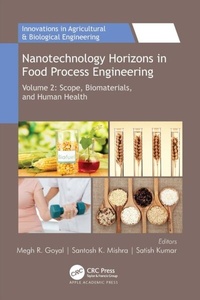
Nanotechnology Horizons in Food Process Engineering
Volume 2: Scope, Biomaterials, and Human Health
1st Edition
Published on 10. March 2023
450 pages
978-1-000-61437-4 (ISBN)
Description

Although nanotechnology has revolutionized fields such as medicine, genetics, biology, bioengineering, mechanics, and chemistry, its increasing application in the food industry is relatively recent in comparison. Nanotechnology in the food industry is now being explored for creating new flavors, extending food shelf life, and improving food protection and nutritional value, as well as for intelligent nutrient delivery systems, "smart" foods, contaminant detection nanodevices and nanosensors, advanced food processing, antimicrobial chemicals, encapsulation, and green nanomaterials.
This new three-volume set addresses a multitude of topical issues and new developments in the field. Volume 1 focuses on food preservation, food packaging and sustainable agriculture, while Volume 2 looks at nanotechnology in food process engineering, applications of biomaterials in food products, and the use of modern nanotechnology for human health. The third volume explores the newest trends in nanotechnology for food applications and their application for improving food delivery systems.
Together, these three volumes provide a comprehensive and in-depth look at the emerging status of nanotechnology in the food processing industry, explaining the benefits and drawbacks of various methodologies that will aid in the improvement and development of food product sourcing and food hygiene monitoring methods.
Volume 2 discusses nanotechnology use in non-thermal techniques such as high-pressure processing (HPP), pulsed electric fields (PEFs), pulsed light, ultraviolet, microwave, ohmic heating, electrospinning, and nano- and microencapsulation. This volume looks at the role and application of minimal processing techniques such as ozone treatment, vacuum drying, osmotic dehydration, dense phase carbon dioxide treatment, and high-pressure assisted freezing. The successful applications of nanotechnologies on juices, meat and fish, fruits and vegetable slices, food surface, purees, milk and milk products, extraction, drying enhancement, and encapsulation of micro-macro nutrients are also considered. The volume also presents several computer-aided techniques that are emerging in the food processing sector, such as robotics, radio frequency identification (RFID), three-dimensional food printing, artificial intelligence, etc. Significant role of food properties in design of specific food and edible packaging films have been elucidated.
This new three-volume set addresses a multitude of topical issues and new developments in the field. Volume 1 focuses on food preservation, food packaging and sustainable agriculture, while Volume 2 looks at nanotechnology in food process engineering, applications of biomaterials in food products, and the use of modern nanotechnology for human health. The third volume explores the newest trends in nanotechnology for food applications and their application for improving food delivery systems.
Together, these three volumes provide a comprehensive and in-depth look at the emerging status of nanotechnology in the food processing industry, explaining the benefits and drawbacks of various methodologies that will aid in the improvement and development of food product sourcing and food hygiene monitoring methods.
Volume 2 discusses nanotechnology use in non-thermal techniques such as high-pressure processing (HPP), pulsed electric fields (PEFs), pulsed light, ultraviolet, microwave, ohmic heating, electrospinning, and nano- and microencapsulation. This volume looks at the role and application of minimal processing techniques such as ozone treatment, vacuum drying, osmotic dehydration, dense phase carbon dioxide treatment, and high-pressure assisted freezing. The successful applications of nanotechnologies on juices, meat and fish, fruits and vegetable slices, food surface, purees, milk and milk products, extraction, drying enhancement, and encapsulation of micro-macro nutrients are also considered. The volume also presents several computer-aided techniques that are emerging in the food processing sector, such as robotics, radio frequency identification (RFID), three-dimensional food printing, artificial intelligence, etc. Significant role of food properties in design of specific food and edible packaging films have been elucidated.
More details
Series
Edition
1. Auflage
Language
English
Place of publication
London
United Kingdom
Publishing group
Taylor & Francis Ltd
Target group
Professional and scholarly
Illustrations
18 Tables, black and white; 29 Line drawings, color; 9 Line drawings, black and white; 3 Halftones, black and white; 29 Illustrations, color; 12 Illustrations, black and white
ISBN-13
978-1-000-61437-4 (9781000614374)
Copyright in bibliographic data and cover images is held by Nielsen Book Services Limited or by the publishers or by their respective licensors: all rights reserved.
Schweitzer Classification
Other editions
Additional editions
Megh R. Goyal | Santosh K. Mishra | Satish Kumar
Nanotechnology Horizons in Food Process Engineering
Volume 2: Scope, Biomaterials, and Human Health
Book
03/2023
1st Edition
Apple Academic Press Inc.
€206.50
Shipment within 3-4 weeks
Persons
Megh R. Goyal, PhD, PE, is a Retired Professor in Agricultural and Biomedical Engineering from the General Engineering Department in the College of Engineering at the University of Puerto Rico-Mayaguez Campus. He was proclaimed as the "Father of Irrigation Engineering in Puerto Rico for the twentieth century" by the ASABE, Puerto Rico Section, for his pioneering work on micro irrigation, evapotranspiration, agroclimatology, and soil and water engineering. A prolific author and editor, he has written more than 200 journal articles and several textbooks and has edited over 100 books.
Santosh K. Mishra, PhD, is an Assistant Professor in the Department of Dairy Microbiology at the College of Dairy Science and Technology at Guru Angad Dev Veterinary and Animal Sciences University, Ludhiana, Punjab, India. He has served in the dairy industry as a Quality Assurance Executive at Mother Dairy, New Delhi, and has handled several externally funded projects. He has published research, review, and popular articles in national and international journals as well as several book chapters and teaching reviews in various training programs.
Satish Kumar, PhD, is an Assistant Professor (Food Science and Technology) at the College of Horticulture and Forestry at Dr. Y. S. Parmar University of Horticulture and Forestry in Himachal Pradesh, India. Dr. Kumar served at Lovely Professional University, Phagwara-Punjab, India, as Assistant Professor (Food Technology and Nutrition). He has participated in several national and international conferences, seminars, workshops, training, symposiums, etc. He has to his credit research papers, book chapters, conference papers, and abstracts.
Santosh K. Mishra, PhD, is an Assistant Professor in the Department of Dairy Microbiology at the College of Dairy Science and Technology at Guru Angad Dev Veterinary and Animal Sciences University, Ludhiana, Punjab, India. He has served in the dairy industry as a Quality Assurance Executive at Mother Dairy, New Delhi, and has handled several externally funded projects. He has published research, review, and popular articles in national and international journals as well as several book chapters and teaching reviews in various training programs.
Satish Kumar, PhD, is an Assistant Professor (Food Science and Technology) at the College of Horticulture and Forestry at Dr. Y. S. Parmar University of Horticulture and Forestry in Himachal Pradesh, India. Dr. Kumar served at Lovely Professional University, Phagwara-Punjab, India, as Assistant Professor (Food Technology and Nutrition). He has participated in several national and international conferences, seminars, workshops, training, symposiums, etc. He has to his credit research papers, book chapters, conference papers, and abstracts.
Content
Part 1: Scope of Nanotechnology in Food Process Engineering 1. Scope of Metal Chalcogenide Nanomaterials in Food Processing Technologies 2. Flavan-3-Ols Research: From Chemistry to Nanomedicine 3. Potential of Carbon Nanotubes for Green Applications Part 2: Applications of Biomaterials in Food Products 4. Nanotechnology for Cereal-Based Food Products 5. Nanostructure Materials for Food Enrichment and Fortification 6. Applications of Nanomaterials in Food Packaging Systems 7. Recent Advances in Nano/Micro-Emulsion Delivered Curcumin: A Focus on Improved Anticancer and Antioxidant Responses 8. Edible Nanoemulsion Coating Materials: Potential in Fresh Fruits and Vegetables Part 3: Modern Nanotechnology for Human Health 9. Scope of Nanotechnology in Human Health 10. Nanotechnology Applications in Biological Engineering: Plant Health Management
