

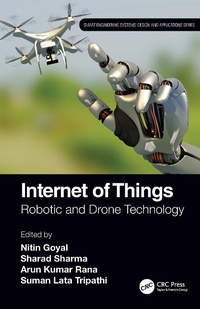
Internet of Things
Robotic and Drone Technology
1st Edition
Published on 1. February 2022
288 pages
978-1-000-45015-6 (ISBN)
Description

This reference text discusses intelligent robotic and drone technology with embedded Internet of Things (IoT) for smart applications.
The text discusses future directions of optimization methods with various engineering and science fundamentals used in robotics and drone-based applications. Its emphasis is on covering deep learning and similar models of neural network-based learning techniques employed in solving optimization problems of different engineering and science applications. It covers important topics including sensors and actuators in the internet of things (IoT), internet-of-robotics-things (IoRT), IoT in agriculture and food processing, routing challenges in flying Ad-hoc networks, and smart cities.
The book will serve as a useful text for graduate students and professionals in the fields of electrical engineering, electronics engineering, computer science, and mechanical engineering.
The text discusses future directions of optimization methods with various engineering and science fundamentals used in robotics and drone-based applications. Its emphasis is on covering deep learning and similar models of neural network-based learning techniques employed in solving optimization problems of different engineering and science applications. It covers important topics including sensors and actuators in the internet of things (IoT), internet-of-robotics-things (IoRT), IoT in agriculture and food processing, routing challenges in flying Ad-hoc networks, and smart cities.
The book will serve as a useful text for graduate students and professionals in the fields of electrical engineering, electronics engineering, computer science, and mechanical engineering.
More details
Series
Edition
1. Auflage
Language
English
Place of publication
London
United Kingdom
Publishing group
Taylor & Francis Ltd
Target group
College/higher education
Professional and scholarly
Product notice
Reflowable
Illustrations
11 Tables, black and white; 99 Line drawings, black and white; 48 Halftones, black and white; 147 Illustrations, black and white
ISBN-13
978-1-000-45015-6 (9781000450156)
Copyright in bibliographic data and cover images is held by Nielsen Book Services Limited or by the publishers or by their respective licensors: all rights reserved.
Schweitzer Classification
Other editions
Additional editions
Book
10/2024
1st Edition
CRC Press
€73.70
Shipment within 10-20 days
Book
02/2022
1st Edition
CRC Press
€171.30
Shipment within 15-20 days
Persons
Nitin Goyal is currently working as an associate professor, Chitkara University Research and Innovation Network (CURIN), Chitkara University, Punjab, India. He is specialized in underwater wireless sensor networks (UWSN), having applications of military operations. He worked on wireless sensor networks (WSN), mobile ad-hoc network (MANET), etc. He is having around 11 years of teaching and research experience and has published approximately 40 research papers in various International/National Journals, Books and Conferences out of which 5 are SCI, 4 are SCOPUS, 4 are SCOPUS indexed book chapters. He is currently working in the area of machine learning, IoT, IoD in communication networks to solve some real-world problems.
Sharad Sharma is currently working as head, department of electronics and communication engineering, Maharishi Markandeshwar (Deemed to be University), India. He has more than 20 years of teaching and research experience. He has conducted workshops on Soft Computing and its applications in engineering, Wireless Networks, Simulators, etc. He has a keen interest in teaching and implementing the latest techniques related to wireless and mobile Communications. His research interests are routing protocol design, performance evaluation, and optimization for wireless mesh networks using nature-inspired computing, Internet of Things and Space Communication, etc.
Arun Kumar Rana is currently working as an assistant professor, Panipat Institute of Engineering & Technology, Samalkha, India. He has more than 13 years of teaching and research experience. He has published around 50 papers in National and International Journals and also in conferences. His area of interest includes image processing, wireless sensor network, Internet of Things, artificial intelligence, machine learning, and embedded systems. He is also a member of the Asia Society of Research.
Suman Lata Tripathi is presently working as a professor, School of Electronics and Electrical Engineering, Lovely Professional University, Punjab, India. She has more than seventeen years of teaching and research experience and has published more than 45 research papers in refereed journals and conferences. She has been nominated for the "Research Excellence Award" in 2019 at Lovely professional university. She had received the best paper at IEEE ICICS-2018. She has published an edited book titled "Recent advancement in Electronic Device, Circuit and Materials" by Nova science publishers. She has also submitted edited books, "Advanced VLSI Design and Testability Issues" and "Electronic Devices and Circuit Design Challenges for IoT application" in CRC Taylor & Francis and Apple Academic Press. She is also associated as an editor of book Series on "Green Energy: Fundamentals, Concepts, and Applications" and " Design and development of Energy efficient systems" to be published by Scrivener Publishing, Wiley (In production). She is currently working on two accepted book proposals specifically on biomedical engineering with Elsevier and CRC Press. She is also associated with Wiley-IEEE for her multi-authored (ongoing) book in the area of VLSI design with HDLs. Her area of expertise includes microelectronics device modeling and characterization, low power VLSI circuit design, VLSI design of testing, and advance FET design for IoT, Embedded System Design, and biomedical applications.
Sharad Sharma is currently working as head, department of electronics and communication engineering, Maharishi Markandeshwar (Deemed to be University), India. He has more than 20 years of teaching and research experience. He has conducted workshops on Soft Computing and its applications in engineering, Wireless Networks, Simulators, etc. He has a keen interest in teaching and implementing the latest techniques related to wireless and mobile Communications. His research interests are routing protocol design, performance evaluation, and optimization for wireless mesh networks using nature-inspired computing, Internet of Things and Space Communication, etc.
Arun Kumar Rana is currently working as an assistant professor, Panipat Institute of Engineering & Technology, Samalkha, India. He has more than 13 years of teaching and research experience. He has published around 50 papers in National and International Journals and also in conferences. His area of interest includes image processing, wireless sensor network, Internet of Things, artificial intelligence, machine learning, and embedded systems. He is also a member of the Asia Society of Research.
Suman Lata Tripathi is presently working as a professor, School of Electronics and Electrical Engineering, Lovely Professional University, Punjab, India. She has more than seventeen years of teaching and research experience and has published more than 45 research papers in refereed journals and conferences. She has been nominated for the "Research Excellence Award" in 2019 at Lovely professional university. She had received the best paper at IEEE ICICS-2018. She has published an edited book titled "Recent advancement in Electronic Device, Circuit and Materials" by Nova science publishers. She has also submitted edited books, "Advanced VLSI Design and Testability Issues" and "Electronic Devices and Circuit Design Challenges for IoT application" in CRC Taylor & Francis and Apple Academic Press. She is also associated as an editor of book Series on "Green Energy: Fundamentals, Concepts, and Applications" and " Design and development of Energy efficient systems" to be published by Scrivener Publishing, Wiley (In production). She is currently working on two accepted book proposals specifically on biomedical engineering with Elsevier and CRC Press. She is also associated with Wiley-IEEE for her multi-authored (ongoing) book in the area of VLSI design with HDLs. Her area of expertise includes microelectronics device modeling and characterization, low power VLSI circuit design, VLSI design of testing, and advance FET design for IoT, Embedded System Design, and biomedical applications.
Content
1. Internet of Robotic Things. 2. Internet of Robotic Things for Security. 3. Internet of Robotic Things based Disease Prediction and Diagnosis System for Healthcare Architecture. 4. Technological Advances in Robotic. 5. AI and Machine Learning in Robotics. 6. Sensors and Actuators in Robotics. 7. Security, Privacy, and Reliability in Robotics. 8. Flying Adhoc Networks in IoT. 9. Routing Challenges in Flying Adhoc Networks. 10. Implementation and Deployment of 5G-drone Setups. 11. Sensors and Actuators in Drones. 12. Data Collection, Analytics, Processing for Drones. 13. AI and Machine Learning in Drones. 14. Content Delivery Technologies for Drones. 15. Smart Cities and IoD. 16. Cloud and Big Data Technologies for IoD. 17. Security, Cryptography, and Privacy in IoD. 18. Internet of Robotic Things in Agriculture and Food Processing.
