

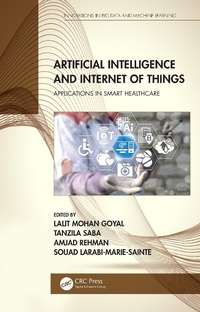
Artificial Intelligence and Internet of Things
Applications in Smart Healthcare
1st Edition
Published on 25. August 2021
398 pages
978-1-000-38635-6 (ISBN)
Description

This book reveals the applications of AI and IoT in smart healthcare and medical systems. It provides core principles, algorithms, protocols, emerging trends, security problems, and the latest e-healthcare services findings.
The book also provides case studies and discusses how AI and IoT applications such as wireless devices, sensors, and deep learning could play a major role in assisting patients, doctors, and pharmaceutical staff. It focuses on how to use AI and IoT to keep patients safe and healthy and, at the same time, empower physicians to deliver superlative care.
This book is written for researchers and practitioners working in the information technology, computer science, and medical equipment manufacturing industry for products and services having basic- and high-level AI and IoT applications. The book is also a useful guide for academic researchers and students.
The book also provides case studies and discusses how AI and IoT applications such as wireless devices, sensors, and deep learning could play a major role in assisting patients, doctors, and pharmaceutical staff. It focuses on how to use AI and IoT to keep patients safe and healthy and, at the same time, empower physicians to deliver superlative care.
This book is written for researchers and practitioners working in the information technology, computer science, and medical equipment manufacturing industry for products and services having basic- and high-level AI and IoT applications. The book is also a useful guide for academic researchers and students.
More details
Series
Edition
1. Auflage
Language
English
Place of publication
London
United Kingdom
Publishing group
Taylor & Francis Ltd
Target group
Professional and scholarly
Illustrations
48 Tables, black and white; 43 Line drawings, black and white; 44 Halftones, black and white; 80 Illustrations, black and white
ISBN-13
978-1-000-38635-6 (9781000386356)
Copyright in bibliographic data and cover images is held by Nielsen Book Services Limited or by the publishers or by their respective licensors: all rights reserved.
Schweitzer Classification
Other editions
Additional editions
Lalit Mohan Goyal | Tanzila Saba | Amjad Rehman
Artificial Intelligence and Internet of Things
Applications in Smart Healthcare
Book
10/2024
1st Edition
CRC Press
€81.60
Shipment within 15-20 days
Lalit Mohan Goyal | Tanzila Saba | Amjad Rehman
Artificial Intelligence and Internet of Things
Applications in Smart Healthcare
Book
08/2021
1st Edition
CRC Press
€243.00
Shipment within 15-20 days
Persons
Lalit Mohan Goyal received BTech (Hons.) in computer engineering from Kurukshetra University, Kurukshetra; MTech (Hons.) in information technology from Guru Gobind Singh Indraprastha University, New Delhi; and PhD in computer engineering from Jamia Millia Islamia, New Delhi. He has 16 years of teaching experience in the area of theory of computation, parallel and random algorithms, distributed data mining, and cloud computing. He is currently with the Department of Computer Engineering, J.C. Bose University of Science and Technology, YMCA, Faridabad, India. He is currently working on the project sponsored by the Indian Council of Medical Research, Delhi. He has published research papers in SCI indexed and Scopus indexed journals and conferences. He is a reviewer of many reputed journals and conferences.
Tanzila Saba earned her PhD in document information security and management from Faculty of Computing, Universiti Teknologi Malaysia (UTM), Malaysia in 2012. She won the best student award in the Faculty of Computing, UTM for 2012. Currently, she is serving as an Associate Chair of Information Systems Department in the College of Computer and Information Sciences, Prince Sultan University Riyadh, Saudi Arabia. Her primary focuses of research focuses in recent years are medical imaging, pattern recognition, data mining, MRI analysis, and soft-computing. She has above 200 publications that have above 5000 citations with h-index 46. Her mostly publications are in biomedical research published in ISI/SCIE indexed. Due to her excellent research achievement, she is included in Marquis Who's Who (S & T) 2012. Currently, she is an editor and reviewer of reputed journals and on the panel of TPC of international conferences. She has full command of a variety of subjects and taught several courses at the graduate and postgraduate levels. On the accreditation side, she is a skilled lady with ABET and NCAAA quality assurance. She is the senior member of IEEE. Dr. Tanzila is the leader of the Artificial Intelligence and Data Analytics Research Lab at PSU and active professional members of ACM, AIS, and IAENG organizations. She is the PSU WiDS (Women in Data Science) ambassador at Stanford University and Global Women Tech Conference. She earned the best researcher award at PSU for consecutive 4 years. She has been nominated as a Research Professor at PSU since September 2019.
Amjad Rehman is a Senior Researcher in the Artificial Intelligence and Data Analytics Lab, Prince Sultan University, Riyadh, Saudi Arabia. He received his PhD and Postdoc from Faculty of Computing, Universiti Teknologi Malaysia with specialization in Forensic Documents Analysis and Security with honors in 2010 and 2011, respectively. He received the Rector Award 2010 for best student in the university. Currently, he is PI in several funded projects and also completed projects funded from MOHE, Malaysia, Saudi Arabia. His keen interests are in data mining, health informatics, and pattern recognition. He is author of more than 200 ISI journal papers, conferences and is a senior member of IEEE with h-index 44.
Souad Larabi-Marie-Sainte graduated in operational research from the University of Sciences and Technology Houari Boumediene, Algeria. She received dual MSc in mathematics, decision and organization from Paris Dauphine University, France, and in computing and applications from Sorbonne Paris 1 University, France, and PhD in bioinspired algorithms (artificial intelligence) from the Computer Science Department, Toulouse 1 University Capitole, France, in 2011. She was an Assistant Professor with the College of Computer and Information Sciences, King Saud University. She was also an Associate Researcher with the Department of Computer Science, Toulouse 1 University Capitole, France. She is currently an Assistant Professor with the Department of Computer Science, Associate Director of Software Engineering and Cyber Security Master Programs, and Vice-Chair of the ACM Professional Chapter at Prince Sultan University. She has written several articles and has attended various specialized international conferences. She has also participated in several research projects. Her research interests include combinatorial optimization, metaheuristics, artificial intelligence and especially bioinspired algorithms applied to multidisciplinary domains, algorithms analysis and design, bioinformatics, data mining, machine and deep learning, biometric identification, natural language processing, and software engineering.
Tanzila Saba earned her PhD in document information security and management from Faculty of Computing, Universiti Teknologi Malaysia (UTM), Malaysia in 2012. She won the best student award in the Faculty of Computing, UTM for 2012. Currently, she is serving as an Associate Chair of Information Systems Department in the College of Computer and Information Sciences, Prince Sultan University Riyadh, Saudi Arabia. Her primary focuses of research focuses in recent years are medical imaging, pattern recognition, data mining, MRI analysis, and soft-computing. She has above 200 publications that have above 5000 citations with h-index 46. Her mostly publications are in biomedical research published in ISI/SCIE indexed. Due to her excellent research achievement, she is included in Marquis Who's Who (S & T) 2012. Currently, she is an editor and reviewer of reputed journals and on the panel of TPC of international conferences. She has full command of a variety of subjects and taught several courses at the graduate and postgraduate levels. On the accreditation side, she is a skilled lady with ABET and NCAAA quality assurance. She is the senior member of IEEE. Dr. Tanzila is the leader of the Artificial Intelligence and Data Analytics Research Lab at PSU and active professional members of ACM, AIS, and IAENG organizations. She is the PSU WiDS (Women in Data Science) ambassador at Stanford University and Global Women Tech Conference. She earned the best researcher award at PSU for consecutive 4 years. She has been nominated as a Research Professor at PSU since September 2019.
Amjad Rehman is a Senior Researcher in the Artificial Intelligence and Data Analytics Lab, Prince Sultan University, Riyadh, Saudi Arabia. He received his PhD and Postdoc from Faculty of Computing, Universiti Teknologi Malaysia with specialization in Forensic Documents Analysis and Security with honors in 2010 and 2011, respectively. He received the Rector Award 2010 for best student in the university. Currently, he is PI in several funded projects and also completed projects funded from MOHE, Malaysia, Saudi Arabia. His keen interests are in data mining, health informatics, and pattern recognition. He is author of more than 200 ISI journal papers, conferences and is a senior member of IEEE with h-index 44.
Souad Larabi-Marie-Sainte graduated in operational research from the University of Sciences and Technology Houari Boumediene, Algeria. She received dual MSc in mathematics, decision and organization from Paris Dauphine University, France, and in computing and applications from Sorbonne Paris 1 University, France, and PhD in bioinspired algorithms (artificial intelligence) from the Computer Science Department, Toulouse 1 University Capitole, France, in 2011. She was an Assistant Professor with the College of Computer and Information Sciences, King Saud University. She was also an Associate Researcher with the Department of Computer Science, Toulouse 1 University Capitole, France. She is currently an Assistant Professor with the Department of Computer Science, Associate Director of Software Engineering and Cyber Security Master Programs, and Vice-Chair of the ACM Professional Chapter at Prince Sultan University. She has written several articles and has attended various specialized international conferences. She has also participated in several research projects. Her research interests include combinatorial optimization, metaheuristics, artificial intelligence and especially bioinspired algorithms applied to multidisciplinary domains, algorithms analysis and design, bioinformatics, data mining, machine and deep learning, biometric identification, natural language processing, and software engineering.
Content
PART I: AI Applications in Healthcare
Chapter 1: AI Technologies in Health-care Applications
Sajid Iqbal, Mehreen Tariq, Hareem Ayesha, Noor Ayesha
Chapter 2: Two-Level Breast Cancer Staging Diagnosis
Sahar Bayoumi, Sanaa Ghouzali, Souad Larabi-Marie-Sainte, Hanaa Kamel
Chapter 3: Breast Cancer Diagnostic Analysis based on Convolutional Neural Networks
Muhammad Kashif, Amjad Rehman, Tariq Sadad, Zahid Mehmood
Chapter 4: Automated Medical Image Analysis in Digital Mammography
Mohsen Karimi, Majid Harouni, Shadi Rafieipour
Chapter 5: Precise Segmentation Techniques in Various Medical Images
Majid Harouni, Mohsen Karimi, Shadi Rafieipour
Chapter 6: Lung Cancer Detection and Diagnosis based on Deep Learning Models Evaluation
Tanzila Saba, Muhammad Kashif, Hind Alaskar, Erum Afzal
Chapter 7: Image-Based Glioblastoma Segmentation-Traditional versus Deep Learning Approaches: Analysis, Comparisons and Future Look
Amjad Rehman
Chapter 8: Artificial Intelligence Techniques for Glaucoma Detection Through Retinal Images-State of the Art
Ayesha Shoukat and Shahzad Akbar
Chapter 9: Artificial Intelligence in Brain Tumor Detection Through MRI Images-Advancements and Challenges
Sahar Gull and Shahzad Akbar
PART II: IoT Applications in Healthcare
Chapter 10: An Empirical Study of Domain, Design and Security of Remote-Health-Monitoring Cyber-Physical Systems
Albatool Al-katrang, Shahed Al-kharsa, Einaas Kharsah, Anees Ara
Chapter 11: IoT Security and Privacy Issues-A Game of Catch-Up
Atheer Almogbil
Chapter 12: Internet of Things for Mitigating Climate Change Impacts on Health
Rehab A. Rayan, Romash B. Iryna, Christos Tsagkaris, Imran Zafar
Chapter 13: Automated Hybrid Recommender System for Cardiovascular Disease with Applications in Smart Healthcare
Fouzia Jabeen, Zahid Mehmood, Muhammad Tahir, Rehan Mehmood Yousaf, Noor Ayesha
Chapter 14: Virtual Reality-Robotic Improved Surgical Precision using AI Techniques
Aditi and Aman Dureja
Chapter 15: Lung Nodule Detection and Classification Based on 2D and 3D Convolution Neural Networks (CNNs)
Hikmat Yar, Naveed Abbas, Tariq Sadad, Sajid Iqbal
Chapter 1: AI Technologies in Health-care Applications
Sajid Iqbal, Mehreen Tariq, Hareem Ayesha, Noor Ayesha
Chapter 2: Two-Level Breast Cancer Staging Diagnosis
Sahar Bayoumi, Sanaa Ghouzali, Souad Larabi-Marie-Sainte, Hanaa Kamel
Chapter 3: Breast Cancer Diagnostic Analysis based on Convolutional Neural Networks
Muhammad Kashif, Amjad Rehman, Tariq Sadad, Zahid Mehmood
Chapter 4: Automated Medical Image Analysis in Digital Mammography
Mohsen Karimi, Majid Harouni, Shadi Rafieipour
Chapter 5: Precise Segmentation Techniques in Various Medical Images
Majid Harouni, Mohsen Karimi, Shadi Rafieipour
Chapter 6: Lung Cancer Detection and Diagnosis based on Deep Learning Models Evaluation
Tanzila Saba, Muhammad Kashif, Hind Alaskar, Erum Afzal
Chapter 7: Image-Based Glioblastoma Segmentation-Traditional versus Deep Learning Approaches: Analysis, Comparisons and Future Look
Amjad Rehman
Chapter 8: Artificial Intelligence Techniques for Glaucoma Detection Through Retinal Images-State of the Art
Ayesha Shoukat and Shahzad Akbar
Chapter 9: Artificial Intelligence in Brain Tumor Detection Through MRI Images-Advancements and Challenges
Sahar Gull and Shahzad Akbar
PART II: IoT Applications in Healthcare
Chapter 10: An Empirical Study of Domain, Design and Security of Remote-Health-Monitoring Cyber-Physical Systems
Albatool Al-katrang, Shahed Al-kharsa, Einaas Kharsah, Anees Ara
Chapter 11: IoT Security and Privacy Issues-A Game of Catch-Up
Atheer Almogbil
Chapter 12: Internet of Things for Mitigating Climate Change Impacts on Health
Rehab A. Rayan, Romash B. Iryna, Christos Tsagkaris, Imran Zafar
Chapter 13: Automated Hybrid Recommender System for Cardiovascular Disease with Applications in Smart Healthcare
Fouzia Jabeen, Zahid Mehmood, Muhammad Tahir, Rehan Mehmood Yousaf, Noor Ayesha
Chapter 14: Virtual Reality-Robotic Improved Surgical Precision using AI Techniques
Aditi and Aman Dureja
Chapter 15: Lung Nodule Detection and Classification Based on 2D and 3D Convolution Neural Networks (CNNs)
Hikmat Yar, Naveed Abbas, Tariq Sadad, Sajid Iqbal
