

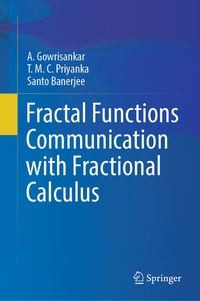
Fractal Functions Communication with Fractional Calculus
Description

This book provides an in-depth examination of fractal functions, focusing on their self-similar structures and the relatively simple construction procedures that make them a subject of fascination in mathematics and engineering. By exploring fractal interpolation functions, the book sheds light on naturally occurring phenomena that exhibit irregularity and non-integer dimensions, offering a fresh perspective on these complex mathematical constructs.
The chapters cover a range of topics, including the foundational principles of fractal geometry, the construction of fractal functions through iterated function systems, and the critical role of scaling parameters. Readers will find expert analyses of affine and non-affine fractal functions, as well as discussions on the application of fractional calculus methods such as the Riemann-Liouville and Caputo derivatives. The book also explores the practical applications of fractal interpolation in areas like epidemiology and climate dynamics, demonstrating the relevance of these mathematical concepts to real-world problems.
This volume is an essential resource for researchers and scholars in mathematics, engineering, and related fields. It offers a comprehensive overview of the current research on fractal functions and fractional calculus, providing readers with the tools to understand and apply these concepts in their work. Whether you are an academic seeking to deepen your knowledge or a practitioner looking to apply fractal functions to practical challenges, this book is a valuable addition to your library. It invites you to engage with the latest research and explore the potential of fractal functions in addressing complex scientific and engineering problems.
More details
Other editions
Additional editions
Persons
Santo Banerjee was an Associate Professor, in the Institute for Mathematical Research (INSPEM), University Putra Malaysia, Malaysia till 2020, and also a founder member of the Malaysia-Italy Centre of Excellence in Mathematical Science, UPM, Malaysia. He is now associated with the Department of Mathematics, Politecnico di Torino, Italy. His research is mainly concerned with Nonlinear Dynamics, Chaos, Complexity and Secure Communication. He is the Managing Editor of The European Physical Journal Plus.
A. Gowrisankar is presently working as an Assistant Professor in the Department of Mathematics, School of Advanced Sciences, Vellore Institute of Technology (VIT), Vellore, Tamil Nadu, India. He was a Visiting Professor in the Department of Mathematical Sciences "GL Lagrange", Politecnico di Torino, Turin, Italy (Oct, 2024). He was an Institute Post-Doctoral Programme (IPDF) in Indian Institute of Technology Guwahati (IITG, 2017) and received his Ph.D. from The Gandhigram Rural Institute, Tamil Nadu, India. He serves as an Editorial Board member in 'The European Physical Journal Plus'. He was one among the guest editors for four special issues in reputed journals. His ongoing projects include 'VIN award' and 'SEED' grant (RGEMS) funded by VIT (2023 - 2025). He is a 'TARE fellow' under the Science and Engineering Research Board (SERB) for the period 2024 - 2026. His major research areas include Fractals, Multifractals, Fractional Calculus, Nonlinear Dynamics and Chaos. He has more than 80 publications including research articles, 3 co-authored books and 4 edited volumes.
T.M.C. Priyanka is, presently, a Postdoctoral Fellow in the Department of Mathematics, Guizhou University, Guizhou, China. She was awarded a Ph.D. at Vellore Institute of Technology, Vellore, Tamil Nadu, India. She was a Senior Research Fellow (SRF-Direct) under the Council of Scientific and Industrial Research (CSIR), Government of India for the year 2023-2024. Her research broadly focusses on Fractal Interpolation, Multifractal Analysis, Fractional Calculus and Nonlinear Dynamics. She has 28 publications including 23 research articles, 3 book chapters and 2 conference proceedings published in reputed SCI journals.
Content
Fractal Geometry.- Fractal Functions An Overview.- Fractal Interpolation Vs Classical Interpolation.- Fractal Splines.- Fractal Co efficients.- Classical Integration on Fractal Functions.- Methods of Fractional Calculus.- Fractional Derivative Order and Fractal Scalings.- Fractional Integral Order and Fractal Scalings.- Applications of Fractal Interpolation Functions.
