

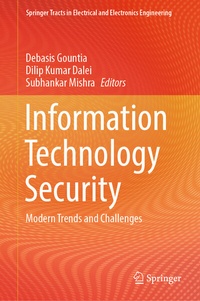
Information Technology Security
Description

This book focuses on current trends and challenges in security threats and breaches in cyberspace which have rapidly become more common, creative, and critical. Some of the themes covered include network security, firewall security, automation in forensic science and criminal investigation, Medical of Things (MOT) security, healthcare system security, end-point security, smart energy systems, smart infrastructure systems, intrusion detection/prevention, security standards and policies, among others. This book is a useful guide for those in academia and industry working in the broad field of IT security.
More details
Other editions
Additional editions
Persons
Debasis Gountia was awarded his Ph. D. degree in Information Security from the Indian Institute of Technology (IIT), Roorkee, Master of Technology degree in Computer Science and Engineering from IIT Kharagpur, and Bachelor of Technology degree in Computer Science and Engineering from the University College of Engineering (UCE), Burla, India. His research interests include cryptography, electronic design automation of microfluidic Lab-on-a-Chips, computer security, artificial intelligence, blockchain, Internet of Things, machine learning, and distributed systems. He has authored 19 international referred journals, 18 conference proceedings, 3 books, 5 book chapters, and 4 filed patents in the aforementioned areas. He has carried out several international and national projects including SERB Govt. of India, Microsoft, COVID-19 Grant, ICIT, DETECT-X for Innovate4Health design sprint, submitted proposals for NISAR and Geospatial project of ISRO, DST, OURIIP, BIRAC, etc.He is a professional member of ACM, IEEE, SMIE, FSIESRP, and IFERP.
Dilip Kumar Dalei received his Master degree in Information Technology Security (ITS) from Masaryk University, Czech Republic and M.Tech. in Computer Science & Engineering (CSE) from Indian Institute of Technology (IIT), Kharagpur. He has completed his B.Tech. degree in Computer Science & Engineering from National Institute of Technology (NIT), Rourkela. Currently, he is working as Scientist in Centre for Artificial and Robotics (CAIR), DRDO, Bengaluru, India. He has 18 years of R&D experience in defence software product development. His research interests are information security, computer security, Artificial Intelligence (AI), machine learning (ML), data visualization, cloud computing, GPU computing, algorithm design and Geographical Information System (GIS). He has authored several international conference proceedings in the aforementioned areas.
Subhankar Mishra
received his Ph.D. degree in Computer Science from the University of Florida, USA, in 2016. He is Reader F in the School of Computer Sciences, NISER, Bhubaneswar, India. His research interests include critical infrastructure cybersecurity, machine learning, and privacy. Previously, he worked as Assistant Professor at Indian Institute of Technology (IIT) Roorkee and Research Associate at Oak Ridge National Laboratory. He finished his B. Tech. in Computer Science and Engineering from National Institute of Technology (NIT), Rourkela, India, in 2010. He has authored several international conference proceedings, journals, and transactions in the aforementioned areas.
Content
Zero Trust Security Architecture for Digital Privacy in Healthcare.- Security issues and challenges in deploying a CPS using WSN.- Firewall: A Vital Constituent of Network Security.- Exploring the Landscape of Password Managers for Individual Users through Innovative Solution.- Review on Wi-Fi attacks and Detection methods.- Privacy Preserving Spatio-Temporal Attribute Based Access Control for Collaborative E-Healthcare.- Advances in Differential Privacy and Differentially Private Machine Learning.- Secure Certificateless Maximum Achievable Throughput in Successive IoT Relay Networks.- MRMM based keystream generators for information security.
