

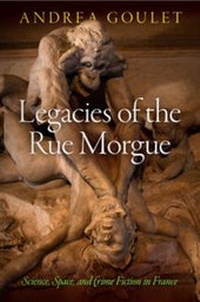
Legacies of the Rue Morgue
Science, Space, and Crime Fiction in France
1st Edition
Published on 27. October 2015
304 pages
978-0-8122-9216-9 (ISBN)
Description

Taking Edgar Allan Poe's 1841 "The Murders in the Rue Morgue" as an inaugural frame, Andrea Goulet traces shifting representations of violence, space, and nation in French crime fiction from serial novels of the 1860s to cyberpunk fictions today. She argues that the history of spatial sciences-geology, paleontology, cartography-helps elucidate the genre's fundamental tensions: between brutal murder and pure reason; historical past and reconstructive present; national identity and global networks.
As the sciences underlying her analysis make extensive use of strata and grids, Goulet employs vertical and horizontal axes to orient and inform her close readings of crime novels. Vertically, crimes that take place underground subvert above-ground modernization, and national traumas of the past haunt present criminal spaces. Horizontally, abstract crime scene maps grapple with the sociological realities of crime, while postmodern networks of international data trafficking extend colonial anxieties of the French nation.
Crime gangs in the catacombs of 1860s Paris. Dirt-digging detectives in coastal caves at the fin-de-siEcle. Schizoid cartographers in global cyberspace. Crime fiction's sites of investigation have always exposed central rifts in France's national identity while signaling broader, enduring unease with violent disruptions to social order. Reading murder novels of the last 150 years in the context of shifting sciences, Legacies of the Rue Morgue provides a new spatial history of modern crime fiction.
As the sciences underlying her analysis make extensive use of strata and grids, Goulet employs vertical and horizontal axes to orient and inform her close readings of crime novels. Vertically, crimes that take place underground subvert above-ground modernization, and national traumas of the past haunt present criminal spaces. Horizontally, abstract crime scene maps grapple with the sociological realities of crime, while postmodern networks of international data trafficking extend colonial anxieties of the French nation.
Crime gangs in the catacombs of 1860s Paris. Dirt-digging detectives in coastal caves at the fin-de-siEcle. Schizoid cartographers in global cyberspace. Crime fiction's sites of investigation have always exposed central rifts in France's national identity while signaling broader, enduring unease with violent disruptions to social order. Reading murder novels of the last 150 years in the context of shifting sciences, Legacies of the Rue Morgue provides a new spatial history of modern crime fiction.
Reviews / Votes
"Those who love detective fiction and film-or just France-will learn here to be detectives of the city of Paris above and below ground. The ghoulish, the geological, and the sublime merge in the layers of burial grounds, literary texts, and scientific paradigms. It is a wonderful book." (Deborah Jenson, Duke University) "The astounding variety, strength, and coherence of the theoretical and conceptual frameworks-involving the cultural history of crime and detection; the history of sciences; cutting-edge urban, space, and place studies; trauma theory and psychoanalysis; a deconstructionist approach to language and textuality; a literary history renewed by a history of the print media-as well as the brilliant close readings of various embodiments of modern and postmodern crime fiction make Legacies of the Rue Morgue an absolute intellectual delight." (Catherine Nesci, University of California, Santa Barbara)More details
Series
Language
English
Place of publication
Pennsylvania
United States
Target group
College/higher education
US School Grade: College Graduate Student
Illustrations
10 illus.
10 illus.
ISBN-13
978-0-8122-9216-9 (9780812292169)
Copyright in bibliographic data and cover images is held by Nielsen Book Services Limited or by the publishers or by their respective licensors: all rights reserved.
Schweitzer Classification
Other editions
Additional editions
Book
12/2015
University of Pennsylvania Press
€84.18
Article not available at the moment
Person
Andrea Goulet is Professor of French at the University of Pennsylvania and author of Optiques: The Science of the Eye and the Birth of Modern French Fiction, also available from the University of Pennsylvania Press.
Content
Prologue: Poe
Chapter 1. Introduction: Mapping Murder
PART I: ARCHAEOLOGIES
Chapter 2. Quarries and Catacombs: Underground Crime in Second Empire Romans-feuilletons
Chapter 3. Skulls and Bones: Paleohistory in Leroux and Leblanc
Chapter 4. Crypts and Ghosts: Terrains of National Trauma in Japrisot and Vargas
PART II: INTERSECTIONS
Chapter 5. Street-Name Mysteries and Private/Public Violence, 1867-2001
PART III: CARTOGRAPHIES
Chapter 6. Terrains Vagues: Gaboriau and the Birth of the Cartographic Mystery
Chapter 7. Mapping the City: Malet's Mysteries and Butor's Bleston
Chapter 8. ZEropa-Land: Balkanization and the Schizocartographies of Dantec and Radoman
Epilogue
Notes
Index
Acknowledgments
Chapter 1. Introduction: Mapping Murder
PART I: ARCHAEOLOGIES
Chapter 2. Quarries and Catacombs: Underground Crime in Second Empire Romans-feuilletons
Chapter 3. Skulls and Bones: Paleohistory in Leroux and Leblanc
Chapter 4. Crypts and Ghosts: Terrains of National Trauma in Japrisot and Vargas
PART II: INTERSECTIONS
Chapter 5. Street-Name Mysteries and Private/Public Violence, 1867-2001
PART III: CARTOGRAPHIES
Chapter 6. Terrains Vagues: Gaboriau and the Birth of the Cartographic Mystery
Chapter 7. Mapping the City: Malet's Mysteries and Butor's Bleston
Chapter 8. ZEropa-Land: Balkanization and the Schizocartographies of Dantec and Radoman
Epilogue
Notes
Index
Acknowledgments
