

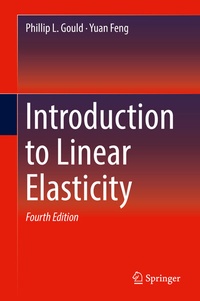
Introduction to Linear Elasticity
Description

This augmented and updated fourth edition introduces a new complement of computational tools and examples for each chapter and continues to provide a grounding in the tensor-based theory of elasticity for students in mechanical, civil, aeronautical and biomedical engineering and materials and earth science. Professor Gould's proven approach allows faculty to introduce this subject early on in an educational program, where students are able to understand and apply the basic notions of mechanics to stress analysis and move on to advanced work in continuum mechanics, plasticity, plate and shell theory, composite materials and finite element mechanics. With the introductory material on the use of MATLAB, students can apply this modern computational tool to solve classic elasticity problems. The detailed solutions of example problems using both analytical derivations and computational tools helps student to grasp the essence of elasticity and practical skills of applying the basic mechanics theorem.
More details
Other editions
Additional editions
Persons
Dr. Phillip L. Gould was the Harold D. Jolley Professor of Civil Engineering from 1981 until 2010 and is now a Senior Professor at Washington University in St.Louis. His research activities have centered on shell analysis with applications to finite element modeling, biomedical engineering, earthquake engineering, and the structural design of thin-shell structures. Dr. Gould is the author of numerous papers and several books and is the founding editor of the prestigious journal, Engineering Structures . He has served as a consultant to industry and to governmental organizations and has received numerous awards for his research, professional and educational activities.
Dr. Yuan Feng is Associate Professor within the School of Biomedical Engineering, Shanghai Jiao Tong University, Shanghai, China.
Content
Introduction and Mathematical Preliminaries.- Traction, Stress and Equilibrium.- Deformations.- Material Behavior.- Formulations, Uniqueness and Solutions Strategies.- Extension, Bending and Torsion.- Two-Dimensional Elasticity.- Thin Plates and Shells.- Dynamic Effects.- Viscoelasticity.- Energy Principles.- Strength and Failure Criteria.- Something New.
