

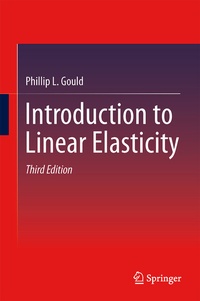
Introduction to Linear Elasticity
Description

Introduction to Linear Elasticity, 3rd Edition provides an applications-oriented grounding in the tensor-based theory of elasticity for students in mechanical, civil, aeronautical, biomedical engineering, as well as materials and earth science. The book is distinct from the traditional text aimed at graduate students in solid mechanics by introducing its subject at a level appropriate for advanced undergraduate and beginning graduate students. The author's presentation allows students to apply the basic notions of stress analysis and move on to advanced work in continuum mechanics, plasticity, plate and shell theory, composite materials, and finite method analysis.
Reviews / Votes
From the reviews of the third edition:
"The present textbook is an introductory course in the theory of linear elasticity. . It is pleasantly readable not only for students specialized in engineering, but also for students specializing in other fields, especially in mathematics, who are interested in mathematical and technical theories of elasticity. It can also serve as a reference book. . The chapters are endowed with computational examples and exercises, which make the textbook transparent and easy to understand." (Georg V. Jaiani, zbMATH, Vol. 1280, 2014)
More details
Other editions
Additional editions
Previous edition
Person
Dr. Phillip L. Gould was the Harold D. Jolley Professor of Civil Engineering from 1981 until 2010 and is now a Senior Professor at Washington University in St.Louis. His research activities have centered on shell analysis with applications to finite element modeling, biomedical engineering, earthquake engineering, and the structural design of thin-shell structures. Dr. Gould is the author of numerous papers and several books and is the founding editor of the prestigious journal, Engineering Structures . He has served as a consultant to industry and to governmental organizations and has received numerous awards for his research, professional and educational activities.
Content
Introduction and Mathematical Preliminaries.- Traction, Stress and Equilibrium.- Deformations.- Material Behavior.- Formulations, Uniqueness and Solutions Strategies.- Extension, Bending and Torsion.- Two-Dimensional Elasticity.- Thin Plates and Shells.- Dynamic Effects.- Viscoelasticity.- Energy Principles.- Strength and Failure Criteria.- Something New.
