
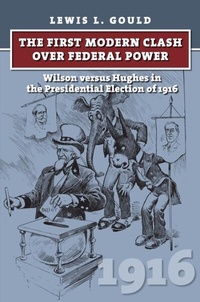
The First Modern Clash over Federal Power
Description
Alles über E-Books | Antworten auf Fragen rund um E-Books, Kopierschutz und Dateiformate finden Sie in unserem Info- & Hilfebereich.
Fully examined for the first time in this engrossing book by one of America's preeminent presidential scholars, the election that pitted Woodrow Wilson against Charles Evan Hughes emerges as a clear template for the partisan differences of the modern era. The 1916 election dramatically enacted the two parties' fast-evolving philosophies about the role and reach of federal power. Lewis Gould reveals how, even more than in the celebrated election of 1912, the parties divided along class-based lines in 1916, with the Wilson campaign in many respects anticipating the New Deal while the Republicans adopted the small government, anti-union, and anti-regulation positions they have embraced ever since. The Republicans dismissed Wilson's 1912 win as a fluke, the result of Theodore Roosevelt's ?Progressive? apostasy splitting the party. But in US Supreme Court Justice Hughes, whose electoral prowess had been proven in two successful runs for governor of New York, the Republicans had anointed a flawed campaigner whose missteps in California sealed his fate very late in the election. Wilson's strong performance as the head of a united Democratic government (for the first time since 1894), along with Americans' uncertainty about the outbreak of war in Europe, led to victory.
Along with the ins and outs of the race itself, Gould's book explores the election's broader meaning?as, for the first time, the popular election of the Senate coincided with a presidential election, and the women's suffrage movement gathered steam. The year 1916 also marked the restoration of a two-party competition for president and, as we see in this enlightening book, the beginning of the two-party battle for the hearts and minds of Americans that continues to this day.
All prices
More details
Other editions
Additional editions
Person
Content
Editors' Foreword
Preface
Acknowledgments
1. The Legacy of 1912
2. The 1914 Election, the Great War, and Beyond
3. The Republican Field
4. The State of the Democrats
5. The Selection of Hughes and the Launching of the Republican Campaign
6. The Campaign Becomes Ideological
7. The Final Month
8. the Election and Its Meaning
Appendix A: Votes Cast in Republican Primaries, 1816
Appendix B: Electoral Votes
Appendix C: Woodrow Wilson's Second Inaugural Address, March 4, 1917
Notes
Bibliographical Essay
Index

System requirements
File format: ePUB
Copy protection: Adobe-DRM (Digital Rights Management)
System requirements:
- Computer (Windows; MacOS X; Linux): Install the free reader Adobe Digital Editions prior to download (see eBook Help).
- Tablet/smartphone (Android; iOS): Install the free app Adobe Digital Editions or the app PocketBook before downloading (see eBook Help).
- E-reader: Bookeen, Kobo, Pocketbook, Sony, Tolino and many more (not Kindle).
The file format ePub works well for novels and non-fiction books – i.e., „flowing” text without complex layout. On an e-reader or smartphone, line and page breaks automatically adjust to fit the small displays.
This eBook uses Adobe-DRM, a „hard” copy protection. If the necessary requirements are not met, unfortunately you will not be able to open the eBook. You will therefore need to prepare your reading hardware before downloading.
Please note: We strongly recommend that you authorise using your personal Adobe ID after installation of any reading software.
For more information, see our ebook Help page.
File format: PDF
Copy-Protection: Adobe-DRM (Digital Rights Management)
System requirements:
- Computer (Windows; MacOS X; Linux): Install the free reader Adobe Digital Editions prior to download (see eBook Help).
- Tablet/smartphone (Android; iOS): Install the free app Adobe Digital Editions or the app PocketBook before downloading (see eBook Help).
- E-reader: Bookeen, Kobo, Pocketbook, Sony, Tolino and many more (only limited: Kindle).
The file format PDF always displays a book page identically on any hardware. This makes PDF suitable for complex layouts such as those used in textbooks and reference books (images, tables, columns, footnotes). Unfortunately, on the small screens of e-readers or smartphones, PDFs are rather annoying, requiring too much scrolling.
This eBook uses Adobe-DRM, a „hard” copy protection. If the necessary requirements are not met, unfortunately you will not be able to open the eBook. You will therefore need to prepare your reading hardware before downloading.
Please note: We strongly recommend that you authorise using your personal Adobe ID after installation of any reading software.
For more information, see our eBook Help page.
File format: ePUB
Copy protection: Watermark-DRM (Digital Rights Management)
System requirements:
- Computer (Windows; MacOS X; Linux): Use a reading software that can process the file format ePUB: e.g., Adobe Digital Editions or FBReader – both free (see eBook Help).
- Tablet/Smartphone (Android; iOS): Before downloading, install the free app Adobe Digital Editions (see eBook Help).
- E-reader: Bookeen, Kobo, Pocketbook, Sony, Tolino and many more (not Kindle).
The file format ePUB works well for novels and non-fiction books – i.e., „flowing” text without complex layout. On an e-reader or smartphone, line and page breaks automatically adjust to fit the small displays.
This eBook uses Watermark-DRM, a „soft” copy protection. This means that there are no technical restrictions to prevent illegal distribution. However, there is a personalised watermark embedded in the eBook that can be used to identify the purchaser of the eBook in the event of misuse and to provide evidence for legal purposes.
For more information, see our eBook Help page.
