

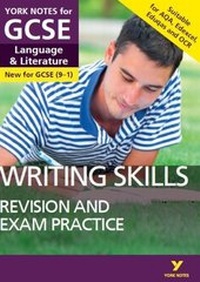
English Language and Literature Writing Skills Revision and Exam Practice: York Notes for GCSE (9-1)
1st Edition
Published on 2. May 2018
88 pages
978-1-292-24569-0 (ISBN)
Description

Academic Level: GCSE (9-1)Subject: English Language and LiteratureFirst teaching: September 2015First Exams: Summer 2017 To achieve top grades in English Language and Literature, you need to be confident in your writing skills. With everything you need right at hand, and suitable for all exam boards and abilities, this York Notes Revision and Exam Practice guide will help you to master the core skills, write brilliant essays and face your exams with confidence. Learn and revise every essential skill Use each of the dedicated sections to learn and revise key writing skills, from writing about fiction and non-fiction extracts to planning and writing your own texts in the exam. With key definitions, examples from typical Language and Literature tasks, regular tests and Top tips for improvement, you will feel confident you have covered all bases. Stay focused and aim high Use the mix of short and longer tasks to practise your skills and vary your revision. The targeted Aiming high tips will to help you to perfect your techniques and write the very best answers you can. Check your progress Use the regular Apply your skills tasks and Progress check bullets to monitor what you have achieved. Use the full answer key provided to assess your improvement. Feel ready for the exam Regular quick tests and longer exam-style tasks with sample answers show the level to aim for.
More details
Other editions
Additional editions
Book
08/2017
Pearson Education Limited
€8.50
Shipment within 10-20 days
Content
- Front Cover
- Contents
- Chapter One: Core Writing Skills
- 1.1: 'Writing' in both GCSE English Language and Literature
- English Language Assessment Objectives
- English Literature Assessment Objectives
- What Types of Writing will I have to do?
- 1.2: Task, audience and purpose
- Breaking Down the Task
- Understanding Audience
- 1.3: Forms of writing
- Conventions
- Viewpoint or Persuasive Writing
- Writing Critically
- 1.4: Creating an impact
- Different Sorts of Impact
- Variety and Surprise
- 1.5: Using quotations effectively
- The Basics
- Grammatical Fluency
- Quotations in Paragraphs
- Single Word Quotations
- 1.6: Spelling, punctuation and grammar
- Checking that your Sentences are Correct and Effective
- Punctuation for Meaning
- Punctuation When Quoting
- Spelling
- Spelling Advice
- Chapter Two: Planning, Drafting and Checking
- 2.1: Generating ideas
- The Type of Task
- Starting with the Task
- Ways of Generating Ideas
- Word Association
- 2.2: Effective planning
- Keeping it Simple
- Different Forms of Writing
- Logical Order and Flexibility
- Chapter Three: Responding to texts in the Exam
- 3.1: Writing effective short and longer answers
- Short Answers
- Effective, Short Responses
- Longer Responses to Texts
- 3.2: Writing about fiction texts
- What You Have to Write About
- Making Precise References
- Developing An Appropriate Vocabulary
- 3.3: Writing about non-fiction texts
- Responding to Opinion Pieces or Personal Writing
- Writing about your Impressions
- 3.4: Writing about poetry and drama
- Getting your Subject Vocabulary Right
- Writing about Plays
- Poetry: Bringing all the Elements Together
- 3.5: Selecting and synthesising information
- What is Synthesis?
- Concise Synthesis
- Synthesising Information in Literary Texts
- 3.6: Comparing and contrasting
- Sentence Structure
- Paragraph Structure
- Whole Text Structure
- Using Connectives
- Chapter Four: Writing Your Own Texts
- 4.1: Vocabulary for Impact
- Wide and Specific Vocabulary
- Noun Phrases
- Synonyms and Senses
- Positive and Negative Connotations
- 4.2: Sentences for variety and effect
- Length of Sentences
- Active and Passive
- 4.3: Punctuation for clarity and creativity
- Creating Meaning with Punctuation
- Questions for Impact
- Punctuation in Stories
- 4.4: Paragraphs for organisation and sequence
- Paragraph Purposes
- Paragraph Focus and Order
- Paragraphs in Viewpoint Essays
- 4.5: Connectives for cohesion
- Connectives for Building an Argument
- Connectives for Comparison and Contrast
- Connectives for Cause and Effect
- 'IF' Clauses
- 4.6: Simile, metaphor and other language techniques
- Simile and Metaphor
- Analogy
- Symbolism
- Personification
- Sound Effects: Alliteration, Assonance and Onomatopoeia
- Rhetorical Questions and Patterns of Three
- 4.7: Writing a descriptive text
- What makes an Effective Description?
- Using the Senses
- Powerful Language Techniques
- Structuring Description
- 4.8: Writing a narrative or short story
- What makes an Effective Narrative?
- Character and Voice in Stories
- Structuring Narratives
- The Importance of Location
- 4.9: Writing to express a personal viewpoint
- What makes an Effective Piece of Viewpoint Writing?
- Register and Style
- Planning a Viewpoint Essay
- Chapter Five: Putting it into Practice
- 5.1: Introduction to Sample Tasks
- Typical Features of Mid-Level and High-Level Responses
- 5.2: Task A: Creative writing - making an impact
- Introduction
- How to Approach the Task
- 5.3: Task B: Non-Fiction Writing - Expressing Apoint of View
- Introduction
- How to Approach the Task
- 5.4: Task C: Unseen Poetry - Analysing a Writer's Methods
- Introduction
- The Poem
- How to Approach the Task
- Chapter Six: Answers and Glossary
- Answers
- Glossary
- Back Cover
