

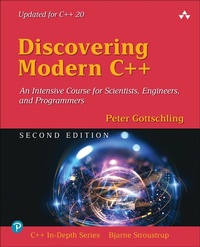
Discovering Modern C++
2nd Edition
Published on 18. February 2022
576 pages
978-0-13-783301-6 (ISBN)
Description

Discovering Modern C++, Second Edition by Peter Gottschling is an intensive introduction that guides you smoothly to sophisticated approaches based on advanced features. Thoroughly updated for C++17 and C++20, this Second Edition introduces key concepts using examples from many technical problem domains, drawing on his extensive experience training professionals and teaching C++ to students of physics, math, and engineering.
This book is designed to help you get started rapidly and then master increasingly robust features, from lambdas to expression templates. You will also learn how to take advantage of the powerful libraries available to C++ programmers: both the Standard Template Library (STL) and scientific libraries for arithmetic, linear algebra, differential equations, and graphs. In this Second Edition, Gottschling also presents thorough and expert coverage of multi-threading and variadic templates.
Throughout, Gottschling demonstrates how to write clear and expressive software using object orientation, generics, metaprogramming, and procedural techniques. By the time you are finished, you will have mastered all the abstractions you need to write C++ programs with exceptional quality and performance.
This book is designed to help you get started rapidly and then master increasingly robust features, from lambdas to expression templates. You will also learn how to take advantage of the powerful libraries available to C++ programmers: both the Standard Template Library (STL) and scientific libraries for arithmetic, linear algebra, differential equations, and graphs. In this Second Edition, Gottschling also presents thorough and expert coverage of multi-threading and variadic templates.
Throughout, Gottschling demonstrates how to write clear and expressive software using object orientation, generics, metaprogramming, and procedural techniques. By the time you are finished, you will have mastered all the abstractions you need to write C++ programs with exceptional quality and performance.
More details
Edition
2nd edition
Language
English
Place of publication
Boston
United States
Publishing group
Pearson Education (US)
Target group
Professional and scholarly
File size
70,47 MB
ISBN-13
978-0-13-783301-6 (9780137833016)
Copyright in bibliographic data and cover images is held by Nielsen Book Services Limited or by the publishers or by their respective licensors: all rights reserved.
Schweitzer Classification
Other editions
Additional editions
Peter Gottschling
Discovering Modern C++
Book
02/2022
2nd Edition
Addison Wesley
€47.50
Shipment within 15-20 days
Person
Peter Gottschling is founder of SimuNova, a company that develops the Matrix Template Library (MTL4) and offers C++ training. He is a member of the ISO C++ standards committee, vice-chair of Germany's programming language standards committee, and founder of the C++ User Group in Dresden. He earned his Ph.D. in computer science at Technische Universitaet Dresden in 2002.
Content
Preface xix
Acknowledgments xxv
About the Author xxvii
Chapter 1: C++ Basics 1
1.1 Our First Program 1
1.2 Variables 4
1.3 Operators 12
1.4 Expressions and Statements 22
1.5 Functions 30
1.6 Error Handling 35
1.7 I/O 41
1.8 Arrays, Pointers, and References 52
1.9 Structuring Software Projects 64
1.10 Exercises 69
Chapter 2: Classes 71
2.1 Program for Universal Meaning, Not Technical Details 71
2.2 Members 73
2.3 Setting Values: Constructors and Assignments 78
2.4 Destructors 105
2.5 Method Generation Summary 111
2.6 Accessing Member Variables 112
2.7 Operator Overloading Design 117
2.8 Exercises 126
Chapter 3: Generic Programming 129
3.1 Function Templates 129
3.2 Namespaces and Function Lookup 138
3.3 Class Templates 147
3.4 Type Deduction and Definition 154
3.5 Template Specialization 162
3.6 Non-Type Parameters for Templates 174
3.7 Functors 177
3.8 Lambda 185
3.9 Variable Templates 190
3.10 Programming with Concept(s) 192
3.11 Variadic Templates 200
3.12 Exercises 208
Chapter 4: Libraries 211
4.1 Standard Template Library 211
4.2 Numerics 239
4.3 Meta-programming 252
4.4 Utilities 256
4.5 The Time Is Now 267
4.6 Concurrency 270
4.7 Scientific Libraries Beyond the Standard 282
4.8 Exercises 285
Chapter 5: Meta-Programming 289
5.1 Let the Compiler Compute 289
5.2 Providing and Using Type Information 297
5.3 Expression Templates 318
5.4 Meta-Tuning: Write Your Own Compiler Optimization 328
5.5 Optimizing with Semantic Concepts 354
5.6 Turing Completeness 359
5.7 Exercises 362
Chapter 6: Object-Oriented Programming 365
6.1 Basic Principles 365
6.2 Removing Redundancy 379
6.3 Multiple Inheritance 380
6.4 Dynamic Selection by Sub-typing 387
6.5 Conversion 389
6.6 Advanced Techniques 397
6.7 Exercises 405
Chapter 7: Scientific Projects 407
7.1 Implementation of ODE Solvers 407
7.2 Creating Projects 418
7.3 Modules 430
7.4 Some Final Words 434
Appendix A: Clumsy Stuff 435
A.1 More Good and Bad Scientific Software 435
A.2 Basics in Detail 441
A.3 Real-World Example: Matrix Inversion 449
A.4 Class Details 458
A.5 Method Generation 462
A.6 Template Details 474
A.7 More on Libraries 479
A.8 Dynamic Selection in Old Style 480
A.9 More about Meta-Programming 481
A.10 Linking to C Code 489
Appendix B: Programming Tools 491
B.1 g++ 491
B.2 Debugging 492
B.3 Memory Analysis 496
B.4 gnuplot 498
B.5 Unix, Linux, and Mac OS 498
Appendix C: Language Definitions 501
C.1 Value Categories 501
C.2 Operator Overview 502
C.3 Conversion Rules 504
Bibliography 507
Subject Index 513
Acknowledgments xxv
About the Author xxvii
Chapter 1: C++ Basics 1
1.1 Our First Program 1
1.2 Variables 4
1.3 Operators 12
1.4 Expressions and Statements 22
1.5 Functions 30
1.6 Error Handling 35
1.7 I/O 41
1.8 Arrays, Pointers, and References 52
1.9 Structuring Software Projects 64
1.10 Exercises 69
Chapter 2: Classes 71
2.1 Program for Universal Meaning, Not Technical Details 71
2.2 Members 73
2.3 Setting Values: Constructors and Assignments 78
2.4 Destructors 105
2.5 Method Generation Summary 111
2.6 Accessing Member Variables 112
2.7 Operator Overloading Design 117
2.8 Exercises 126
Chapter 3: Generic Programming 129
3.1 Function Templates 129
3.2 Namespaces and Function Lookup 138
3.3 Class Templates 147
3.4 Type Deduction and Definition 154
3.5 Template Specialization 162
3.6 Non-Type Parameters for Templates 174
3.7 Functors 177
3.8 Lambda 185
3.9 Variable Templates 190
3.10 Programming with Concept(s) 192
3.11 Variadic Templates 200
3.12 Exercises 208
Chapter 4: Libraries 211
4.1 Standard Template Library 211
4.2 Numerics 239
4.3 Meta-programming 252
4.4 Utilities 256
4.5 The Time Is Now 267
4.6 Concurrency 270
4.7 Scientific Libraries Beyond the Standard 282
4.8 Exercises 285
Chapter 5: Meta-Programming 289
5.1 Let the Compiler Compute 289
5.2 Providing and Using Type Information 297
5.3 Expression Templates 318
5.4 Meta-Tuning: Write Your Own Compiler Optimization 328
5.5 Optimizing with Semantic Concepts 354
5.6 Turing Completeness 359
5.7 Exercises 362
Chapter 6: Object-Oriented Programming 365
6.1 Basic Principles 365
6.2 Removing Redundancy 379
6.3 Multiple Inheritance 380
6.4 Dynamic Selection by Sub-typing 387
6.5 Conversion 389
6.6 Advanced Techniques 397
6.7 Exercises 405
Chapter 7: Scientific Projects 407
7.1 Implementation of ODE Solvers 407
7.2 Creating Projects 418
7.3 Modules 430
7.4 Some Final Words 434
Appendix A: Clumsy Stuff 435
A.1 More Good and Bad Scientific Software 435
A.2 Basics in Detail 441
A.3 Real-World Example: Matrix Inversion 449
A.4 Class Details 458
A.5 Method Generation 462
A.6 Template Details 474
A.7 More on Libraries 479
A.8 Dynamic Selection in Old Style 480
A.9 More about Meta-Programming 481
A.10 Linking to C Code 489
Appendix B: Programming Tools 491
B.1 g++ 491
B.2 Debugging 492
B.3 Memory Analysis 496
B.4 gnuplot 498
B.5 Unix, Linux, and Mac OS 498
Appendix C: Language Definitions 501
C.1 Value Categories 501
C.2 Operator Overview 502
C.3 Conversion Rules 504
Bibliography 507
Subject Index 513
