

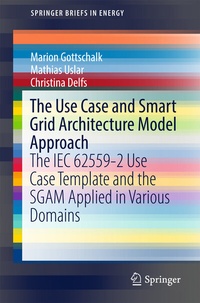
The Use Case and Smart Grid Architecture Model Approach
Description

This book introduces readers to the fundamentals of the IEC 62559 Use Case Methodology, explains how it is related to the Smart Grid Architecture Model (SGAM), and details how a holistic view for both architecture and requirements engineering can be achieved. It describes a standardized and holistic approach to requirements engineering for smart grid projects based on work conducted in the context of the EU M/490 standardization mandate. Over the last years, this method has been established in Europe as the basic building block of requirements engineering in the utilities sector.
The authors present a canonical, structured approach that users can apply to the Use Case Methodology and the SGAM, as well as open tools for this purpose. The application in various domains outside the smart grid is also discussed, as it can be used for critical infrastructures or system-of-systems domains like Industrie 4.0 and Ambient Assisted Living. Accordingly, the book also presents various architecture models for different fields of application, like EMAM, SCIAM, RAMI 4.0, and MAF.
Reviews / Votes
"The book tackles the aspect of evaluating the combined application of SGAM and the IEC 62559-2 series (that provides a formalized process to describe use cases) in various domains . . The book presents both topics in detail (SGAM and the use case templates) and outlines a methodology for the application of the model. The book positions itself as a survey of EU projects and is useful and recommended reading for both experts and novices in the SGAM field." (Computing Reviews, December, 2017)More details
Other editions
Additional editions
Persons
Marion Gottschalk holds a Master's degree in Computer Science from the Carl von Ossietzky University in Oldenburg. She currently works at OFFIS - Institute for Information Technology Energy department in the group "Architecture Engineering and Interoperability". The topic of her PhD project was included in the IEC 62559 standard series for improving the quality of use cases. In 2015, she took part in the IEC Young Professional Program in Minsk.
Dr. Mathias Uslar is Group Manager of the "Architecture Engineering and Interoperability" group at the OFFIS Energy department. Mr. Uslar leads OFFIS' national and international work packages for standardization and interoperability. He is a member of German GI, IEEE, ACM and IEC German mirror committee member DKE K 952, 952.0.10, 952.0.14, 952.0.17 and international member of IEC PC 118, TC 57 WG 13, 14 and 16. Additionally, he is one of the main authors of the M490 Smart Grid Reference Architecture Model (SGAM).
Dr. Christina Delfs received her PhD in Mathematics from the Carl von Ossietzky University in Oldenburg. She is currently working in the group "Architecture Engineering and Interoperability" of the OFFIS - Institute for Information Technology Energy division, where her primary focus is on the Use Case and Smart Grid Architecture Model Approach to a national R&D project.
