

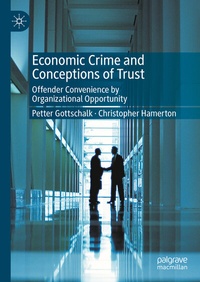
Economic Crime and Conceptions of Trust
Description

Economic Crime and Conceptions of Trust explores the intricacies of the contemporary concept of trust in episodes of misconduct through an analysis of workplace deviance and crime. Grounded in detailed examinations of contemporary case studies and bolstered by original comparative fieldwork, the text takes an offender-focused approach, emphasizing the pivotal role of convenience. Adopting an interdisciplinary perspective, the authors seek to enhance and broaden existing understanding of white-collar and corporate criminology, while also highlighting its relevance to strategic management studies. A core argument of the book is that the traditional emphasis on individual actors and notions of trustworthiness when conceptualising white-collar has waned in recent times. The authors' perspective revisits and builds upon this important foundational concept of late twentieth-century discourse within the discipline, signalling a need for a reassessment and highlighting a number of recent conceptual developments to evaluate and position trust within the twenty-first century globalized business sphere.
More details
Other editions
Additional editions
Persons
Petter Gottschalk is Professor in the Department of Leadership and Organizational behaviour at BI Norwegian Business School, Norway.
Christopher Hamerton teaches and researches Criminology and Criminal justice in the School of Policy & Global Affairs at City, University of London, United Kingdom.
Content
Chapter 1: Trust Privilege and Convenient Access to Resources.- Chapter 2: Trustworthiness and the Deterioration of Guardianship.- Chapter 3: Assessing Public Trust Within a National Institution.- Chapter 4: Cyber-offending, Convenience, and the Circumvention of Trust.- Chapter 5: Deterrence from Investigation.- Chapter 6: Trust in Surveys of Economic Crime.- Chapter 7: Comparative Fraud Authority Convenience and Public Trust.- Chapter 8: Trust and the Implicatations of Economic Sanctions.- Chapter 9: Crime Seriousness Perceptions.- Chapter 10: Trusted Professions, Convenience, Criminality and the Effect of Personal Proximity.- Conclusion.
