


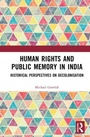
Human Rights and Public Memory in India
Historical Perspectives on Decolonization
Will be published approx. on 31. July 2026
152 pages
E-Book
978-1-040-97528-2 (ISBN)
Description

The book examines the political use of the past in post-colonial India. It shows how past 'injustices' are used to justify current violations of human rights. It shows how the recent and increased reappraisal of European colonial rule and postcolonial theory formation are introducing further confrontations into the struggles over memory and, with advancing globalization, they are beginning to dominate international as well as national politics. It also looks at textbook controversies in India as well as debates about the necessity of historiography to be decolonized. The volume will be of great interest to scholars and researchers of South Asian studies, politics, history, and postcolonial studies.
More details
Language
English
Place of publication
London
United Kingdom
Publishing group
Taylor & Francis Ltd
Target group
College/higher education
ISBN-13
978-1-040-97528-2 (9781040975282)
Copyright in bibliographic data is held by Nielsen Book Services Limited or its licensors: all rights reserved.
Schweitzer Classification
Other editions
Additional editions
Book
approx. 07/2026
1st Edition
Routledge
€191.50
Not yet published
Person
Michael Gottlob, retired (born 1950), taught German language and literature at universities in India and Italy Research interests: history and intercultural comparison of historical thought. Relevant publications:
Historical Thinking in South Asia. A Handbook of Sources from Colonial Times to the Present, 2003 (book)
India's Unity in Diversity as a Question of Historical Perspective, 2007 (article)
History and Politics in Post-colonial India, 2011 (book)
Historical Thinking in South Asia. A Handbook of Sources from Colonial Times to the Present, 2003 (book)
India's Unity in Diversity as a Question of Historical Perspective, 2007 (article)
History and Politics in Post-colonial India, 2011 (book)
Content
I. Human Rights and Remembrance - a Dilemma
II. Politics of History in India, or: 'Righting a Historical Wrong'
III. Indian Textbook Controversies
IV. Indian Historical Discourse under Colonialism
V. India's Connection to History
VI. On the Other Side of Globalization. Indian Queries to Western history
VII. History and Obstinacy in India
VIII. Inclusions and Exclusions in the Encounter between India and Europe
II. Politics of History in India, or: 'Righting a Historical Wrong'
III. Indian Textbook Controversies
IV. Indian Historical Discourse under Colonialism
V. India's Connection to History
VI. On the Other Side of Globalization. Indian Queries to Western history
VII. History and Obstinacy in India
VIII. Inclusions and Exclusions in the Encounter between India and Europe
