

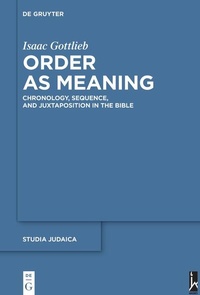
Order as Meaning
Chronology, Sequence, and Juxtaposition in the Bible With an Essay by Daniel Frank
1st Edition
Published on 31. December 2023
XIII, 198 pages
978-3-11-058515-5 (ISBN)
Description

Jewish Bible commentary in the Middle Ages took on two aspects, the Sephardic and the Ashkenazic. The first, Spanish interpretation, developed in a Muslim surrounding, which appreciated secular studies, the sciences, and Arabic literature, much of which it had translated from Greek. These studies made their mark on Bible exegesis, which sought the simple straightforward sense (peshat) of a verse and its grammatical meaning. The Ashkenazic school, however, situated in France and Germany, was firmly anchored in the rabbinic study hall and its exegesis was a continuation of the methods of Midrash and Aggadah as practiced in Mishnah and Talmud.
In the beginning of the twelfth century, Ashkenazic commentary in northern France took on a new face. Contact with the outside world, including Christian scholarship, and partial knowledge of general studies, brought the Ashkenazi Jewish commentators to the realization that the Bible, besides being a religious text, was also literature. As literature, many features including the order of biblical pericopes or units attracted attention. The classic commentators, Rashi in France, Ibn Ezra in Toledo and Ramban (Nahmanides) in northern Spain all dealt with biblical order. Order as Meaning cites many cases of sequential arrangement and juxtaposition taken from the rabbinic period as well as from the above three commentators, explaining what there was to learn from such a study.
In the beginning of the twelfth century, Ashkenazic commentary in northern France took on a new face. Contact with the outside world, including Christian scholarship, and partial knowledge of general studies, brought the Ashkenazi Jewish commentators to the realization that the Bible, besides being a religious text, was also literature. As literature, many features including the order of biblical pericopes or units attracted attention. The classic commentators, Rashi in France, Ibn Ezra in Toledo and Ramban (Nahmanides) in northern Spain all dealt with biblical order. Order as Meaning cites many cases of sequential arrangement and juxtaposition taken from the rabbinic period as well as from the above three commentators, explaining what there was to learn from such a study.
More details
Other editions
Additional editions
Isaac Gottlieb
Order as Meaning
Chronology, Sequence, and Juxtaposition in the Bible With an Essay by Daniel Frank
Book
12/2023
1st Edition
De Gruyter
€144.95
Shipment within 5-7 days
Isaac Gottlieb
Order as Meaning
Chronology, Sequence, and Juxtaposition in the Bible With an Essay by Daniel Frank
E-Book
12/2023
1st Edition
De Gruyter
€144.95
Available for download
Person
Isaac Gottlieb
, Bar-Ilan University, Ramat-Gan, Israel.
Content
- Intro
- Preface. The Question of Order
- Contents
- Chapter 1: Introduction. Making Sense out of Sequence
- Chapter 2: Rabbinic Literature. "There is no 'earlier' or 'later' in the Torah"
- Chapter 3: Rashi. The Plain Sense of Scripture
- Chapter 4: Ibn Ezra. Juxtaposition: From Derash to Peshat
- Chapter 5: Nahmanides The Entire Torah is in Order
- Chapter 6: Modern Approaches
- Epilogue
- Bibliography
- Excursus: Narrative Sequence in Early Karaite Exegesis
- Index of Biblical Verses
- Index of Rabbinic Sources
- Index of Sages
- Index of Names
