

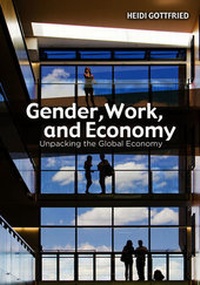
Gender, Work, and Economy
Description

The full extent of changing patterns of employment and the current financial crisis cannot be fully understood in the confines of narrow conceptions of work and economy. Feminists address this shortcoming by developing both a theory and a political movement aimed at unveiling the power relations inherent in old and new forms of work. By providing an analysis of gender, work, and the economy, Heidi Gottfried brings to light the many faces of power from the bedroom to the boardroom. A discussion of globalization is threaded throughout the book to uncover the impact of increasing global interconnections, and vivid case studies are included, from industrialized countries such as the US and the global cities of New York, London, and Tokyo, as well as from developing countries and the emerging global cities of Beijing, Shanghai, and Dubai.
This comprehensive analysis of gender and work in a global economy, incorporating sociology, geography, and political economy perspectives, will be a valued companion to students in gender studies and across the social sciences more generally.
More details
Other editions
Additional editions
Person
Content
PART I Studying Gender, Work and Economy
2. Theories of Work and Economy
3. An Integrative Framework for the Study of Gender, Work and Economy
PART II Political Economy of Gender, Work and Economy
4. The Puzzle of Gender Segregation: From Historical Roots to Contemporary Divisions
5. Serving People: Gender and Services in the New Economy
6. Caring for People: Gender and Social Reproduction in Service Economies
7. State and Economy: Gender, Policy and Work
8. Terrains of Struggle: Gender, Work and Labor Organizing
PART III Gender, Work and Economy in a Global Context
9. Thinking Globally, Global Thinking: Theories of Internationalization and Globalization
10. Global Labor Markets, Commodity Chains and Gender Mobilities: Globalizing Production and Reproduction
11. On the Global Economic Grid: Tokyo Tales, London Chronicles, Shanghai Stories
12. New Political Landscapes: Gender Equality Projects in Global Arenas and Nation States
CHAPTER
1
An Introduction to Gender, Work, and Economy: Unpacking the Global Economy
RECENTLY, the near economic cataclysm resulting from the financial meltdown exposed hidden fault-lines in the global economy. Lehman Brothers was not the only casualty on that fateful day of September 15, 2008. Soon after, a suit brought by two female ex-vice presidents against the former head of the derivatives unit of AIG raised the specter that the “ ‘boys club’ culture” ignored the impact of risk-taking on women’s careers and on working-class communities at large. In this specific case, the boss allegedly admitted his preference for “young (female) workers with ‘curb appeal’ to those who look like his aunt” (Gallu and Son 2010: 1). Such sentiments, usually left unsaid, express a structural condition valorizing beauty over brains, profits over people’s lives and livelihoods. The usual narrative of the financial crisis glosses over the possibility that such corporate leaders’ hyper-masculine bravado may have contributed to irrational exuberance born out of their neglect of social responsibility for others. Behind the scenes, their abstract financial investment calculations, and hubris rooted in the expression of hegemonic masculine domination over nature, fostered a culture of undue risk-taking, bringing global capitalism to the precipice. Crises such as this allow a glimpse into both the intricacies of global economic processes and the usually shrouded worlds of work.
Another remnant left in the wake of the crisis has been dubbed “The Great ‘He-cession’ ” (Salem cited in the New York Times 2009). Relatively new in this recession, more men than women lost their jobs and experienced long bouts of unemployment. Between 2007 and 2009, the economy shed manufacturing and construction jobs, once the primary engines of muscular economic growth and the underpinning of working-class masculinity and the strong male breadwinner family model. This idea of the he-cession describes a process of economic restructuring already underway. Less clear is what drives the shift from industrial production to service-dominated economies.
These examples cannot be fully understood in the confines of gender-neutral theories of the financial crisis and the he-cession. Though seemingly neutral, definitions of work and economy are themselves gendered. Yet gender is more than juxtaposing men’s and women’s different work experiences and biographies. What mechanisms systematically and systemically disadvantage women in and at work, and how are differences among women structured depending on class, race and national origin? The rest of the introduction provides a brief for studying gender at work in the global economy.
Why study gender at work in the global economy?
During the closing decades of the twentieth century the work world dramatically changed. In the United States, societal norms gave way to civil rights laws opening up new employment opportunities, and women’s paid labor force participation steadily increased. Now, a majority of women with young children work at least part-time or part-year outside of their homes. In addition, young women hold more bachelor’s and master’s degrees than men, and increase their representation in law, business, and medical schools (Rose and Hartmann 2004). By 1982 women college graduates outnumbered men, and by 2007, women accounted for 57% of college graduates (Skapinker 2010: 11). No longer confined to jobs as domestic servants, sales clerks, secretaries, nurses, and teachers, women gained a foothold in management, earning 43% of all MBAs in 2006, up from only 4% in 1970 (Bertrand et al. 2010: 229). Career paths of women and men have become more similar, yet important differences remain. Despite inroads into male-dominated fields and the high rates of male unemployment during the Great Recession of 2008–9, women still earn less than men and end up re-segregated at lower ends of occupational hierarchies. What seemed like steady progress has stalled and the gender revolution remains unfinished.
It is still the case that women bear disproportionate responsibility for unpaid and, increasingly, for paid labor in the household, which makes it difficult for them to compete equally with men outside the home. Moreover, the current economic system places a burden on American men, who have the longest work week in the advanced industrialized world and consequently the least amount of leisure when employed. In this context, the relative lack of social infrastructure to support working parents in the United States, such as subsidized childcare or paid family leave, requires that families cope on their own either through paying for care and services on the market or by using unpaid labor of family members (usually relying on mothers or other female relatives), especially in times of economic distress.
Meanwhile, government cost-cutting measures deprive individuals and families of the social safety net. State and federal government budget cuts add to the economic tsunami, eliminating 581,000 jobs in its wake. Women lost 81% of the jobs disappearing from the public sector from December 2008 to September 2011 (Institute for Women’s Policy Research September 9, 2011). Though men’s employment fell by 1.6% at the local level – less than the 4.7% decline for women – men’s employment grew by 5.3% at the federal level, likely due to the expansion of homeland security jobs. Increasing unemployment and decreasing prospects for good jobs among men add to the sense of economic uncertainty and insecurity. Precarious jobs and livelihoods are now the economic reality for a growing number of men and women, both in the USA and worldwide. This book considers how economic transformation plays out across social locations, and what effects it has on gender as well as class relations.
Making global connections: unpacking the global economy
Seemingly distant work conditions and processes ripple from one location to another as a result of increasing global interconnections. Financialization of assets, already by the 1970s, generated a crisis of capital accumulation on a global scale. From the 1980s onward, the need to absorb excessive profits fueled speculation and boosted property prices, inflating an already overextended housing bubble (Harvey 2010). Meanwhile, the financial elite parked capital in construction sites of older global cities, or created crystalline cityscapes in actual urban deserts like Dubai and other emergent global cities in India and China. Capital’s attempts to overcome the most recent crisis fed the building frenzy, bid up asset values and drove up costs for all residents in the global cities of New York, London, and Tokyo. The built environment, thus, is not merely a façade behind which the real economy must be analyzed. Global urban spaces concretize capital accumulation in both form and function.
Today, old and emergent global cities and countries vie for power in their region, most prominently in Asia, and in the world economy more generally. Once the economic juggernaut in the region, Japan now faces competition from the ascending geographic powers of China and India. These new economic powerhouses’ rapid industrialization and urbanization leapfrogged into the 21st-century service economy. Exploring Beijing, Shanghai, Kolkata (formerly Calcutta), and Dubai opens a window into the spatiality of changing economic landscapes, especially migration flows within the region. From the vantage point of these new global cities, migration patterns crisscross rural villages and growing metropolitan areas both within and across Asian countries. For example, female domestic workers and male construction workers, sometimes from the same village, embark on journeys from their homes in south Asia to the wealthy oil-producing nation of Saudi Arabia and to the new shopping mecca of Dubai, and from rural areas in the interior to coastal cities in China. Female care workers from nearby countries such as the Philippines are permitted entry to work on temporary visas in the aging society of Japan (Ito 2005; Parrenas 2011). Women from lower castes support the lifestyles and work of a burgeoning middle class and the elite in cities such as Kolkata. Gender is central to understanding these migration processes and their outcomes in global cities and for the homes left behind.
A unique aspect of this book recasts political economy theory using concepts culled from social geography. Social geography has a ready-made vocabulary to map the spatial dimension of work, and to understand what accounts for the placement and spatial arrangement of concrete work performed by men and women. The social geography frame from a feminist perspective pushes us to think beyond the usual borders and categories common to the sociology of work and traditional political economy, enabling us to unpack the dynamics of the global economy.
Outline of the book
This book integrates gender throughout its study of work and economy to reveal how structural inequalities are produced, why they persist, and how they change. Further, the book advocates using a feminist lens to tells us where to look, and why we must consider work in the intimate spaces of the household, inside the offices looming over old and emergent global cities, and in the factories rusting in the span of old industrial corridors. In so doing, a feminist lens sheds light on the less...
