

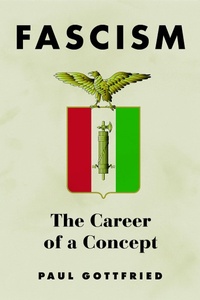
Fascism
The Career of a Concept
Published on 8. February 2016
256 pages
978-1-60909-183-5 (ISBN)
Description

"For historians, Fascism offers clear and provocative insights and arguments, and the very detailed notes are especially helpful.... Recommended."a* Choice
What does it mean to label someone a fascist? Today, it is equated with denouncing him or her as a Nazi. But as intellectual historian Paul E. Gottfried writes in this provocative yet even-handed study, the term's meaning has evolved over the years. Gottfried examines the semantic twists and turns the term has endured since the 1930s and traces the word's polemical function within the context of present ideological struggles.
Like "conservatism," "liberalism," and other words whose meanings have changed with time, "fascism" has been used arbitrarily over the years and now stands for a host of iniquities that progressives, multiculturalists, and libertarians oppose, even if they offer no single, coherent account of the historic evil they condemn. Certain factors have contributed to the term's imprecise usage, Gottfried writes, including the equation of all fascisms with Nazism and Hitler, as well as the rise of a post-Marxist left that expresses predominantly cultural opposition to bourgeois society and its Christian and/or national components.
Those who stand in the way of social change are dismissed as "fascist," he contends, an epithet that is no longer associated with state corporatism and other features of fascism that were once essential but are now widely ignored. Gottfried outlines the specific historical meaning of the term and argues that it should not be used indiscriminately to describe those who hold unpopular opinions.
His important study will appeal to political scientists, intellectual historians, and general readers interested in politics and history.
What does it mean to label someone a fascist? Today, it is equated with denouncing him or her as a Nazi. But as intellectual historian Paul E. Gottfried writes in this provocative yet even-handed study, the term's meaning has evolved over the years. Gottfried examines the semantic twists and turns the term has endured since the 1930s and traces the word's polemical function within the context of present ideological struggles.
Like "conservatism," "liberalism," and other words whose meanings have changed with time, "fascism" has been used arbitrarily over the years and now stands for a host of iniquities that progressives, multiculturalists, and libertarians oppose, even if they offer no single, coherent account of the historic evil they condemn. Certain factors have contributed to the term's imprecise usage, Gottfried writes, including the equation of all fascisms with Nazism and Hitler, as well as the rise of a post-Marxist left that expresses predominantly cultural opposition to bourgeois society and its Christian and/or national components.
Those who stand in the way of social change are dismissed as "fascist," he contends, an epithet that is no longer associated with state corporatism and other features of fascism that were once essential but are now widely ignored. Gottfried outlines the specific historical meaning of the term and argues that it should not be used indiscriminately to describe those who hold unpopular opinions.
His important study will appeal to political scientists, intellectual historians, and general readers interested in politics and history.
Reviews / Votes
Paul Gottfried's is far and away the best book on fascism I've read in many years.(Claremont Review of Books) Gottfried's study is particular, nuanced, and multifaceted... a model for the type of work that can earn the right a hearing from more attentive audiences.
(The American Conservative) For historians, [Fascism] offers clear and provocative insights and arguments, and the very detailed notes are especially helpful.... Recommended.
(Choice) Books warning of 'the new fascism' have become a cottage industry among academics. But at least one author, Dr. Paul E. Gottfried, professor emeritus of humanities at Elizabethtown College and editor of Chronicles magazine, takes a more historically informed view.
(Quillette) Gottfried's Fascism: The Career of a Concept is so valuable as a provocation, for it was written to correct the sloppy use of the epithet 'fascist' to condemn whatever politician or movement one finds distasteful.
(Rhetoric Society Quarterly) In these studies, Gottfried notes how, partly because of how varied fascist administrations were, the elements which can be described as characteristic of fascism are actually very few.
(Human Events)
More details
Language
English
Place of publication
Ithaca
United States
Publishing group
Cornell University Press
Target group
College/higher education
Product notice
Reflowable
ISBN-13
978-1-60909-183-5 (9781609091835)
Copyright in bibliographic data and cover images is held by Nielsen Book Services Limited or by the publishers or by their respective licensors: all rights reserved.
Schweitzer Classification
Other editions
Person
Paul E. Gottfried is the retired Horace Raffensperger Professor of Humanities at Elizabethtown College and a Guggenheim recipient. He is the author of numerous books, including The Search for Historical Meaning and, most recently, Leo Strauss and the Conservative Movement in America.
Content
- Cover
- FASCISM
- Title
- Copyright
- Contents
- ACKNOWLEDGMENTS
- Introduction
- Chapter One Defining Fascism
- Chapter Two Totalitarianism and Fascism
- Chapter Three Fascism as the Unconquered Past
- Chapter Four Fascism as a Movement of the Left
- Chapter Five The Failure of Fascist Internationalism
- Chapter Six The Search for a Fascist Utopia
- Chapter Seven A Vanished Revolutionary Right
- APPENDIX Fascism and Modernization
- A Final Loose End
- NOTES
- INDEX
