

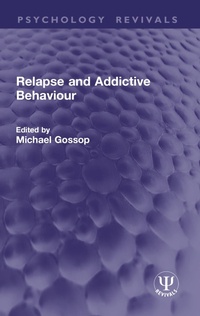
Relapse and Addictive Behaviour
Description

Mark Twain once remarked that giving up smoking was easy - so easy that he had done it a hundred times. In this observation, he neatly summed up the problem of relapse as the central problem of addiction. Originally published in 1989, in Relapse and Addictive Behaviour, an international group of researchers and clinical workers investigate why people find it so difficult to move away from their addictive behaviour. By looking at several different addictions, they consider how we can understand and explain relapse.
The discussion also addresses an issue of major current concern at the time - can the study of relapse serve to unite the apparently different types of addictive behaviour? Traditionally, addictive behaviours, such as drinking, smoking, and heroin abuse, had been investigated and treated separately. There was, however, increasing recognition of the similarities that link these addictions. Relapse and Addictive Behaviour considers to what extent the problem of relapse may serve as one of the important links.
Relapse and Addictive Behaviour provided an up-to-date source of information for all who were professionally involved with or had a scientific interest in the many forms of addictive behaviour at the time. Today it can be read in its historical context.
More details
Other editions
Additional editions
Person
Professor Michael Gossop worked for more than 35 years in the drug and alcohol treatment services at the Bethlem Royal and Maudsley Hospitals in London. He has been a leading addictions researcher at the National Addiction Centre, King's College London, and at the addiction research centre (SERAF) in Oslo, Norway. He has worked with the World Health Organization and the United Nations. He has published more than 400 articles on drug and alcohol problems.
Content
List of Contributors. 1. Introduction Michael Gossop Part I 2. Relapse and Alcohol Problems Steven Allsop and Bill Saunders 3. Relapse Following Smoking Cessation: A Critical Review of Current Theory and Research Stephen Sutton 4. Heroin and the Opiates Brendan P. Bradley 5. Relapse and Eating Disorders: The Recurring Illusion Howard Rankin 6. Understanding and Preventing Relapse in Sex Offenders Janice K. Marques and Craig Nelson 7. Relapses from a Gambling Perspective R. Iain F. Brown 8. Relapse Prevention and AIDS Among Intravenous Drug Users Anna Stallard and Nick Heather Part II 9. Conceptual Issues in the Study of Relapse Saul Shiffman 10. Does the Marlatt Model Underestimate the Importance of Conditioned Craving in the Relapse Process? Nick Heather and Anna Stallard 11. Attitudes and Learning in Addiction and Relapse J. Richard Eiser 12. The End of Optimism: The Prehistory of Relapse Virginia Berridge 13. Relapse: A Critique Bill Saunders and Steven Allsop 14. Relapse Prevention: Future Directions G. Alan Marlatt and Judith R. Gordon. Name Index. Subject Index.
